

Introduction

Read this information carefully to learn how to operate and maintain your product properly and to avoid injury and product damage. You are responsible for operating the product properly and safely.

You may contact Toro directly at www.Toro.com for product safety and training materials, accessory information, help finding a dealer, or to register your product.

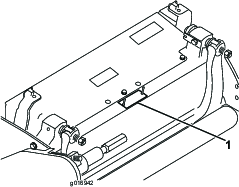
Whenever you need service, genuine Toro parts, or additional information, contact an Authorized Service Dealer or Toro Customer Service and have the model and serial numbers of your product ready. Figure 1 identifies the location of the model and serial numbers on the product. Write the numbers in the space provided.

g016942

This manual identifies potential hazards and has safety messages identified by the safety alert symbol (Figure 2), which signals a hazard that may cause serious injury or death if you do not follow the recommended precautions.

g000502

This manual uses 2 words to highlight information. Important calls attention to special mechanical information and Note emphasizes general information worthy of special attention.

Warning

CALIFORNIA

Proposition 65 Warning

Close section

Safety

Hazard control and accident prevention are dependent upon the awareness, concern, and proper training of the personnel involved in the operation, transport, maintenance, and storage of the machine. Improper use or maintenance of the machine can result in injury or death. To reduce the potential for injury or death, comply with the following safety instructions.

  • Read, understand, and follow all instructions in the traction unit and cutting unit operator’s manuals before operating the cutting unit.

  • Keep children out of the operating area. Never allow children to operate the machine.

  • Never operate the cutting units while ill, tired, or under the influence of drugs or alcohol.

  • Do not operate the machine without all guards and other safety protective devices in place and working on the machine.

  • Wear appropriate clothing, including eye protection, slip resistant, substantial footwear, and hearing protection. Tie back long hair and do not wear jewelry.

  • Remove all debris or other objects that the cutting-unit blades might pick up and throw. Keep all bystanders away from the working area.

  • If the cutting blades strike a solid object or the unit vibrates abnormally, stop and shut off the engine. Check the cutting unit for damaged parts. Repair any damage before starting the cutting unit.

  • Keep all nuts, bolts, and screws tight to be sure the equipment is in safe working condition.

  • Remove the key from ignition switch to prevent accidental starting of the engine when servicing, adjusting, or storing the machine.

  • If major repairs are ever needed or if assistance is desired, contact an authorized Toro distributor.

  • To ensure optimum performance and continued safety certification of the machine, use only genuine Toro replacement parts and accessories. Replacement parts and accessories made by other manufacturers could be dangerous, and such use could void the product warranty.

Safety and Instructional Decals

Graphic

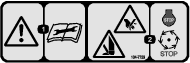
Safety decals and instructions are easily visible to the operator and are located near any area of potential danger. Replace any decal that is damaged or missing.

decal104-7729
decal120-9570
decal121-4650
Close section
Close section

Setup

Installing the Front Roller

The cutting unit is shipped without a front roller. Install the roller using the loose parts supplied with the cutting unit and installation instructions included with the roller.

Close section

Using the Cutting-Unit Prop

Whenever the cutting unit has to be tipped to expose the bedknife/reel, prop up the rear of the cutting unit to make sure the nuts on the back end of the bedbar adjusting screws are not resting on the work surface (Figure 3).

g016943
Close section

Adjusting the Bedknife to the Reel

Note: For eFlex cutting units the reel to bedknife contact has significant impact on energy consumption. Very light contact is recommended for optimum cutting performance and battery consumption.

The bedknife to reel adjustment is accomplished by rotating the bedbar adjusting screws, located on top of the mower.

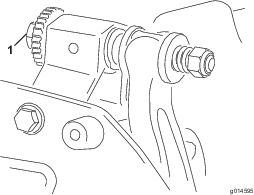
  1. Position the cutting unit on a flat, level work surface. Make sure the reel contact is removed by turning the bedbar adjusting screws counterclockwise (Figure 4).

    g014595
  2. Tip the cutting unit on its back to expose the bedknife and reel.

    Important: Make sure the nuts on the back end of the bedbar adjusting screws are not resting on the work surface (Figure 3).

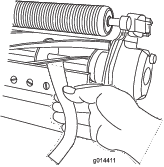
  3. At one end of the reel, insert a long strip of newspaper between the reel and bedknife (Figure 5). While slowly rotating the reel forward, turn the bedbar adjusting screw clockwise (on same end of reel, one click at a time, until the paper is pinched lightly, when inserted from the front, parallel to the bedknife. You should notice a slight drag as you pull the paper.

    g014411

    Note: Each time the adjusting screw is rotated one click clockwise, the bedknife moves 0.0007 inch (0.018 mm) closer to the reel. Do not overtighten the adjusting screws.

  4. Check for light contact at the other end of the reel using paper and adjust it as required.

  5. After the adjustment is accomplished, check to see if the reel can pinch paper when inserted from the front and cut the paper when inserted at a right angle to the bedknife (Figure 5).

    Note: It should be possible to cut the paper with minimum contact between the bedknife and the reel blades. Should excessive reel drag be evident, it will be either necessary to backlap or regrind the cutting unit to achieve the sharp edges needed for precision cutting (refer to the Toro Reel Sharpening Manual).

Close section

Adjusting the Rear Roller

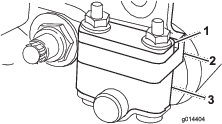
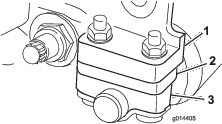
Depending on your desired height-of-cut range you need to adjust the the rear roller brackets (Figure 6 or Figure 7) to the low or high position:

  • Position the spacer above the sideplate mounting flange (factory setting) when the height-of-cut settings range from 1/16 to 1/4 inch (Figure 6).

    g014404
  • Position the spacer below the sideplate mounting flange when the height of cut settings range from 1/8 inch to 1 inch (Figure 7).

    g014405

To adjust rear roller proceed as follows:

  1. Raise the rear of the cutting unit and place a block under the bedknife.

  2. Remove the 2 nuts securing each roller bracket and spacer to each sideplate mounting flange.

  3. Lower the roller and screws from the sideplate mounting flanges and spacers.

  4. Place the spacers onto the screws above of below the roller brackets, as required (Figure 6 or Figure 7).

  5. Secure the roller bracket and spacers to the underside of the mounting flanges with the nuts previously removed.

  6. Verify that the bedknife to reel contact is correct. Tip the mower to expose the front and rear rollers and the bedknife.

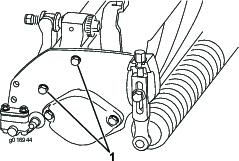
    Note: The position of the rear roller to the reel is controlled by the machining tolerances of the assembled components and paralleling is not required. A limited amount of adjustment is possible by setting the cutting unit on a surface plate and loosening the sideplate mounting bolts (Figure 8). Adjust and tighten bolts when finished.

    g016944

    Important: Whenever the cutting unit has to be tipped to expose bedknife/reel, prop up rear of cutting unit to make sure nuts on back end of bedbar adjusting screws are not resting on work surface (Figure 3).

Close section

Adjusting the Height of Cut

Note: This cutting unit comes standard with the Edgemax Micro-cut bedknife and standard bedbar. The effective height of cut is dependent on previous mower configurations and turf conditions (i.e. roller type, bedknife behind center distance, soft or firm greens, season conditions). Set initial height of cut .010 – .015 inch higher than previous greensmower setup and adjust to match conditions.

Note: For heights of cut greater than 0.500 inch, the high height of cut kit must be installed.

Note: Use the following chart to determine which bedknife is best suited for the desired height of cut.

Recommended Bedknife/Height of Cut Chart
BedknifePart NumberHeight of Cut
Edgemax Micro-cut (Standard)115-1880 (2100)117-1530 (1800)0.062–0.188 inch (1.5–4.7 mm)
Edgemax Tournament (Optional)115-1881 (2100)117-1532 (1800)0.125–0.500 inch (3.1–12.7 mm)
Micro-cut (Optional)93-4262 (2100)98-7261 (1800)0.062–0.188 inch (1.5–4.7 mm)
Tournament (Optional)93-4263 (2100)98-7260 (1800)0.125–0.500 inch (3.1–12.7 mm)
Extended Micro-cut (Optional)108-4303 (2100)110-2300 (1800)0.062–0.188 inch (1.5–4.7 mm)
Extended Tournament (Optional)108-4302 (2100)0.125–0.500 inch (3.1–12.7 mm)
Low-cut (Optional)93-4264 (2100)110-2301 (1800)0.188–1.00 inch (4.7–25.4 mm)
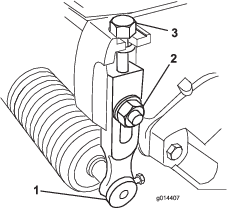
  1. Loosen the locknuts securing the height-of-cut arms to the cutting unit side plates (Figure 9).

    g014407
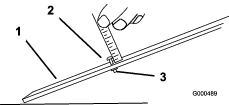
  2. Loosen the nut on the gauge bar and set the adjusting screw to the desired height of cut (Figure 10).

    Note: The distance between the bottom of the screw head and the face of bar is the height of cut.

    g000489
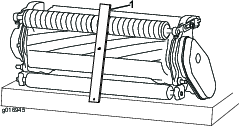
  3. Hook the screw head onto the cutting edge of the bedknife and rest the rear end of the bar onto the rear of the roller (Figure 11).

    g016945
  4. Rotate the adjusting screw until the roller contacts the front of the gauge bar. Adjust both ends of the roller until the entire roller is parallel to the bedknife.

    Important: When set properly, the rear and front rollers will contact the gauge bar and the screw will be snug against the bedknife. This ensures that the height-of-cut is identical at both ends of the bedknife.

  5. Tighten the nuts to secure the adjustment. Do not overtighten them. Tighten them only enough to remove play from the washer.

Close section

Adjusting the Cut-Off Bar

Adjust the cut-off bar to ensure that the clippings are cleanly discharged from the reel area, as follows:

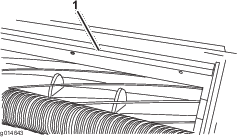
  1. Loosen the screws securing the top bar (Figure 12) to the cutting unit.

    g014643
  2. Insert a 0.15 cm (0.060 inch) feeler gauge between the top of the reel and the bar and tighten the screws.

    Important: Ensure that the bar and reel are equal distance apart across the complete reel.

    Note: The bar is adjustable to compensate for changes in turf conditions. The bar should be adjusted closer to the reel when the turf is extremely dry. By contrast, adjust the bar further away from the reel when the turf conditions are wet. The bar should be parallel to the reel to ensure optimum performance and should be adjusted whenever the reel is sharpened on a reel grinder.

Close section

Preparing the Cutting Unit for Use on an eFlex Machine

Parts needed for this procedure:

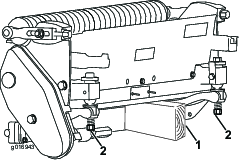
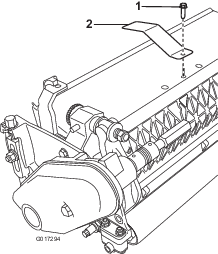
Target plate1
Pitch arm spring2

Installing the Target Plate

If you will be using the cutting unit on an eFlex traction unit, install the provided target plate, then adjust the machine sensors as described in the eFlex Traction Unit Operator’s Manual. If you will be using the cutting unit on gasoline-powered machines, you do not need the target plate. If you will be using the cutting unit on both gasoline-powered units and the eFlex machines, you can install the target plate and leave it installed regardless of which machine you use it on.

  1. Setup and prepare the cutting unit as described in the cutting unit Operator’s Manual.

  2. Remove the center, grass-shield bolt (Figure 13).

  3. Install the target plate to the top of the cutting unit (under the plastic cowling) using the bolt you removed previously (Figure 13).

    g017294
Close section

Installing the Pitch-Arm Springs

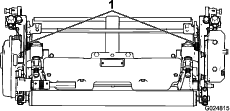
If you will be using the cutting unit on an eFlex machine, install a spring onto the post on the back of each pitch arm (Figure 14).

g024817

Remove and save the springs before using the cutting unit on a gas powered machine.

Close section
Close section
Close section

Product Overview

TractorsThese cutting units will mount on the appropriate size Flex and eFlex traction units.
Height of cutThe cutting height is adjusted on the front roller by 2 vertical screws and held by 2 locking cap screws
Height-of-cut-rangeThe standard bench height of cut range is 1.6 mm (.062 inch) to 12.7 mm (.500 inch). Bench height of cut range with the High Height of Cut Kit installed is 7 to 25 mm (0.285 to 1.00 inch). The effective HOC may vary depending on turf conditions, type of bedknife, rollers and attachments installed.
Reel bearingsThere are 2 sealed stainless steel, deep groove ball bearings.
RollersThe front roller is 6.3 cm (2.5 inches) in diameter with a variety of configurations selected by the customer. The rear roller is a 5.1 cm (2 inch) diameter aluminum full roller.
BedknifeThe replaceable single edged, high carbon steel bedknife is fastened to a machined cast iron bedbar with 13 screws (2100) or 11 screws (1800).
Bedknife adjustmentThere is a dual screw adjustment to the reel; detents corresponding to 0.018 mm (.0007 inch) bedknife movement for each indexed position.
Grass shieldThe non-adjustable shield with adjustable cut-off bar improves grass discharge from the reel in wet conditions.
CounterweightA cast iron weight mounted opposite to the drive line balances the cutting unit.
Net Weight, 2100 (without front roller)11-Blade—32.2 kg (71 lb); 14-Blade—33.5 kg (74 lb)
Net Weight, 1800 (without front roller)11-Blade—30.8 kg (68 lb); 14-Blade—32.2 kg (71 lb)

Attachments/Accessories

A selection of Toro approved attachments and accessories is available for use with the machine to enhance and expand its capabilities. Contact your Authorized Service Dealer or Distributor or go to www.Toro.com for a list of all approved attachments and accessories.

Close section
Close section

Operation

Note: Determine the left and right sides of the machine from the normal operating position.

Cutting Unit Characteristics

The dual point bedknife-to-reel adjustment system incorporated in this cutting unit simplifies the adjustment procedure needed to deliver optimum mowing performance. The precise adjustment possible with the dual point/bedbar design gives the necessary control to provide a continual self-sharpening action-thus maintaining sharp cutting edges, ensuring good quality of cut, and greatly reducing the need for routine backlapping.

Close section

Adjusting the Cutting Unit Daily

Prior to mowing each day, or as required, check the cutting unit to verify proper bedknife-to-reel contact. Perform this procedure even though quality of cut is acceptable.

  1. Move the cutting unit onto a hard, level surface, shut off the engine, and remove the key.

  2. Engage the parking brake.

  3. Shut off the machine as follows:

    • Gas units: stop the engine and disconnect the spark plug wire.

    • Electric units: turn off the machine and disconnect the battery connector (T-handle).

  4. Slowly rotate the reel in a reverse direction, listening for reel-to-bedknife contact. If no contact is evident, turn the bedknife adjusting knobs clockwise, 1 click at a time, until you hear and feel light contact.

    Note: The adjustment knobs have detents corresponding to 0.018 mm (0.0007 inch) bedknife movement for each indexed position.

  5. If excessive contact is felt, turn the bedknife adjusting knobs counterclockwise, 1 click at a time until no contact is evident. Then turn the bedknife adjusting knobs 1 click at a time clockwise, until you feel light contact.

    Important: Light contact is preferred at all times. If light contact is not maintained, the bedknife/reel edges will not sufficiently self-sharpen and dull cutting edges will result after a period of operation. If excessive contact is maintained, bedknife/reel wear will be accelerated, uneven wear can result, and quality of cut may be adversely affected.

    Note: For eFlex cutting units, the reel to bedknife contact has significant impact on energy consumption. Very light contact is recommended for optimum cutting performance and battery consumption.

    Note: As the reel blades continue to run against the bedknife, a slight burr will appear on the front cutting edge surface along the full length of the bedknife. If a file is occasionally run across the front edge to remove this burr, improved cutting can be obtained.After extended running, a ridge will eventually develop at both ends of the bedknife. These notches must be rounded off or filed flush with the cutting edge of the bedknife to ensure smooth operation.

Close section

Adjusting the Clip Setting

There are 6 clip settings on the cutting unit that you can set to match your turf conditions. Start out setting the clip to match the height of cut, but should then test the cutting unit and adjust the clip to obtain the quality of cut that you desire.

  1. Shut off the machine as follows:

    • Gas units: Stop the engine and disconnect the spark-plug wire.

    • Electric units: Turn off the machine and disconnect the battery connector (T-handle).

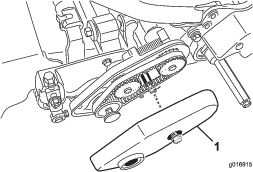
  2. Loosen the flange bolt securing the belt cover and remove the belt cover to expose the belt (Figure 15).

    g016915
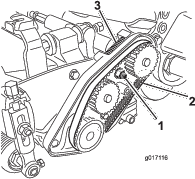
  3. Loosen the bearing-housing nut (Figure 16).

    g017116
  4. Using a 16 mm (5/8 inch) wrench, rotate the bearing housing to make sure that it operates freely.

  5. Remove the belt (Figure 16).

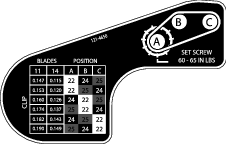
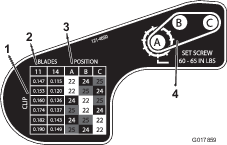
  6. Using the chart shown on the decal in Figure 17, determine the clip setting you want and which pulleys you will need to move.

    Note: Each pulley is numbered (22, 24, and 25). Move the pulleys to the positions indicated in the chart for your clip setting.

    g017859
  7. Loosen the 2 set screws on each pulley you need to move using a 1/8 inch hex wrench.

  8. Remove each pulley.

  9. Install each pulley in the new configuration as indicated on the decal (Figure 17).

    Note: Ensure that the setscrews on each pulley are positioned to align with the key and flat area on the shaft.

  10. Torque the setscrews to 6.8 to 7.3 N-m (60 to 65 in-lb).

  11. Install the belt.

  12. Ensure that the compression spring is applying tension to the belt (Figure 16).

  13. Tighten the bearing-housing nut.

  14. Install the belt cover.

Close section
Close section

Maintenance

Note: Determine the left and right sides of the machine from the normal operating position.

Servicing the Bedbar

Removing the Bedbar

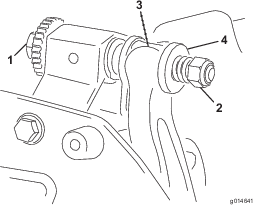
  1. Turn the bedbar-adjusting screw, counterclockwise, to back the bedknife away from the reel (Figure 18).
    g014641
  2. Back out the spring-tension nut until the washer is no longer tensioned against the bedbar (Figure 18).

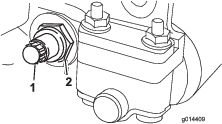
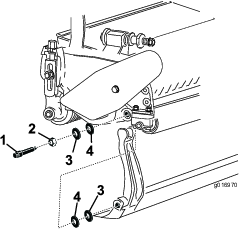
  3. On each side of the machine, loosen the locknut securing the bedbar bolt (Figure 19).
    g014409
  4. Remove each bedbar bolt allowing the bedbar to be pulled downward and removed from the machine bolt (Figure 19).

    Account for the 2 nylon and 2 stamped steel washers on each end of the bedbar (Figure 20).
    g016970
Close section

Assembling the Bedbar

  1. Install the bedbar, positioning the mounting ears between the washer and bedbar adjuster.

  2. Secure the bedbar to each side plate with the bedbar bolts (nuts on bolts) and 4 washers (8 total).

  3. Position a nylon washer on each side of the side plate boss. Place a steel washer outside each of the nylon washers (Figure 20).

  4. Torque the bedbar bolts to 27 to 36 N-m (240 to 320 inch-lb). Tighten the locknuts by hand until the outside steel washer stops rotating and the end play is removed. The washers on the inside may have a gap.

    Important: Do not overtighten the locknuts or they will deflect the side plates.

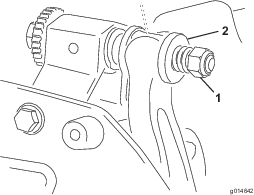
  5. Tighten the spring tension nut until the spring is collapsed, then back it off 1/2 turn (Figure 21).
    g014642
Close section
Close section

Backlapping the Reel

Danger

Contact with the reel or other moving parts can result in personal injury.

Keep fingers, hands, and clothing away from the reels or other moving parts.

  • Stay away from the reel while backlapping.

  • Never use a short handled paint brush for backlapping. Part No. 29-9100 Handle assembly complete or individual parts are available from your local Authorized Toro Distributor.

You can backlap the reels either by leaving the cutting unit on the traction unit or removing the cutting unit completely from the traction unit. If the cutting unit is left on the traction unit, the hex coupler between the main drive and cutting unit drive should be moved to the decoupled position to prevent excessive wear to the reel brake. The following procedure describes backlapping:

  1. Position the machine on a clean, level surface.

  2. Shut off the machine as follows:

    • Gas units: stop the engine and disconnect the spark-plug wire.

    • Electric units: turn off the machine and disconnect the battery connector (T-handle).

  3. Engage the parking brake.

  4. Connect the backlapping machine to the cutting unit by connecting a 1/2 inch hex socket to the reel pulley output shaft on the left side of the cutting unit.

    Note: Additional instructions and procedures on Backlapping are available in the Toro Sharpening Reel and Rotary Mowers Manual, Form No. 80-300PT.

    Note: For a better cutting edge, run a file across the front face of the bedknife when the lapping operation is completed. This will remove any burrs or rough edges that may have built up on the cutting edge. A very light file touch may be necessary on the top edge to break the burr off completely from the cutting edge.

    Note: If the cutting unit was left attached to the machine during backlapping remember to couple the hex shaft of the machine back to the cutting unit.

Close section
Close section