Introduction

This cutting unit is designed for cutting grass on well-maintained lawns in golf courses, parks, sports fields, and on commercial grounds. Using this product for purposes other than its intended use could prove dangerous to you and bystanders.

Read this information carefully to learn how to operate and maintain your product properly and to avoid injury and product damage. You are responsible for operating the product properly and safely.

Visit www.Toro.com for product safety and operation training materials, accessory information, help finding a dealer, or to register your product.

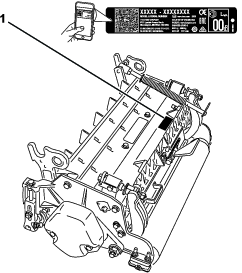
Whenever you need service, genuine Toro parts, or additional information, contact an Authorized Service Dealer or Toro Customer Service and have the model and serial numbers of your product ready. Figure 1 identifies the location of the model and serial numbers on the product. Write the numbers in the space provided.

Important: With your mobile device, you can scan the QR code on the serial number plate (if equipped) to access warranty, parts, and other product information.

g277992

This manual identifies potential hazards and has safety messages identified by the safety-alert symbol (Figure 2), which signals a hazard that may cause serious injury or death if you do not follow the recommended precautions.

g000502

This manual uses 2 words to highlight information. Important calls attention to special mechanical information and Note emphasizes general information worthy of special attention.

This product complies with all relevant European directives. For details, please see the Declaration of Incorporation (DOI) at the back of this publication.

Safety

This machine has been designed in accordance with EN ISO 5395 and ANSI B71.4–2017.

General Safety

This product is capable of amputating hands and feet. Always follow all safety instructions to avoid serious personal injury.

  • Read and understand the contents of this Operator’s Manual before starting the machine.

  • Use your full attention while operating the machine. Do not engage in any activity that causes distractions; otherwise, injury or property damage may occur.

  • Do not put your hands or feet near moving components of the machine.

  • Do not operate the machine without all guards and other safety protective devices in place and functioning properly on the machine.

  • Keep clear of any discharge opening.

  • Keep bystanders and children out of the operating area. Never allow children to operate the machine.

  • Before you leave the operator’s position, do the following:

    • Park the machine on a level surface.

    • Lower the cutting unit(s).

    • Disengage the drives.

    • Engage the parking brake (if equipped).

    • Shut off the engine and remove the key (if equipped).

    • Wait for all movement to stop.

Improperly using or maintaining this machine can result in injury. To reduce the potential for injury, comply with these safety instructions and always pay attention to the safety-alert symbolGraphic, which means Caution, Warning, or Danger—personal safety instruction. Failure to comply with these instructions may result in personal injury or death.
Cutting Unit Safety

  • The cutting unit is only a complete machine when installed on a traction unit. Read the traction unit Operator’s Manual carefully for complete instructions on the safe use of the machine.

  • Stop the machine, remove the key (if equipped), and wait for all movement to stop before inspecting the attachment after striking an object or if there is an abnormal vibration in the machine. Make all necessary repairs before resuming operation.

  • Keep all parts in good working condition and all hardware tightened. Replace all worn or damaged decals.

  • Use only accessories, attachments, and replacement parts approved by Toro.

Blade Safety

A worn or damaged blade can break, and a piece of the blade could be thrown toward you or bystanders, resulting in serious personal injury or death.
  • Inspect the blade periodically for wear or damage.

  • Use care when checking the blades. Wrap the blades or wear gloves, and use caution when servicing the blades. Only replace or sharpen the blades; never straighten or weld them.

  • On multi-bladed machines, take care as rotating 1 blade can cause other blades to rotate.

Safety and Instructional Decals

Graphic

Safety decals and instructions are easily visible to the operator and are located near any area of potential danger. Replace any decal that is damaged or missing.

decal93-6688

Setup

Note: Determine the left and right sides of the machine from the normal operating position.

Removing the Tipper Assemblies

Remove the tipper assemblies (if so equipped) from the number 1, number 2, and number 3 lift arms to avoid interference with the carrier frames of the cutting units.

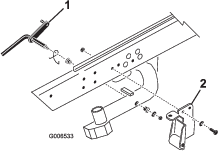
  1. Remove the locknut and the washer securing the pivot rod to the number 2 lift arm (Figure 3). Remove the pivot rod and spring from the lift arm. Repeat the procedure on the number 1 and number 3 lift arms.

    g006533

    Note: The tipper bracket with the roller and the tipper support brackets are not required when operating the DPA cutting units (Figure 3).

  2. Disconnect the lift chains from the cutting units, if attached.

Mounting the Lift Brackets and Chains

Parts needed for this procedure:

Lift chain5/7
Chain bracket5/7
U-bolt5/7
Nut10/14
Screw5/7
Washer5/7
Nut5/7

Mount a chain bracket to each lift arm with a U-bolt and 2 nuts. Position the brackets as follows:

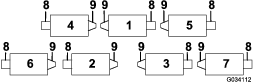
Note: Refer to Figure 4 to determine the lift arm number being described.

g034112
  1. On lift arm numbers 1, 4, and 5, position the chain brackets and U-bolts 38.1 cm (15 inches) behind the center line of the pivot knuckle (Figure 5).

  2. On lift arm numbers 1 and 5 the brackets should be rotated to the right 10 degrees from vertical (Figure 5).

  3. On lift arm number 4 the bracket should be rotated to the left 10 degrees from vertical (Figure 5).

    g020546
  4. On lift arm numbers 2 and 3, position the brackets and U-bolts 38.1 cm (15 inches) behind the center line of the pivot knuckle (Figure 6).

    Note: Rotate the brackets 45 degrees to the outboard side of the machine.

    g020547
  5. On lift arm number 6 and number 7, position the brackets and U-bolts 36.8 cm (14.5 inches) behind the center line of the pivot knuckle (Figure 7).

    Note: Rotate the brackets 10 degrees to the outboard side of the machine.

    g020548
  6. Tighten all the U-bolt nuts to 52 to 65 N∙m (38 to 48 ft-lb).

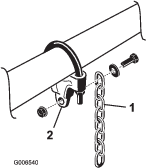
  7. Mount a lift chain to each chain bracket with a screw, a washer, and a nut, positioning them as shown in Figure 8.

    g006540

Adjusting the Cutting Unit

  1. Adjust the bedknife to the reel.

  2. Adjust the rear roller for your height-of-cut requirements.

  3. Set the height of cut.

  4. Adjust the rear shield if necessary.

Refer to Adjusting the Cutting Unit for complete instructions for performing these adjustments

Mounting the Counterweights

All cutting units are shipped with the counterweight mounted to the left end of the cutting unit. Use the following diagram to determine the position of the counterweights and reel motors.

Note: Some traction units have only 5 cutting units.

g034112
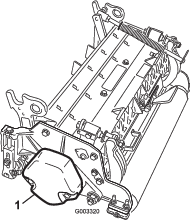
  1. On cutting unit numbers 2, 4, and 6, remove the 2 cap screws securing the counterweight to the left end of the cutting unit.

    Note: Remove the counterweight (Figure 10).

    g003320
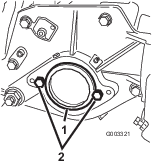
  2. On the right end of the cutting unit, remove the plastic plug from the bearing housing (Figure 11).

  3. Remove the 2 cap screws from the right side plate (Figure 11).

    g003321
  4. Install the counterweight to the right end of the cutting unit with the 2 screws previously removed.

  5. Loosely install the 2 reel motor mounting cap screws to the left side plate of the cutting unit (Figure 11).

Installing the Cutting Units

Parts needed for this procedure:

Large O-ring5/7
Screw2
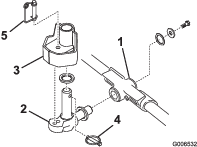
  1. Insert a thrust washer onto the horizontal shaft of the pivot knuckle as shown in Figure 12.

    g006532
  2. Insert the horizontal shaft of the pivot knuckle into the mounting tube of the carrier frame (Figure 12).

  3. Secure pivot knuckle to carrier frame with a thrust washer, a flat washer, and a flange-head cap screw (Figure 12).

  4. Insert a thrust washer onto the vertical shaft of the pivot knuckle (Figure 12).

  5. If removed, insert the vertical shaft of the pivot knuckle into the lift-arm pivot hub (Figure 12).

  6. Guide the pivot knuckle in place between the 2 rubber centering bumpers in the underside of the lift-arm steering plate.

  7. Insert the lynch pin into the cross hole on the pivot-knuckle shaft (Figure 12).

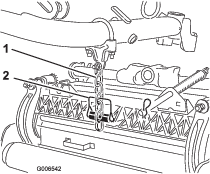
  8. Secure the lift arm chain to the cutting unit chain bracket (Figure 13) with the snapper pin as follows:

    • On cutting unit numbers 1, 4, 5, 6, and 7, use only 6 of the chain links.

    • On cutting unit numbers 2 and 3, use all 7 of the chain links.

    g006542
  9. Coat the spline of the reel motor with clean grease.

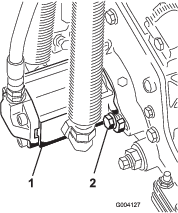
  10. Oil the reel motor O-ring and install it onto the motor flange.

  11. Install the motor by rotating it clockwise so that the motor flanges clear the cap screws (Figure 14).

  12. Rotate the motor counterclockwise until the flanges encircle the cap screws and then tighten the cap screws.

    Important: Make sure that the reel motor hoses are not twisted, kinked, or at risk of being pinched.

    g004127

    Note: If a fixed cutting unit position is required, insert the steering locking pin into the pivot knuckle mounting hole (Figure 12).

  13. Hook the spring wire around the bottom of the steering locking pin (Figure 12).

Product Overview

Cutting UnitWeight
8 blade67 kg (147 lb)
11 blade69 kg (151 lb)

Attachments/Accessories

A selection of Toro approved attachments and accessories is available for use with the machine to enhance and expand its capabilities. Contact your Authorized Service Dealer or authorized Toro distributor or go to www.Toro.com for a list of all approved attachments and accessories.

To ensure optimum performance and continued safety certification of the machine, use only genuine Toro replacement parts and accessories. Replacement parts and accessories made by other manufacturers could be dangerous, and such use could void the product warranty.

Operation

Note: Determine the left and right sides of the machine from the normal operating position.

Adjusting the Cutting Unit

Adjusting the Rear Shield

Under most conditions, best dispersion is attained when the rear shield is closed (front discharge). When conditions are heavy or wet, the rear shield may be opened.

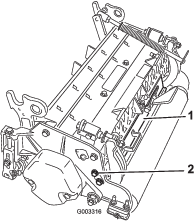
To open the rear shield (Figure 15), loosen the cap screw securing the shield to the left side plate, rotate the shield to the open position, and tighten the cap screw.

g003316

Checking the Cutting Unit

The dual knob bedknife-to-reel adjustment system incorporated in this cutting unit simplifies the adjustment procedure needed to deliver optimum mowing performance. The precise adjustment possible with the dual knob/bedbar design gives the necessary control to provide a continual self-sharpening action—thus maintaining sharp cutting edges, ensuring good quality of cut, and greatly reducing the need for routine backlapping.

Prior to mowing each day, or as required, check each cutting unit to verify proper bedknife-to-reel contact. This must be performed regardless of whether the quality of cut is acceptable.

  1. Lower the cutting units onto a hard surface, shut off the engine, and remove the ignition key.

  2. Slowly rotate the reel in a reverse direction, listening for reel-to-bedknife contact. If no contact is evident, turn the bedknife adjusting knobs clockwise, 1 click at a time, until you feel and hear light contact.

    Note: The reel must cut one sheet of paper, when inserted at a right angle to the bedknife, at both ends and the center of the reel.

    Note: The adjustment knobs have detents corresponding to 0.023 mm (0.0009 inch) bedknife movement for each indexed position.

  3. If excessive contact/reel drag is evident, either backlap, reface the front of the bedknife, or grind the cutting unit to achieve the sharp edges needed for precision cutting; refer to the Toro Manual for Sharpening Reel and Rotary Mowers, Form No. 09168SL.

    Important: Light contact is preferred at all times. If light contact is not maintained, the bedknife/reel edges will not sufficiently self-sharpen and dull cutting edges will result after a period of operation. If excessive contact is maintained, bedknife/reel wear will be accelerated, uneven wear can result, and quality of cut may be adversely affected.

    Note: As the reel blades continue to run against the bedknife, a slight burr will appear on the front cutting edge surface along the full length of the bedknife. To improve the cutting performance, occasionally run a file across the front edge to remove this burr.After extended running, a ridge will eventually develop at both ends of the bedknife. You must round off these notches or file them flush with the cutting edge of the bedknife to ensure smooth operation.

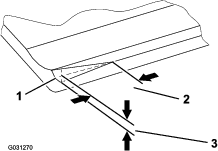
    Note: Over time, the chamfer (Figure 16) will need to be ground as it is only designed to last 40% of the bedknife life.

    g031270

    Note: Do not make lead-in chamfer too large as it may cause turf tufting.

Adjusting the Bedknife to the Reel

Use this procedure to set the bedknife to the reel and to check the condition of the reel and bedknife and their interaction. After completing this procedure, always test the cutting unit performance under your field conditions. You may need to make further adjustments to obtain optimal cutting performance.

Important: Do not overtighten the bedknife to the reel or you will damage it.

  • After backlapping the cutting unit or grinding the reel, you may need to mow with the cutting unit for a few minutes and then perform this procedure to adjust the bedknife to the reel as the reel and bedknife adjust to each other.

  • You may need additional adjustments if the turf is extremely dense or your cutting height is very low.

You will need the following tools to complete this procedure:

  • Shim, 0.05 mm (0.002 inch)—Part No. 125-5611

  • Cutting performance paper—Part No. 125-5610

  1. Position the cutting unit on a flat, level work surface. Turn the bedbar-adjusting screws counterclockwise to ensure that the bedbar does not contact the reel (Figure 17).

    g019940
  2. Tip the mower to expose the bedknife and the reel; refer to Using the Kickstand When Tipping the Cutting Unit.

  3. Rotate the reel so that a blade crosses the bedknife approximately 25 mm (1 inch) in from the end of the bedknife on the right hand side of the cutting unit. Putting an identifying mark on this blade makes subsequent adjustments easier. Insert the 0.05 mm (0.002 inch) shim between the marked reel blade and the bedknife at the point where the blade crosses the bedknife.

  4. Turn the right bedbar adjuster clockwise until you feel light pressure (i.e., drag) on the shim, then back off the bedbar adjuster 2 clicks and remove the shim.

    Note: Because adjusting 1 side of the cutting unit affects the other side, the 2 clicks provide clearance for when the other side is adjusted.

    Note: If starting with a large gap, both sides should initially be drawn closer by alternately tightening the right and left sides.

  5. Slowly rotate the reel so that the same blade that you checked on the right side is crossing the bedknife approximately 25 mm (1 inch) in from the end of the bedknife on the left side of the cutting unit.

  6. Turn the left bedbar adjuster clockwise until the shim can be slid through the reel to bedknife gap with light drag.

  7. Return to the right side and adjust as necessary to get light drag on the shim between the same blade and bedknife.

  8. Repeat steps 6 and 7 until the shim can be slid through both gaps with slight drag, but 1 click in on each side prevents the shim from passing through on both sides. The bedknife is now parallel to the reel.

    Note: This procedure should not be needed on daily adjustments, but should be done after grinding or disassembly.

  9. From this position (i.e., 1 click in and shim not passing through) turn the bedbar adjusters clockwise 1 click each.

    Note: Each click turned moves the bedknife 0.022 (0.0009 inches). Do not overtighten the adjusting screws.

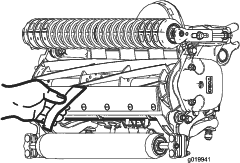
  10. Test the cutting performance by inserting a long strip of cutting performance paper (Toro part number 125-5610) between reel and bedknife, perpendicular to the bedknife (Figure 18). Slowly rotate the reel forward; it should cut the paper.

    g019941

    Note: If excessive reel drag occurs either backlap or grind the cutting unit to achieve the sharp edges needed for precision cutting.

Adjusting the Rear Roller

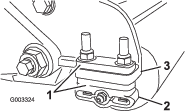
  1. Adjust the rear roller brackets (Figure 19) to the desired height-of-cut range by positioning the required amount of spacers below the side-plate mounting flange (Figure 19) per the HOC Chart.

    g003324
  2. Raise the rear of the cutting unit and place a block under the bedknife.

  3. Remove the 2 nuts securing each roller bracket and spacer to each side-plate mounting flange.

  4. Lower the roller and screws from the side-plate mounting flanges and spacers.

  5. Place the spacers onto the screws on the roller brackets.

  6. Secure the roller bracket and spacers to the underside of the side-plate mounting flanges with the nuts previously removed.

  7. Verify that the bedknife-to-reel contact is correct. Tip the mower to expose the front and rear rollers and the bedknife.

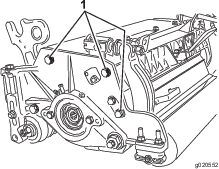
    Note: The position of the rear roller to the reel is controlled by the machining tolerances of the assembled components and paralleling is not required. A limited amount of adjustment is possible by setting the cutting unit on a surface plate and loosening the side-plate mounting cap screws (Figure 20).

    g020552
  8. Adjust and tighten the cap screws and torque the cap screws to 27 to 36 N∙m (240 to 320 in-lb).

Adjusting the Turf-Compensation Settings

The turf-compensation spring transfers the weight from the front to the rear roller. This helps to reduce a wave pattern in the turf, also known as marcelling or bobbing.

Important: Make spring adjustments with the cutting unit mounted to the traction unit, pointing straight ahead and lowered to the shop floor.

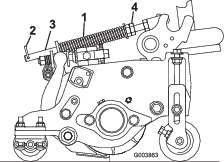
  1. Make sure that the hairpin cotter is installed in the rear hole in the spring rod (Figure 21).

    g003863
  2. Tighten the hex nuts on the front end of the spring rod until the compressed length of the spring is 15.9 cm (6.25 inches); refer to Figure 21.

    Note: When operating on rough terrain decrease the spring length by 12.7 mm (0.5 inch). Ground following will be slightly shorter.

    Note: You must reset the turf-compensation setting if the HOC setting or the aggressiveness-of-cut setting is changed.

Adjusting the Height of Cut (HOC)

Note: For heights of cut greater than 2.54 cm (1.00 inch) install the High Height-of-Cut Kit.

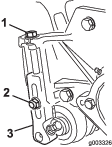
  1. Loosen the locknuts securing the height-of-cut arms to the cutting-unit side plates (Figure 22).

    g003326
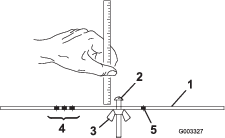
  2. Loosen the nut on the gauge bar (Figure 23) and set the adjusting screw to the desired height of cut.

    g003327
  3. Measure the distance between the bottom of the screw head and the face of the bar to get the height of cut.

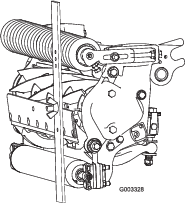
  4. Hook the screw head on the cutting edge of the bedknife and rest the rear end of the bar on the rear roller (Figure 24).

  5. Rotate the adjusting screw until the front roller contacts the gauge bar (Figure 24). Adjust both ends of roller until the entire roller is parallel to the bedknife.

    g003328

    Important: When set properly, the rear and front rollers will contact the gauge bar and the screw will be snug against the bedknife. This ensures that the height of cut is identical at both ends of the bedknife.

  6. Tighten the nuts to secure the adjustment.

    Note: Do not overtighten the nuts. Tighten them just enough to remove play from the washer.

    Height-of-Cut Chart

    HOC SettingAggressiveness of CutNo. of Rear SpacersWith Groomer Kits Installed
    0.64 cm (0.250 inches)Less0Y
    Normal0Y
    More1-
    0.95 cm (0.375 inches )Less0Y
    Normal1Y
    More2-
    1.27 cm (0.500 inches)Less0Y
    Normal1Y
    More2Y
    1.56 cm (0.625 inches)Less1Y
    Normal2Y
    More3-
    1.91 cm (0.750 inches)Less2Y
    Normal3Y
    More4-
    2.22 cm (0.875 inches)Less2Y
    Normal3Y
    More4-
    2.54 cm (1.000 inches)Less3Y
    Normal4Y
    More5-
    2.86 cm (1.125 inches)Less4-
    Normal5-
    More6-
    3.18 cm (1.250 inches)*+Less4-
    Normal5-
    More6-
    3.49 cm (1.375 inches)*+Less4-
    Normal5-
    More6-
    3.81 cm (1.500 inches)*+Less5-
    Normal6-
    More7-
    4.13 cm (1.625 inches)*+Less6-
    Normal7-
    More8-
    4.44 cm (1.750 inches)*+Less6-
    Normal7-
    More8-
    4.76 cm (1.875 inches)*+Less7-
    Normal8-
    More9-
    5.08 cm (2.000 inches)*+Less7-
    Normal8-
    More9-
    * The High HOC Kit (Part No. 110-9600) must be installed. Front HOC bracket must be positioned in the top side-plate hole.
    + When the Height of Cut is above 2.54 cm (1 inch) and a rear roller brush is used, the High Height-of-Cut Brush is required and the optional Steering Cylinder, Part No. 105-9275 should be installed to prevent contact between the rear tire and the brush when making extreme turns.

    Use the following chart to determine which bedknife is best suited for the desired height of cut.

    Bedknife/Height of Cut Chart
    BedknifePart No.Bedknife Lip Height Height of Cut
    Low HOC (Optional)110-40845.6 mm6.4 to 12.7 mm
    (0.220 inch)(0.250 to 0.500 inch)
    EdgeMax® Low HOC137-08325.6 mm6.4 to 12.7 mm
    (Optional)(0.220 inch)(0.250 to 0.500 inch)
    Extended Low HOC (Optional) 120-16405.6 mm6.4 to 12.7 mm
    (0.220 inch)(0.250 to 0.500 inch)
    Extended EdgeMax® Low HOC (Optional)119-42805.6 mm6.4 to 12.7 mm
    (0.220 inch)(0.250 to 0.500 inch)
    EdgeMax® 137-08336.9 mm9.5 to 38.1 mm
    (Models 03698 and 03699)(0.270 inch)(0.375 to 1.50 inches)*
    Standard (Optional)108-90966.9 mm9.5 to 38.1 mm
    (0.270 inch)(0.375 to 1.50 inches)*
    Heavy Duty (Optional)110-40749.3 mm12.7 to 38.1 mm
    (0.370 inch)(0.500 to 1.50 inches)
    * Warm-season grasses may require the Low HOC bedknife for 12.7 mm (0.500 inch) and below.
    g006510

Height-of-Cut Chart Terms

Height-of-Cut Setting (HOC)

This corresponds to the desired height of cut.

Bench-Set Height of Cut

This is the height at which the top edge of the bedknife is set above a flat level surface that contacts the bottom of both the front and rear rollers.

Effective Height of Cut

This is the actual height that the grass has been cut. For a given bench set height of cut, the actual height of cut will vary depending on the type of grass, time of year, turf, and soil conditions. The cutting unit setup (aggressiveness of cut, rollers, bedknives, attachments installed, turf compensation settings, etc.) will also affect the effective height of cut. Check the effective height of cut using the Turf Evaluator (Model 04399) regularly to determine the desired bench set height of cut.

Aggressiveness of Cut

Aggressiveness of cut has a significant impact on the performance of the cutting unit. Aggressiveness of cut refers to the angle of the bedknife relative to the ground (Figure 26).

The best cutting unit setup is dependent on your turf conditions and desired results. Experience with the cutting unit on your turf will determine the best setting to use. Aggressiveness of cut may be adjusted throughout the cutting season to allow for various turf conditions.

In general, less to normal aggressive settings are more appropriate for warm-season grasses (Bermuda, paspalum, zoysia) while cool-season grasses (bent, bluegrass, rye) may require normal to more aggressive setups. More aggressive setups cut more grass off by allowing the spinning reel to pull more grass up into the bedknife.

g006502

Rear Spacers

The number of rear spacers determines the aggressiveness of cut for the cutting unit. For a given height of cut, adding spacers, below the side-plate mounting flange, increases the aggressiveness of the cutting unit. All cutting units on a given machine must be set to the same aggressiveness of cut (number of rear spacers, Part No. 119-0626), otherwise the after-cut appearance could be negatively affected (Figure 26).

Groomer

These are the recommended height-of-cut settings when a groomer kit is installed on the cutting unit.

Maintenance

Using the Kickstand When Tipping the Cutting Unit

Whenever you have to tip the cutting unit to expose the bedknife and the reel, prop up the rear of the cutting unit with the kickstand (supplied with the traction unit) to make sure that the nuts on the back end of the bedbar adjusting screws are not resting on the work surface (Figure 27).
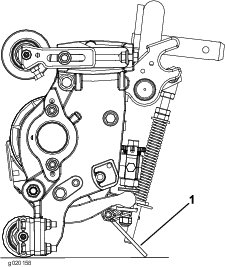
g020158

Lubricating the Cutting Unit

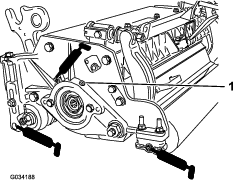
Each cutting unit has 6 grease fittings (Figure 28) that must be lubricated regularly with No. 2 lithium grease.

The lubrication points include the front roller (2), the rear roller (2), and the reel bearing (2).

  1. Wipe each grease fitting with a clean rag.

  2. Apply grease until clean grease comes out of the roller seals and the bearing relief valve.

  3. Wipe any excess grease away.

    g034188

Adjusting the Reel Bearings

To ensure long life of the reel bearings, periodically check if reel end play exists. You can check and adjust the reel bearings as follows:

  1. Loosen the reel-to-bedknife contact by turning the bedknife adjusting knobs (Figure 29) counterclockwise until no contact exists.
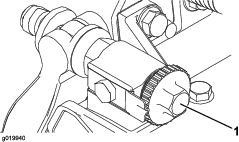
    g019940
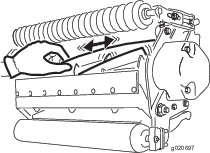
  2. Using a rag or a thickly padded glove, hold on to the reel blade and try to move the reel assembly side to side (Figure 30).
    g020697
  3. If end play exists, proceeded as follows:

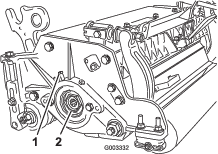
    1. Loosen the external setscrew securing the bearing adjuster nut to bearing housing located on the left side of the cutting unit (Figure 31).
      g003332
    2. Using a 1-3/8 inch socket wrench, slowly tighten the reel-bearing adjustment nut until no end play of the reel exists. If adjusting the nut does not eliminate reel end play, replace the reel bearings.

      Note: The reel bearings do not require preload. Overtightening the reel-bearing adjuster nut will damage the reel bearings.

  4. Tighten the setscrew securing the bearing adjuster nut to the bearing housing.

    Note: Torque the nut to 1.4 to 1.7 N∙m (12 to 15 in-lb).

Servicing the Bedknife

The bedknife service limits are listed in the following chart.

Important: Operating the cutting unit with the bedknife below the service limit may result in poor after-cut appearance and reduce the structural integrity of the bedknife for impacts.

Bedknife Service Limit Chart
BedknifePartBedknife Lip Height*Service Limit*Grind AnglesTop/Front Angles
EdgeMax® Low HOC (Optional)137-08325.6 mm(0.220 inch)6.4 to 12.7 mm(0.250 to 0.500 inch)10/5 degrees
Low HOC (Optional)110-40845.6 mm(0.220 inch)4.8 mm(0.190 inch)10/5 degrees
Extended EdgeMax® Low HOC (Optional)119-42805.6 mm(0.220 inch)4.8 mm(0.190 inch)10/10 degrees
Extended Low HOC (Optional)120-16405.6 mm(0.220 inch)4.8 mm(0.190 inch)10/10 degrees
EdgeMax® (Models 03698 and 03699)137-08336.9 mm(0.270 inch) 4.8 mm(0.190 inch)10/5 degrees
Standard (Optional)108-90966.9 mm(0.270 inch) 4.8 mm(0.190 inch)10/5 degrees
Heavy Duty (Optional)110-40749.3 mm(0.370 inch)4.8 mm(0.190 inch)10/5 degrees
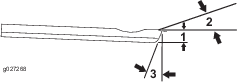
g027268

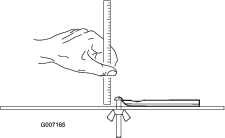
Note: All bedknife service limit measurements relate to the bottom of the bedknife (Figure 33).
g007165

Checking the Top Grind Angle

The angle that you use to grind your bedknives is very important.

Use the angle indicator (Toro Part No. 131-6828) and the angle-indicator mount (Toro Part No. 131-6829) to check the angle that your grinder produces and then correct for any grinder inaccuracy.

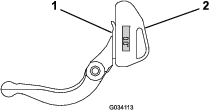
  1. Place the angle indicator on the bottom side of the bedknife as shown in Figure 34.
    g034113
  2. Press the Alt Zero button on the angle indicator.

  3. Place the angle-indicator mount on the edge of the bedknife so that the edge of the magnet is mated with the edge of the bedknife (Figure 35).

    Note: The digital display should be visible from the same side during this step as it was in step 1.
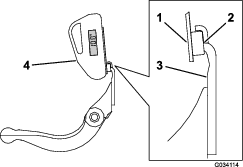
    g034114
  4. Place the angle indicator on the mount as shown in Figure 35.

    Note: This is the angle that your grinder produces; it should be within 2 degrees of the recommended top grind angle.

Servicing the Bedbar

Removing the Bedbar

  1. Turn the bedbar-adjusting screws counterclockwise to back the bedknife away from the reel (Figure 36).
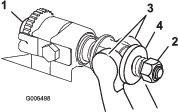
    g006498
  2. Back out the spring-tension nut until the washer is no longer tensioned against the bedbar (Figure 36).

  3. On each side of the machine, loosen the locknut securing the bedbar bolt (Figure 37).
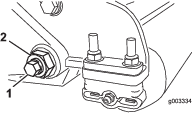
    g003334
  4. Remove each bedbar bolt, allowing the bedbar to be pulled downward and removed from the machine bolt (Figure 37). Account for 2 nylon washers and 1 stamped steel washer on each end of the bedbar (Figure 38).
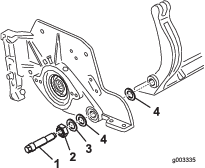
    g003335

Assembling the Bedbar

  1. Install the bedbar, positioning the mounting ears between the washer and the bedbar adjuster.

  2. Secure the bedbar to each side plate with the bedbar bolts (nuts on bolts) and 6 washers.

    Note: Position a nylon washer on each side of side-plate boss. Place a steel washer outside each of the nylon washers (Figure 38).

  3. Torque the bedbar bolts to 27 to 36 N∙m (240 to 320 in-lb).

    Note: Tighten the locknuts until the outside steel washer stops rotating and end play is removed, but do not overtighten or deflect the side plates. The washers on the inside may have a gap.

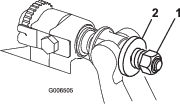
  4. Tighten the spring-tension nut until the spring is collapsed, then back off 1/2 turn (Figure 39).
    g006505

Installing the Bedknife

  1. Remove the rust, scale, and corrosion from the bedbar surface and apply a thin layer of oil to the bedbar surface.

  2. Clean the screw threads.

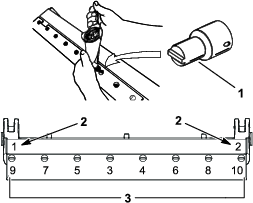
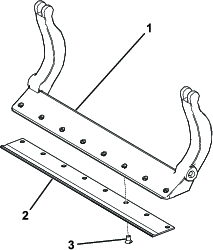
  3. Apply anti-seize compound to the screws and install the bedknife to the bedbar as follows (Figure 40):
    g279161
    1. Torque the 2 outer screws to 1 N∙m (10 in-lb); refer to Figure 40.

    2. Working form the center of the bedknife, torque the screws to 23 to 28 N∙m (200 to 250 in-lb); refer to Figure 40.

      g279162
  4. Grind the bedknife.

Servicing the Roller

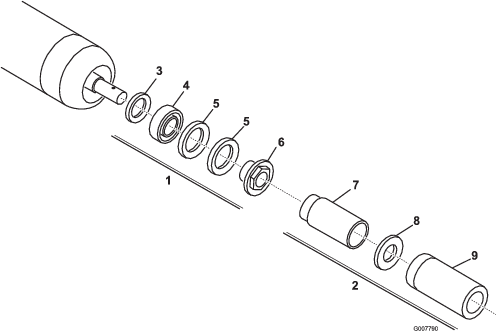
The Roller Rebuild Kit (Part No. 114-5430) and the Roller Rebuild Tool Kit (Part No. 115-0803) (Figure 42) are available for servicing the roller. The Roller Rebuild Kit includes all the bearings, bearing nuts, inner seals, and outer seals to rebuild a roller. The Roller Rebuild Tool Kit includes all the tools and the installation instructions required to rebuild a roller with the roller rebuild kit. Refer to your parts catalog or contact your authorized Toro distributor for assistance.
g007790