
Introduction

If you require a spark arrester, contact your Authorized Service Dealer. Genuine Toro spark arresters are approved by the USDA Forestry Service.

Important: These installation instructions contain engine operation and maintenance information that supersedes the engine operation and maintenance procedures in your machine Operator’s Manual.Before operating or maintaining the machine or engine, always refer to the operation and safety instructions in your Operator’s Manual.Save these instructions.

Important: This engine's warranty is provided by the engine manufacturer. Please refer to the engine manufacturer's warranty and emissions system warranty included in the literature packet. That warranty applies only to the engine. It does not expand or otherwise alter any express or implied warranty terms or warranty period that may apply to the product into which the engine is installed.

Warning

CALIFORNIA

Proposition 65 Warning

The engine exhaust from this product contains chemicals known to the State of California to cause cancer, birth defects, or other reproductive harm.

Safety

Safety and Instructional Decals

Graphic

Safety decals and instructions are easily visible to the operator and are located near any area of potential danger. Replace any decal that is damaged or missing.

decal133-8062

Installation

For Models 04052 and 04060 made in 2008 or later.

Note: If the machine is equipped with an incandescent light kit, order a new kit; contact your Authorized Service Dealer for more information.

Removing the Existing Engine

Important: Save all removed parts unless otherwise noted.

  1. Remove and discard the wire harness.

  2. Remove the bellcrank cover and keep the 1/4 turn stud, 2 washers, mounting bracket, and the mounting bracket screws and washers.

    Note: Discard the bellcrank cover.

  3. Remove the V-belts from the driver pulley.

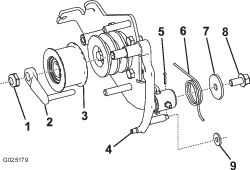
  4. Remove the torque spring, washer, bolt, and cable link from the clutch lever (Figure 2).

  5. Disconnect the traction cable from the clutch assembly on the engine.

  6. Disconnect the throttle control cable from the traction lever assembly.

  7. Disconnect the brake cable from the brake assembly.

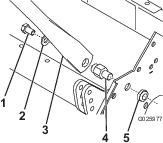
  8. Remove the bolt, washer, handle pivot pin, and flange-head nut securing the handle assembly to the machine (Figure 1).

    Note: You may discard the handle assembly.

    g025977
  9. Remove the existing engine, engine mounting bolts, and nuts.

  10. Remove and discard the existing engine mounting bracket.

    Important: Retain the existing engine mounting bracket bolts.

Installing the New Engine

Parts needed for this procedure:

Engine assembly1
Engine conversion mounting bracket1

Note: Refer to Figure 7 for installing the new engine.

  1. Clean the frame and check for damage or wear.

  2. Install the existing torsion spring, washer, and bolt to the new clutch lever (Figure 2).

    g025179
  3. Secure the bent leg of the torsion spring to the clutch lever using a washer and cotter pin.

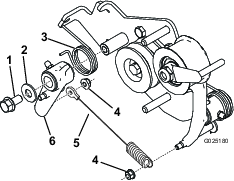
  4. Remove the traction lever assembly and necessary parts from the existing clutch bracket and install them on the new clutch bracket (Figure 3).

    g025180
  5. Connect the existing cable link to the traction lever assembly and the clutch lever using 2 nuts from the existing assembly (Figure 3).

  6. Install the engine conversion mounting bracket to the machine with the previously removed bolts.

    Note: To make installing the engine to the frame easier, hand tighten the bolts.

  7. Mount the engine onto the engine conversion mounting bracket using 3 of the existing bolts and nuts, leaving the front right mounting hole open.

    Note: To make installing the engine to the frame easier, hand tighten the bolts.

Installing the Cables

Parts needed for this procedure:

Handle assembly1
Clip2
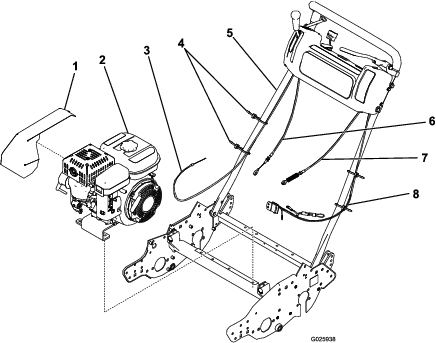
  1. Install the new handle assembly to the machine using the previously removed bolt, washer, handle pivot pin, and flange-head nut (Figure 4).

    g025977
  2. Connect the throttle cable to the engine.

  3. Connect the brake cable to the brake assembly.

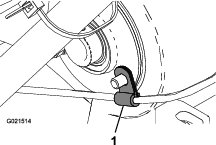
  4. Using the existing throttle cable clip, attach the new throttle cable to the rear of the differential housing (Figure 5).

    g021514
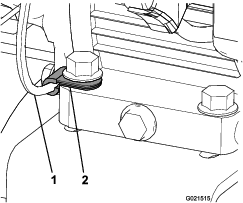
  5. Attach the new clip to the throttle cable and bolt it to the engine conversion mounting bracket using the front right bolt (Figure 6).

    g021515
  6. Connect the traction cable to the traction lever assembly.

Completing the Installation

Parts needed for this procedure:

Bellcrank cover1
Cable tie4
  1. Install the V-belts.

  2. Align the pulleys, and adjust the traction cable and V-belt tension; refer to your Operator’s Manual.

    Note: If you cannot properly adjust the traction cable, order Part No. 94-5870.

  3. Tighten all of the engine and engine conversion mounting bracket bolts.

  4. Route the wire harness up the left side of the handle.

  5. Snap the wire harness into place under the console cover.

  6. Connect the wire harness to the hour meter and the engine power switch.

  7. Install the 1/4 turn stud and 2 washers to the bellcrank cover, and install the cover assembly, mounting bracket, and mounting bracket screws and washers.

  8. Attach the cables and wire harness to the handles using the 4 new cable-ties.

  9. Lubricate the machine; refer to your Operator’s Manual.

  10. Fill the engine crankcase with oil; refer to your Operator’s Manual.

  11. Adjust the engine speed to the following specifications:

    High idle (no load)3375 ±100 rpm
    Low idle (no load)1565 ±150 rpm
    g025938

Product Overview

g264589

Choke Control

The choke control is located at the left side of the control console; you use it to help start a cold engine (Figure 8).

Note: Do not start or run a warm engine with the choke in the ON position.

  • Pull up on the choke control to set the choke to the ON position.

  • Push down on the choke control to set the choke to the OFF position.

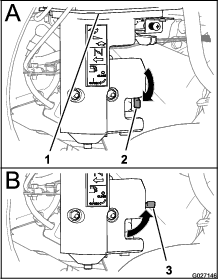
Fuel-Shut-Off Valve

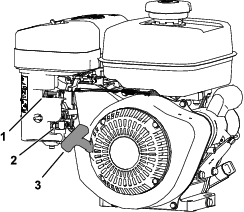
The fuel-shut-off valve is located at the front, right side of the engine below the fuel tank (Figure 8).

Note: Close the fuel-shut-off valve when the machine is not used for a few days, during transport to and from the job site, or when the machine is parked inside a building; refer to Opening and Closing the Fuel-Shut-Off Valve.

Operation

Fuel Specification

Petroleum fuelUse unleaded gasoline with an octane rating of 87 or higher ((R+M)/2 rating method).
Ethanol blended fuelUse an unleaded-gasoline blend with up to 10% ethanol (gasohol) or 15% MTBE (methyl tertiary butyl ether) by volume is acceptable. Ethanol and MTBE are not the same.
Gasoline with 15% ethanol (E15) by volume is not approved for use. Never use gasoline that contains more than 10% ethanol by volume, such as E15 (contains 15% ethanol), E20 (contains 20% ethanol), or E85 (contains up to 85% ethanol). Using unapproved gasoline may cause performance problems and/or engine damage which may not be covered under warranty.

Important: For best results, use only clean, fresh fuel (less than 30 days old).

  • Do not use gasoline containing methanol.

  • Do not store fuel either in the fuel tank or fuel containers over the winter unless you use a fuel stabilizer.

  • Do not add oil to gasoline.

Using Stabilizer/Conditioner

Use a fuel stabilizer/conditioner in the machine to provide the following benefits:

Important: Do not use fuel additives containing methanol or ethanol.

Add the correct amount of fuel stabilizer/conditioner to the gasoline.

Note: A fuel stabilizer/conditioner is most effective when mixed with fresh gasoline. To minimize the chance of varnish deposits in the fuel system, use fuel stabilizer at all times.

Filling the Fuel Tank

Fuel tank capacity: 2.7 L (0.71 US gallons)

  1. Park the machine on a level surface and shut off the engine.

  2. Allow the engine to cool.

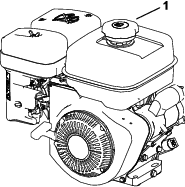
  3. Clean around the fuel-tank cap and remove it (Figure 8).

    g264553
  4. Fill the tank with fuel (Figure 8) to within 6 to 13 mm (1/4 to 1/2 inch) from the top of the tank. Do not fill into the filler neck of the tank.

    Important: Do not fill the tank more than 6 mm (1/4 inch) from the top of the tank because the fuel needs room to expand.

  5. Install the fuel-tank cap securely.

  6. Wipe up any spilled fuel.

Opening and Closing the Fuel-Shut-Off Valve

Control fuel flow to the engine with the fuel-shut-off valve as follows:

  • Rotate the handle for the fuel-shut-off valve 90 degrees clockwise to the open the valve.

  • Rotate fuel-shut-off valve handle 90 degrees counterclockwise to close the valve.

g027146

Maintenance

Important: Refer to your engine owner’s manual for additional maintenance procedures.

Recommended Maintenance Schedule(s)

Maintenance Service IntervalMaintenance Procedure
After the first 20 hours
  • Change the engine oil.
  • Before each use or daily
  • Check the engine-oil level.
  • Every 50 hours
  • Clean the foam air-cleaner element (More often under severe conditions).
  • Every 100 hours
  • Change the engine oil
  • Check and gap the spark plug.
  • Every 200 hours
  • Replace the dual element air filter.
  • Preparing the Machine for Maintenance

    Warning

    While you are maintaining or adjusting the machine, someone could start the engine. Accidentally starting the engine could seriously injure you or other bystanders.

    Remove the key from the ignition, engage parking brake, and pull the wire(s) off the spark plug(s) before you do any maintenance. Also push the wire(s) aside so it does not accidentally contact the spark plug(s).

    Perform the following before servicing, cleaning, or making any adjustments to the machine.

    1. Park the machine on a level surface.

    2. Shut off the engine and remove the key from the machine (if equipped).

    3. Engage the parking brake.

    4. Wait for all moving parts to stop allow the engine to cool before servicing, storing, or making repairs.

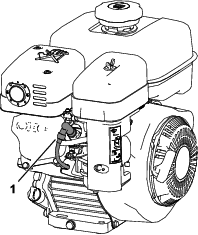
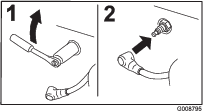
    5. Disconnect the spark-plug wire (Figure 11).
      g259487

    Servicing the Air Cleaner

    Maintenance Service IntervalMaintenance Procedure
    Every 200 hours
  • Replace the dual element air filter.
  • Important: Do not apply oil to the foam or paper element.

    Removing the Foam and Paper Elements

    1. Prepare the machine for maintenance; refer to Preparing the Machine for Maintenance.

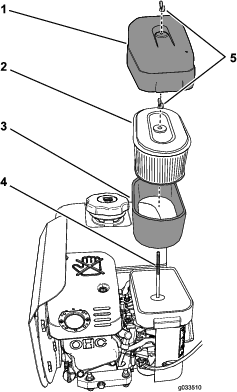
    2. Clean around the air cleaner to prevent dirt from getting into the engine and causing damage (Figure 12).
      g033510
    3. Rotate the wing nut that secures the air-cleaner cover counterclockwise and remove the air-cleaner cover (Figure 12).

    4. Rotate the wing nut that secures the paper and foam-filter elements counterclockwise and remove the filter elements from the hold-down rod (Figure 12).

    5. Carefully pull the foam element off the paper element (Figure 12).

      Note: Inspect the paper and foam-filter elements for damage or an excessive accumulation of dirt. Replace the damaged filters. Clean the foam-filter element if it is dirty. Replace the paper-filter element if it is dirty.

    Servicing the Foam Filter Element

    Maintenance Service IntervalMaintenance Procedure
    Every 50 hours
  • Clean the foam air-cleaner element (More often under severe conditions).
    1. Inspect the element for tears, an oily film, or damaged (Figure 12).

      Important: Replace the foam element if it is worn or damaged.

    2. Wash the foam element in liquid soap and warm water. When the element is clean, rinse it thoroughly.

    3. Dry the element by squeezing it in a clean cloth.

    4. Air dry the foam-filter element.

    Installing the Foam and Paper-Filter Elements

    Important: To prevent engine damage, always operate the engine with the complete foam and paper air-cleaner assembly installed.

    1. Carefully slide the foam-filter element onto the paper-filter element (Figure 12).

    2. Align the hole in the top plate of the paper-filter element with the hold-down rod of the carburetor (Figure 12).

    3. Secure the filter elements to the carburetor with the wing nut (Figure 12) that you removed in step 4 of Removing the Foam and Paper Elements.

    4. Align the hole in the air-cleaner cover with the hold-down rod (Figure 12) and secure the cover to the rod with the wing nut that you removed in step 3 of Removing the Foam and Paper Elements.

    Engine Oil Specification

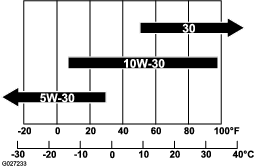
    Oil Type: Detergent oil (API service SJ or higher)

    Oil viscosity: Refer to the table below.
    g027233

    Checking the Engine-Oil Level

    Maintenance Service IntervalMaintenance Procedure
    Before each use or daily
  • Check the engine-oil level.
  • Important: Do not operate the engine with the oil level below the Low (or Add) mark on the dipstick, or over the Full mark.

    1. Move the machine to a level surface.

    2. Prepare the machine for maintenance; refer to Preparing the Machine for Maintenance.

    3. Allow the engine to cool.

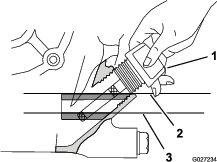
    4. Remove the dipstick from the engine and wipe the dipstick with a clean rag (Figure 14).
      g027234
    5. Insert the dipstick from the engine as shown in Figure 14.

      Note: Do not thread the dipstick into the filler neck when checking the engine oil level.

    6. Remove the dipstick from the filler neck and look at the oil level in the dipstick (Figure 14).

      Note: The engine oil level must cover between the hatch marked areas on the dipstick (Figure 14).

    7. If the oil level is low, wipe off the area around the filler neck and add the specified oil until the oil level is between the hatch marked areas on the dipstick.

      Important: Do not overfill the engine with oil.

    8. Hand tighten the dipstick into the filler neck (Figure 14).

    Changing the Engine Oil

    Maintenance Service IntervalMaintenance Procedure
    After the first 20 hours
  • Change the engine oil.
  • Every 100 hours
  • Change the engine oil
  • Draining the Engine Oil

    Important: Do not operate the engine with the oil level below the Low (or Add) mark on the dipstick, or over the Full mark.

    1. Start and run the engine for a few minutes to warm the engine oil.

    2. Prepare the machine for maintenance; refer to Preparing the Machine for Maintenance.

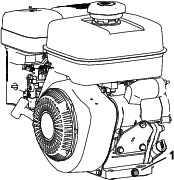
    3. At the rear of the machine, place a drain pan under the drain plug.
      g264566
    4. Remove the drain plug from the engine and allow the oil to drain completely.

    5. Push down on the handle to tip the machine and engine backward, allowing all the oil to run into the drain pan.

      Important: Do not tip the machine at an angle greater than 25°. Tipping the machine beyond 25° leads to oil leaking into the combustion chamber and/or fuel leaking out of the fuel-tank cap.

    6. Install the drain plug and refill the crankcase with the specified oil; refer to Adding Oil to the Engine.

    7. Torque the drain plug to 20 to 23 N∙m (15 to 17 ft-lbs).

    8. Wipe up any spilled oil and dispose of the used oil properly.

    Adding Oil to the Engine

    Engine Oil Capacity: 0.6 L (20 fl oz)

    Important: Do not operate the engine with the oil level below the Low (or Add) mark on the dipstick, or over the Full mark.

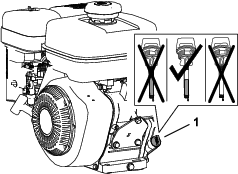
    1. Remove the dipstick from the filler neck of the engine and wipe clean the dipstick with a rag (Figure 16).
      g264565
    2. Slowly pour 0.6 L (20 fl oz) of the specified oil into the crank case of the engine through the filler neck (Figure 16).

    3. Insert the dipstick from the engine as shown in Figure 17.

      Note: Do not thread the dipstick into the filler neck when checking the engine oil level.

      g027234
    4. Remove the dipstick from the filler neck and look at the oil level in the dipstick (Figure 15).

      Note: The engine oil level must cover between the hatch marked areas on the dipstick (Figure 16).

    5. If the oil level is low, add the specified oil into the engine until the oil level is between the hatch marked areas on the dipstick.

      Note: Do not overfill the engine with oil.

    6. Hand tighten the dipstick into the filler neck (Figure 17).

    Servicing the Spark Plug

    Maintenance Service IntervalMaintenance Procedure
    Every 100 hours
  • Check and gap the spark plug.
  • Spark Plug Specification

    Spark Plug Type: NGK BR6HS, Champion RTL86C, or equivalent

    Removing the Spark Plug

    1. Prepare the machine for maintenance; refer to Preparing the Machine for Maintenance.

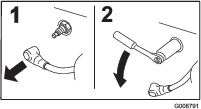
    2. Remove the spark plug as shown in Figure 18.
      g008791

    Checking the Spark Plug

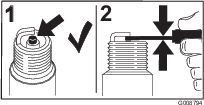
    Air Gap: 0.6 to 0.7 mm (0.02 to 0.03 inch)

    Important: Do not clean the spark plug(s). Always replace the spark plug(s) when it has a black coating, worn electrodes, an oily film, or cracks.

    If you see light brown or gray on the insulator, the engine is operating properly. A black coating on the insulator usually means the air cleaner is dirty.

    Use a gapping tool/feeler gauge to check and adjust the air gap to 0.6 to 0.7 mm (0.02 to 0.03 inch).
    g008794

    Installing the Spark Plug

    Tighten the spark plug as follows:

    • New spark plug—12 to 15 N∙m (8.7 to 10.8 ft-lb)

    • In-service spark plug—23 to 27 N∙m (16.6 to 19.5 ft-lb)
    g008795