Safety
Read the safety and operation instructions in the machine Operator’s Manual.
Warning
Chemical substances used in the spray system may be hazardous and toxic to you, bystanders, animals, plants, soils, or other property.
-
Carefully read and follow the chemical warning labels and safety data sheets (SDS) for all chemicals used and protect yourself according to the chemical manufacturer's recommendations. For example, use appropriate personal protective equipment (PPE) including face and eye protection, gloves, or other equipment to guard against personal contact with the chemical.
-
Keep in mind that there may be more than 1 chemical used and information on each should be assessed.
-
Refuse to operate or work on the sprayer if this information is not available.
-
Before working on a spray system make sure the system has been triple rinsed and neutralized according to the recommendations of the chemical manufacturer(s).
-
Verify that there is an adequate supply of clean water and soap nearby, and immediately wash off any chemicals that contact you.
Chemical Safety
Chemical substances used in the sprayer system may be hazardous and toxic to you, bystanders, and animals, and they may damage plants, soil, and other property.
-
Read the information on each chemical. Refuse to operate or work on the sprayer if this information is not available.
-
Before working on a sprayer system, ensure that it has been neutralized and triple rinsed according to the recommendations of the chemical manufacturer(s) and that all the valves have been cycled 3 times.
-
Verify that there is an adequate supply of clean water and soap nearby, and immediately wash off any chemicals that contact you.
-
Carefully read and follow the chemical warning labels and safety data sheets (SDSs) for all chemicals used, and protect yourself according to the chemical manufacturer's recommendations.
-
Always protect your body while using chemicals. Use the appropriate personal protective equipment (PPE) to guard against contact with chemicals, such as the following:
-
safety glasses, goggles, and/or face shield
-
a chemical suit
-
a respirator or filter mask
-
chemical-resistant gloves
-
rubber boots or other substantial footwear
-
a clean change of clothes, soap, and disposable towels for cleanup
-
-
Obtain proper training before using or handling chemicals.
-
Use the correct chemical for the job.
-
Follow the chemical manufacturer's instructions for the safely applying the chemical. Do not exceed the recommended system application pressure.
-
Do not fill, calibrate, or clean the machine while people, especially children, or pets are in the area.
-
Handle chemicals in a well-ventilated area.
-
Do not eat, drink, or smoke while working near chemicals.
-
Do not clean spray nozzles by blowing through them or placing them in your mouth.
-
Always wash your hands and other exposed areas as soon as possible after working with chemicals.
-
Keep chemicals in their original packages and stored in a safe location.
-
Properly dispose of unused chemicals and chemical containers as instructed by the chemical manufacturer and your local codes.
-
Chemicals and fumes are dangerous; never enter the tank or place your head over or in the opening of a tank.
-
Follow all local, state, and federal regulations for spreading or spraying chemicals.
Installation
Preparing the Machine
Caution
Chemicals are hazardous and can cause personal injury.
-
Read the directions on the chemical labels before handling the chemicals and follow all manufacturer recommendations and precautions.
-
Keep chemicals away from your skin. Should contact occur, wash the affected area thoroughly with soap and clean water.
-
Wear goggles and any other protective equipment recommended by the chemical manufacturer.
-
Park the machine on a level surface.
-
Shift the transmission into the NEUTRAL position (manual) or the PARK position (automatic).
-
Engage the parking brake.
-
Shut off the engine and remove the key.
-
Wait for all movement to stop before leaving the operator’s seat.
-
Clean the sprayer; refer to Cleaning the Sprayer in the Operator’s Manual for the machine.
-
Allow the machine components to cool.
Removing the Flow-Meter Sensor
-
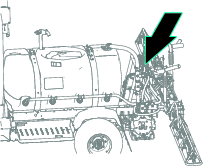
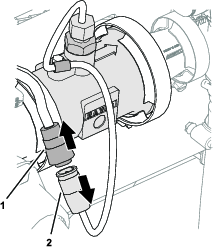
Remove the 3-pin connector for the flow-meter sensor harness from the 3-socket connector of the machine wire harness (Figure 1).
-
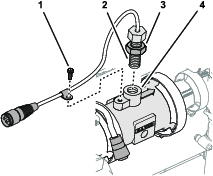
Remove the bolt that secures the sensor harness to the body of the flow meter (Figure 2).
-
Loosen the sensor jam nut, and thread the sensor from flow-meter body (Figure 2).
Installing the Flow-Meter Sensor
Parts needed for this procedure:
| Flow-meter sensor | 1 |
Preparing the Sensor
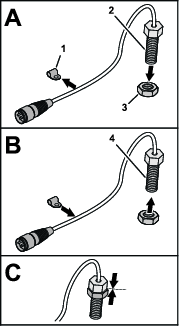
Assembling the Sensor to the Flow Meter
-
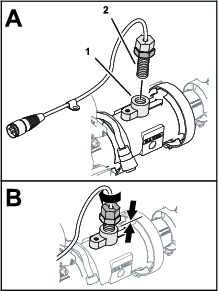
Thread the sensor into the flow-meter body clockwise until the sensor contacts the bottom of the hole (Figure 4).
-
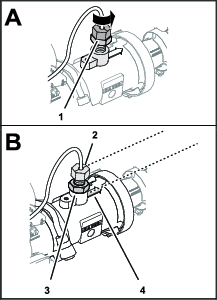
If needed, rotate the sensor counterclockwise until the alignment mark at the top of the sensor aligns with the alignment arrow of the flow-meter body (Figure 5).
-
While holding the position of the sensor, torque the jam nut (Figure 5) to 226 to 282 N∙cm (20 to 25 in-lb),
-
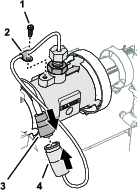
Secure the sensor harness to the body of the flow-meter body with the bolt (Figure 6).
-
Plug the 3-pin connector for the flow-meter sensor harness into the 3-socket connector of the machine wire harness (Figure 6).
Updating the Machine Software
-
Use the software update applicability table to determine if you need to update the software for your machine.
-
If your machine needs a software updated, contact your authorized Toro distributor.
|
Model |
Model No. |
Serial No. |
|---|---|---|
|
Multi Pro 5800 ExcelaRate—Gas |
41394 |
316000001–05060197 |
|
Multi Pro 5800 ExcelaRate—Diesel |
41393 |
316000001–404847104 |
|
Multi Pro 1750 |
41188 |
314000001–405240880 |
|
Multi Pro WM |
41240 |
314000001–404696508 |
|
All other machines |
41240 |
314000001–404696508 |
|
For all other machines, use the CAL numbers from the new flow meter or sensor to calibrate the controllers and display; refer to the operators manual for your display. Important: You need to have the machine software updated so that the sprayer system works with the new flow meter. |
||