

Introduction

This engine conversion kit is only for machines with following model and serial numbers:

Model NumberSerial Number
04040312000001 through 315999999
04041312000001 through 315999999
04044316000001 through 999999999
04045316000001 through 999999999

Light Kit, Model 04064 (Flex 1800/2100/1820/2120 traction units) is compatible with this kit.

Note: Older light kits are not compatible with this kit.

Important: These installation instructions contain engine operation and maintenance information that supersedes the engine operation and maintenance procedures in your machine Operator’s Manual.Before operating or maintaining the machine or engine, always refer to the operating and safety instructions in your Operator’s Manual.Save these instructions.

Important: The engine warranty is provided by the engine manufacturer. Please refer to the engine manufacturer's warranty and emissions system warranty included in the literature packet. That warranty applies only to the engine. It does not expand or otherwise alter any express or implied warranty terms or warranty period that may apply to the product into which the engine is installed.

Warning

CALIFORNIA

Proposition 65 Warning

The engine exhaust from this product contains chemicals known to the State of California to cause cancer, birth defects, or other reproductive harm.

Safety

Safety and Instructional Decals

Graphic

Safety decals and instructions are easily visible to the operator and are located near any area of potential danger. Replace any decal that is damaged or missing.

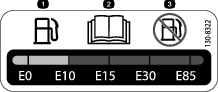
decal130-8322
decal133-8062
decal138-2138

Installation

Note: If the machine is equipped with an incandescent light kit, you may need to order a new kit; contact your authorized Toro distributor for more information.

Preparing the Machine

Prepare the machine; refer to Preparing the Machine for Maintenance.

Removing the Existing Engine

Important: For additional engine-removal instructions and illustrations, refer to the Greensmaster Flex 1800/1820/2100/2120 Service Manual on www.Toro.com.

Important: Retain all removed parts for reuse unless otherwise noted.

  1. Remove the throttle cable from the engine.

  2. Disconnect the electrical connections from the engine and the handle.

  3. Remove engine-base assembly (with the engine attached) from machine.

  4. Remove the engine from the engine base.

    Note: The cap screws, washers, and nuts can be discarded.

  5. Remove the engine coupler and the square key from the engine output shaft.

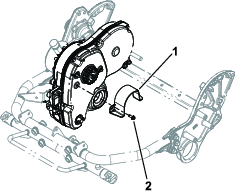
  6. Remove the existing coupler guard from the transmission cover (Figure 1).

    g314125

Installing the New Engine

Parts needed for this procedure:

Engine1
Bolt4
Nut4
Spacer4
Washer4
Coupler guard1
Wire harness1

Important: For additional engine-installation instructions and illustrations, refer to the Greensmaster Flex 1800/1820/2100/2120 Service Manual on www.Toro.com.

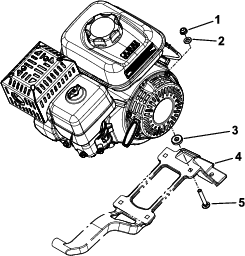
  1. Use 4 bolts, 4 washers, 4 spacers, and 4 nuts to secure the engine to the engine base (Figure 2).

    g314123
  2. Perform the following steps to install the coupler to the engine-output shaft:

    1. Apply anti-seize lubricant to the top surface of the square key and position the key in the output-shaft keyway.

    2. Slide the coupler onto the output shaft until it contacts the shaft shoulder.

    3. Secure the coupler to the output shaft with the 2 previously-removed set screws.

    4. Torque the set screws to 7 N∙m (65 in-lb).

  3. Perform the following steps to install the engine base assembly to the machine:

    1. Ensure that the coupler sleeve is placed on the transmission-input-shaft coupler.

    2. Position the engine-base assembly to the machine.

    3. Carefully slide the engine-base assembly toward the transmission, allowing the engine coupler to be inserted into the transmission coupler sleeve.

      Note: You may have to turn the engine output shaft to align the engine coupler with the coupler sleeve.

    4. Support the engine-base assembly to allow for fastener installation.

    5. Install and finger-tighten the 2 cap screws, hardened washers, and flange nuts that secure the engine-base rear to the rear frame.

    6. Align the frame hole with the front mounting boss of the engine base.

    7. Install and finger tighten the flange head screw and hardened washer that secures the engine base to the frame.

    8. Position the engine-base front to align the engine and transmission couplers. Fully tighten the flange-head screws to secure the engine-base front.

    9. Fully tighten fasteners at rear of engine base.

  4. Connect the wire harness to the appropriate locations on the engine and the handle:

    • Engine connections:

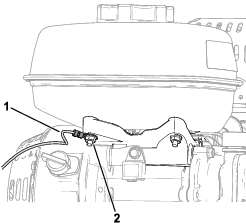
      • Connect the ground wire (terminal ring) to engine with an existing nut under the fuel tank (Figure 3).

        g314124
      • Refer to the following table for the appropriate machine and engine wire harness connections:

        Machine-wire-harness connectorEngine-wire-harness connector
        BlackRed
        GreyBlack
        GreenBlue
    • Handle connections: Connect the wire harness to the engine switch, hour meter, interlock module, and the light kit connections (if equipped).

  5. Connect the throttle cable to engine.

  6. Use the previously-removed bolts to secure the new coupler guard to the transmission cover.

Lubricating and Adjusting the Machine

  1. Lubricate the machine according to the instructions in your Operator’s Manual.

  2. Fill the engine crankcase with oil; refer to Servicing the Engine Oil.

  3. Adjust the engine speed to the following specifications:

    High idle (no load)3450 ± 100 rpm
    Low idle (no load)1900 ± 100 rpm

Product Overview

g265059

Choke Control

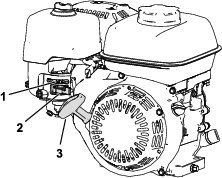
The choke control is located on the side of the engine (Figure 4); you use it to help start a cold engine

Note: Do not start or run a warm engine with the choke in the CLOSED position.

  • Move the choke lever all the way to the left (away from starter handle) to set the choke to the CLOSED position.

  • Move the choke lever all the way to the right (toward starter handle) to set the choke to the OPEN position.

Fuel-Shutoff Valve

The fuel-shutoff valve is located on the side of the engine below the choke control (Figure 4).

Note: Close the fuel-shutoff valve when the machine is not used for a few days, during transport to and from the job site, or when the machine is parked inside a building; refer to Opening and Closing the Fuel-Shutoff Valve.

Operation

Fuel Specifications

Fuel tank capacity: 2.0 L (0.59 US gallons)

Recommended fuel: Unleaded gasoline with an octane rating of 87 or higher ((R+M)/2 rating method)

Ethanol: Gasoline with up to 10% ethanol (gasohol) or 15% MTBE (methyl tertiary butyl ether) by volume is acceptable. Ethanol and MTBE are not the same. Gasoline with 15% ethanol (E15) by volume is not approved for use.

  • Never use gasoline that contains more than 10% ethanol by volume, such as E15 (contains 15% ethanol), E20 (contains 20% ethanol), or E85 (contains up to 85% ethanol).

  • Do not use gasoline containing methanol.

  • Do not store fuel either in the fuel tank or fuel containers over the winter unless a fuel stabilizer is used.

  • Do not add oil to gasoline.

  • For best results, use only clean, fresh (less than 30 days old) fuel.

  • Using unapproved gasoline may cause performance problems and/or engine damage, which may not be covered under the warranty

Using Stabilizer/Conditioner

Important: Do not use fuel additives containing methanol or ethanol.

Add the correct amount of fuel stabilizer/conditioner to the gasoline.

Note: A fuel stabilizer/conditioner is most effective when mixed with fresh gasoline. To minimize the chance of varnish deposits in the fuel system, use fuel stabilizer at all times.

Filling the Fuel Tank

Danger

In certain conditions, fuel is extremely flammable and highly explosive. A fire or explosion from fuel can burn you and others and can damage property.

  • Fill the fuel tank outdoors, in an open area, when the engine is cold. Wipe up any fuel that spills.

  • Never fill the fuel tank inside an enclosed trailer.

  • Do not fill the fuel tank completely full. Add fuel to the fuel tank until the level is 6 to 13 mm (1/4 to 1/2 inch) below the bottom of the filler neck. This empty space in the tank allows fuel to expand.

  • Never smoke when handling fuel, and stay away from an open flame or where fuel fumes may be ignited by a spark.

  • Store fuel in an approved container and keep it out of the reach of children. Never buy more than a 30-day supply of fuel.

  • Do not operate without entire exhaust system in place and in proper working condition.

Danger

In certain conditions during fueling, static electricity can be released, causing a spark which can ignite the fuel vapors. A fire or explosion from fuel can burn you and others and can damage property.

  • Always place fuel containers on the ground away from your vehicle before filling.

  • Do not fill fuel containers inside a vehicle or on a truck or trailer bed because interior carpets or plastic truck-bed liners may insulate the container and slow the loss of any static charge.

  • When practical, remove equipment from the truck or trailer and fuel it on the ground. If this is not possible, then fuel such equipment with a portable container rather than from a fuel-dispenser nozzle.

  • If you must use a fuel-dispenser nozzle, keep the nozzle in contact with the rim of the fuel tank or container opening at all times until fueling is complete.

Warning

Fuel is harmful or fatal if swallowed. Long-term exposure to vapors can cause serious injury and illness.

  • Avoid prolonged breathing of vapors.

  • Keep your face away from the nozzle and fuel tank or conditioner bottle opening.

  • Avoid contact with skin; wash off spills with soap and water.

  1. Park the machine on a level surface and shut off the engine.

  2. Allow the engine to cool.

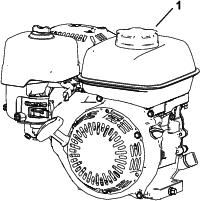
  3. Clean around the fuel-tank cap and remove it (Figure 5).

    g265976
  4. Fill the tank with fuel until the level is just inside the mesh filter basket.

    Do not fill into the filler neck of the tank.

    Important: Do not fill the tank more above the filler mesh because the fuel needs room to expand.

  5. Install the fuel-tank cap securely.

  6. Wipe up any spilled fuel.

Opening and Closing the Fuel-Shutoff Valve

Control fuel flow to the engine with the fuel-shutoff valve as follows:

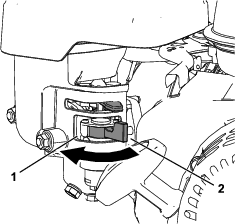
  • To open the fuel valve, turn the fuel-shutoff valve handle toward the recoil starter handle (Figure 6).

  • To shut the fuel valve, turn the fuel-shutoff valve handle away from the recoil starter handle (Figure 6).

    g265993

Maintenance

Important: Refer to your engine owner’s manual for additional maintenance procedures.

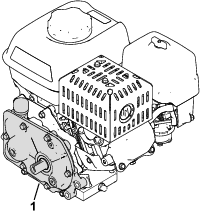
Important: The engine gearbox (Figure 7) does not require maintenance, as it is filled with a high-performance, long-life synthetic semi-fluid grease.
g312416

Recommended Maintenance Schedule(s)

Maintenance Service IntervalMaintenance Procedure
After the first 20 hours
  • Change the engine oil.
  • Before each use or daily
  • Check the engine-oil level.
  • Inspect the air-filter elements.
  • Every 50 hours
  • Clean the air-filter elements.
  • Every 100 hours
  • Change the engine oil.
  • Inspect and adjust the spark plug; replace it if necessary.
  • Every 300 hours
  • Replace the paper filter element (More frequently in dusty operating conditions).
  • Replace the spark plug.
  • Preparing the Machine for Maintenance

    Warning

    While you are maintaining or adjusting the machine, someone could start the engine. Accidentally starting the engine could seriously injure you or other bystanders.

    Remove the key from the ignition, engage parking brake, and pull the wire(s) off the spark plug(s) before you do any maintenance. Also push the wire(s) aside so it does not accidentally contact the spark plug(s).

    Perform the following before servicing, cleaning, or making any adjustments to the machine.

    1. Park the machine on a level surface.

    2. Shut off the engine and remove the key from the machine (if equipped).

    3. Engage the parking brake.

    4. Wait for all moving parts to stop and allow the engine to cool before servicing or storing.

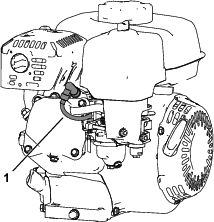
    5. Disconnect the spark-plug wire (Figure 8).
      g265998

    Servicing the Engine Oil

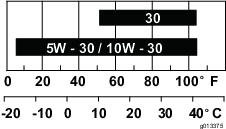
    Fill the crankcase with approximately 0.56 L (19 fl oz) of the proper viscosity oil before starting. The engine uses a high-quality oil that has the American Petroleum Institute (API) service classification of SJ or higher. Select the proper oil viscosity (weight) based on the ambient temperature. Figure 9 illustrates the temperature/viscosity recommendations.
    g013375

    Note: Multi-grade oils (5W-20, 10W-30 and 10W-40) increase oil consumption. Check the engine-oil level more frequently when you use these oils.

    Checking the Engine-Oil Level

    Maintenance Service IntervalMaintenance Procedure
    Before each use or daily
  • Check the engine-oil level.
  • The ideal time to check the engine-oil level is when the engine is cool or before you have started the engine for the day. If you have already ran the engine, allow the oil to drain back down to the sump for at least 10 minutes before you check the engine-oil level.

    1. Shut off the engine and wait for all moving parts to stop; refer to Preparing the Machine for Maintenance.

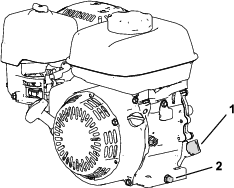
    2. Position the machine so that the engine is level, and clean the area around the oil-fill tube (Figure 10).
      g266053
    3. Remove the dipstick by rotating it counterclockwise.

    4. Remove the dipstick and wipe the end clean.

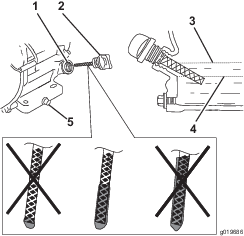
    5. Insert the dipstick fully into the oil-fill tube, but do not thread it in.

    6. Remove the dipstick and check the engine-oil level (Figure 11).
      g019686
    7. If the engine-oil level is incorrect, add or drain oil to correct the level; refer to Changing the Engine Oil.

    Changing the Engine Oil

    Maintenance Service IntervalMaintenance Procedure
    After the first 20 hours
  • Change the engine oil.
  • Every 100 hours
  • Change the engine oil.
  • Warning

    Oil may be hot after the engine has been run, and contact with hot oil can cause severe personal injury.

    Avoid contacting the hot engine oil when you drain it.

    1. Shut off the engine and wait for all moving parts to stop; refer to Preparing the Machine for Maintenance.

    2. Raise the engine off the ground and place a pan under the drain plug to catch the oil.

    3. Remove the drain plug (Figure 10).

    4. When the oil has drained completely, lower the engine to the ground, replace the drain plug and washer, and torque the plug to 18 N⋅m (13 ft-lb).

      Note: Dispose of the used oil at a certified recycling center.

    5. Remove the dipstick, and slowly pour oil into the oil-fill hole until the oil is at the correct level.

    6. Ensure that the oil is at the correct level on the dipstick; refer to Checking the Engine-Oil Level.

    7. Replace and secure the dipstick.

    8. Wipe up any spilled oil.

    9. Connect the wire to the spark plug.

    Servicing the Air Cleaner

    Maintenance Service IntervalMaintenance Procedure
    Before each use or daily
  • Inspect the air-filter elements.
  • Every 50 hours
  • Clean the air-filter elements.
  • Every 300 hours
  • Replace the paper filter element (More frequently in dusty operating conditions).
  • Important: Do not operate the engine without the air filter assembly; extreme engine damage will occur.

    1. Shut off the engine and wait for all moving parts to stop; refer to Preparing the Machine for Maintenance.

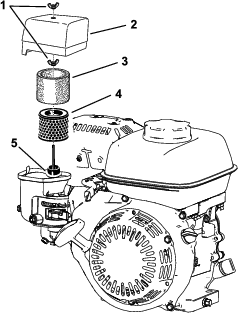
    2. Remove the wingnut securing the air-cleaner cover (Figure 12).

    3. Remove the air-cleaner cover.

      Note: Ensure that no dirt or debris from the air-cleaner cover fall into the base.

    4. Remove the foam and paper elements from the base.

    5. Remove the foam element from the paper element.

    6. Inspect the foam and paper elements; replace them if they are damaged or excessively dirty.
      g265999
    7. Clean the paper element by tapping it gently to remove the dirt.

      Note: Do not try to brush dirt off the paper element; brushing forces the dirt into the fibers. Replace the element if tapping it fails to remove the dirt.

    8. Clean the foam element in warm, soapy water or in a nonflammable solvent.

      Note: Do not use gasoline to clean the foam element because it could create a risk of fire or explosion.

    9. Rinse and dry the foam element thoroughly.

    10. Wipe dirt from the base and the cover with a moist rag.

      Note: Ensure that dirt and debris do not enter the air duct leading to the carburetor.

    11. Install the air-cleaner elements and ensure that they are properly positioned. Install the lower wing nut.

    12. Install the cover and install the upper wing nut to secure it.

    Servicing the Spark Plug

    Maintenance Service IntervalMaintenance Procedure
    Every 100 hours
  • Inspect and adjust the spark plug; replace it if necessary.
  • Every 300 hours
  • Replace the spark plug.
  • Use an NGK BPR6ES spark plug or equivalent.

    1. Shut off the engine and wait for all moving parts to stop; refer to Preparing the Machine for Maintenance.

    2. Clean around the spark plug.

    3. Remove the spark plug from the cylinder head.

      Important: Replace a cracked, fouled, or dirty spark plug. Do not sand blast, scrape, or clean the electrodes because engine damage could result from grit entering the cylinder.

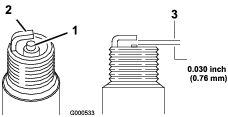
    4. Set the gap on the plug to 0.7 to 0.8 mm (0.028 to 0.031 inch)
      g000533
    5. Carefully install the spark plug by hand (to avoid cross threading) until it is hand tight.

    6. Tighten the spark plug an additional 1/2 turn if it is new; otherwise, tighten it an additional 1/8 to 1/4 turn.

      Important: A loose spark plug can become very hot and can damage the engine; overtightening a spark plug may damage the threads in the cylinder head.

    7. Connect the wire to the spark plug.