Safety

Also read the safety and operation instructions in the vehicle Operator’s Manual.

Chemical Safety

Warning

Chemical substances used in the spray system may be hazardous and toxic to you, bystanders, animals, plants, soils or other property.

  • Carefully read and follow the chemical warning labels and Material Safety Data Sheets (MSDS) for all chemicals used and protect yourself according to the chemical manufacturer's recommendations. For example, use appropriate Personal Protective Equipment (PPE) including face and eye protection, gloves, or other equipment to guard against personal contact with the chemical.

  • Keep in mind that there may be more than one chemical used and information on each should be assessed.

  • Refuse to operate or work on the sprayer if this information is not available!

  • Before working on a spray system make sure the system has been triple rinsed and neutralized according to the recommendations of the chemical manufacturer(s) and all of the valves have been cycled three times.

  • Verify there is an adequate supply of clean water and soap nearby, and immediately wash off any chemicals that contact you.

  • Obtain proper training before using or handling chemicals.

  • Use the correct chemical for the job.

  • Follow the chemical manufacturer's instructions for the safe application of the chemical.

  • Handle chemicals in a well ventilated area.

  • Wear goggles and other protective equipment as instructed by the chemical manufacturer. Ensure that as little skin as possible is exposed while using chemicals.

  • Have clean water available especially when filling the spray tank.

  • Do not eat, drink, or smoke while working with chemicals.

  • Always wash your hands and other exposed areas as soon as possible after finishing the work.

  • Properly dispose of unused chemicals and chemical containers as instructed by the chemical manufacturer and your local codes.

  • Chemicals and fumes in the tanks are dangerous; never enter the tank or place your head over or in the opening.

  • Follow all local/state/federal requirements for the spraying of chemicals.

Setup

Note: Determine the left and right sides of the machine from the normal operating position.

Preparing the Machine

  1. Move the sprayer onto a level surface, set the parking brake, stop the pump, stop the engine, and remove the ignition key.

  2. Drain the contents of the tank to remove any solution in lines. Refer to the Operator’s Manual for more information.

    Note: Take caution while disconnecting any hoses during the installation of this kit and have a catch bucket ready for any solutions remaining in the hose.

  3. Remove the panel from the seat base assembly to expose the rinse tank rest brackets.

Caution

Chemicals are hazardous and can cause personal injury.

  • Read the directions on the chemical labels before handling the chemicals and follow all manufacturer recommendations and precautions.

  • Keep chemicals away from your skin. Should contact occur, wash the affected area thoroughly with soap and clean water.

  • Wear goggles and any other protective equipment recommended by the chemical manufacturer.

Installing the Rinse Tank

Parts needed for this procedure:

Rinse tank bracket2
Large washer2
Flange nut2
Carriage bolt2

Installing the Hardware for the Rinse Tank Straps

  1. Remove and retain the fasteners securing the front tank straps at the top of the tank. Discard the short carriage bolt and nut holding the R-clamp in place.

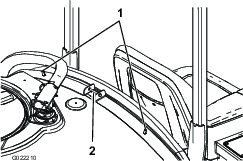
  2. Install 2 carriage bolts to the upper inboard holes on the front tank straps (Figure 1).

    g022210
  3. Install the tank strap fasteners removed previously to secure the straps to the tank.

    Note: Make sure that the strap is secure to the tank. Do not overtighten the hardware.

Install the Rinse Tank

  1. Remove the guard behind the seat of the machine where the rinse tank will be installed.

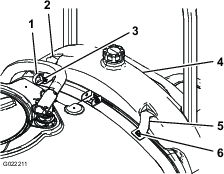
  2. Install the rinse tank as shown in Figure 2.

    Note: You may need to move the fresh water tank to install the rinse tank.

    g022211
  3. Using 2 large washers and flange nuts, install the rinse tank brackets and R-clamp to the previously installed carriage bolts (Figure 2).

Note: Once the rinse tank has been initially filled the rinse tank strap fasteners should be checked and tightened if necessary as the weight of the liquid can further seat the tank against the frame.

Installing the Rinse Nozzles

Parts needed for this procedure:

Rinse nozzle assembly2
Rinse nozzle hosebarb2
Plastic flange nut2

Drilling the Main Tank

  1. Open the tank lid and remove the strainer basket.

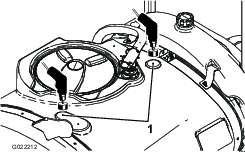
  2. Locate the two drill marks on the main tank (Figure 3).

    g022212
  3. Use a 4 cm (1-5/8 inch) hole saw to drill a hole at each drill mark.

    Note: Place a receptacle inside the tank and below the areas to be drilled to catch any debris created during the cutting.

    Important: Debris left inside a tank could clog and damage the spray system during operation.

Installing the Rinse Nozzles

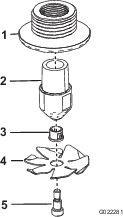
  1. Assemble the 2 rinse nozzles as shown in Figure 4.

    g022281
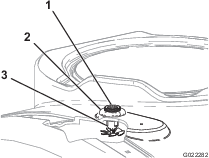
  2. Install the nozzle assemblies up through the drilled holes (Figure 5).

    g022282
  3. Install the plastic flange nut over the exposed threads of the bulkhead on top of the tank (Figure 5). Ensure that the seal is seated correctly between the bulkhead fitting and the underside of the tank.

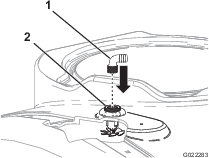
  4. Install the 2 rinse nozzle hosebarbs into the threaded openings of the rinse nozzle bulkheads (Figure 6).

    g022283
  5. Direct the hose barbs towards the middle of the right side of the machine.

Installing the Pump

Parts needed for this procedure:

Rinse pump mounting bracket1
Rinse pump1
Carriage bolt2
Flange nut2
Small washer4
Bolt4
Pump hosebarb2
  1. Remove the fasteners securing the rear tank straps at the top of the tank. Retain all parts.

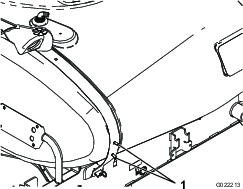
  2. Install 2 carriage bolts to the low inboard holes on the right side of the rear tank strap (Figure 7).

    g022213
  3. Install the tank strap fasteners removed previously to secure the straps to the tank.

    Make sure the strap is secure to the tank. Do not overtighten.

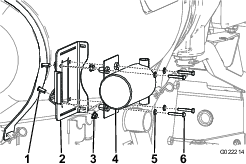
  4. Attach the rinse pump mounting bracket to the previously installed carriage bolts using 2 flange nuts (Figure 8).

    g022214
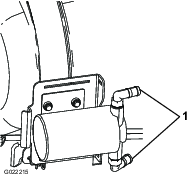
  5. Attach the pump hosebarbs as shown in Figure 9.

    g022215
  6. Secure the pump to the frame using the 4 bolts and 4 small washers (Figure 8).

  7. Connect the pump wire harness to the main wiring harness near the back of the machine.

Installing the Hoses and Filter

Parts needed for this procedure:

Rinse-filter hose assembly1
Tee fitting1
124.5 cm (49 inch) hose1
48 cm (19 inch) hose2
Hose clamp8
Rinse pump cover1
Hairpin2

Install the Rinse Nozzle Hoses and Tee Fitting

Note: Lightly lubricating the barbed end of a hose fitting with a non-petroleum based lubricant such as vegetable oil can ease the process of installation.

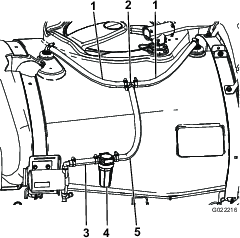
  1. Attach the 48 cm (19 inch) hoses to the previously installed rinse nozzle hosebarbs using 2 hose clamps (Figure 10).

    g022216
  2. Attach the loose ends of the hoses to the tee fitting with 2 hose clamps (Figure 10).

Install the Rinse Filter

  1. Attach the long end of the rinse-filter hose to the tee fitting with a hose clamp (Figure 10).

  2. Attach the other end of the rinse-filter hose to the upper hosebarb on the rinse pump with a hose clamp (Figure 10).

Install the Rinse Tank Hose

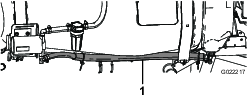
  1. Route the rinse tank hose between the front tank strap and the side of the tank (Figure 11).

    g022217
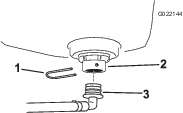
  2. Install the rinse tank hosebarb to the bulkhead fitting and secure it with a retaining fork (Figure 12). Rotate the fitting so that it faces rearward.

    g022144
  3. Attach the end of the hose to the lower hosebarb on the rinse pump with a hose clamp (Figure 11).

  4. Install the rinse pump cover over the pump and secure it with 2 hairpins.

Installing the Dash Switch

Parts needed for this procedure:

Dash switch1

Install the Dash Switch

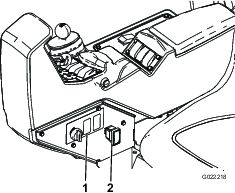
  1. Locate the plug for the rinse tank switch on the side of the sprayer console and remove the plug (Figure 13).

    g022218
  2. Remove and retain the bolts securing the panel to the console.

  3. Locate the box connector labeled rinse tank in the main harness, and route it toward the open hole on the side of the console arm.

  4. Install the switch to the box connector through the console (Figure 13).

    Note: Ensure that the switch is properly oriented; it should remain engaged when pressed up but not when pressed down.

  5. Push the switch into the dash to mount it.

  6. Secure the panel to the console using the previously removed bolts.

Operation

The use of the Tank Cleanse Rinse Kit will result in a rinsate; a diluted solution of residual chemicals. In many cases it is appropriate to apply the rinsate onto the treated areas. However, before doing so, check with the manufacturers of the chemical to ensure the application of a diluted solution to the treated areas will not adversely affect the performance of the product.

Important: The Tank Cleanse Rinse Kit is not intended to dislodge clumped masses of wetable powder or “water-soluble” chemicals that occur when chemicals are not properly introduced into the main tank.

Controls

The Tank Cleanse Rinse Kit is controlled by a 3-position switch.

  • Up: the rinse pump is On, the switch will lock in the up position, and the delay timer is activated.

  • Neutral: the rinse pump is Off and switch is in a middle position.

  • Down: the rinse pump is On, the switch must be held in the down position, and the delay timer in not activated.

Press the switch up to start a timed rinse. The pump runs for 60 seconds and pumps approximately 1/3 of the rinse tank contents into the main tank. During this time the switch will stay in the up position. After 60 seconds the pump will stop running. The switch will remain in the up position until you move it to the center or Neutral position.

When the switch is in the Neutral position, the power is not supplied to the pump and the rinse kit is off.

Press the switch down to cycle the momentary switch. Power is supplied to the pump for the duration in which the switch is held down. Release pressure and the switch will move to the neutral position and power will not be supplied to the pump. While the switch is held in the down position the pump will run.

Filling the Tank

Position the sprayer on a level surface, set the parking brake, stop the pump, stop the engine, and remove the ignition key.

Remove the rinse tank cap and fill the tank with approximately 66 L (17.5 US gallons) of clean water. Replace the cap

Important: The 66 L (17.5 US gallon) rinse tank is only intended to be filled with clean water. The introduction of any other substance to the rinse tank can cause a safety hazard and/or damage the machine.

Using the Rinse Cycle

Using the rinse cycle allows the vehicle to be moving during the rinse processes.

  1. Turn the rinse pump On:

    • Use the Up position for a timed rinse

    • Or press and hold the switch Down for the desired duration.

  2. Once the pump has placed 22 L (5.8 US gallons) of water in the tank, the user can use the agitation switch to put clean water into the agitation loop.

  3. Pump the rinsate out as required by Federal, State and Local regulations. Either:

    • Spray the rinsate through the booms until the main tank is empty.

    • Or drain the main tank contents into a suitable container and dispose of the diluted solution as required by federal, state or local regulations.

    Note: Repeat the rinse cycle again if necessary or for 2 timed rinse cycles.

Maintenance

Inspecting the Rinse Pump Filter

Maintenance Service IntervalMaintenance Procedure
After the first 5 hours
  • Inspect the rinse pump filter
  • Every 50 hours
  • Inspect the rinse pump filter
  • Check the filter for any signs of damage. Replace if any damage is found.

    Inspecting the Rinse System for Leaks and Damage

    Maintenance Service IntervalMaintenance Procedure
    After the first 5 hours
  • Inspect the hoses for damage.
  • Before each use or daily
  • Inspect the hoses for leaks.
  • Every 100 hours
  • Inspect the hoses and O-rings for damage.
  • After the first 5 hours of operation, inspect all hoses and connections for any leaks or signs of damage. Inspect the hose clamps and retaining forks. Verify that all connections are secure. Replace any damaged parts. Repeat this inspection before each use of the rinse system.

    After 100 operating hours, inspect all hoses and O–rings. Replace any damaged parts.

    Contact your Authorized Toro Dealer to obtain replacement parts.

    Inspecting the Rinse Tank Straps

    Maintenance Service IntervalMaintenance Procedure
    After the first hour
  • Check the rinse tank straps.
  • Once the main tank has been filled with water, check to see if there is any play in the tank straps. If the straps are loose, tighten the fasteners at the top of the straps until they are flush with tank. Do not over tighten.

    Important: Over tightening the tank strap fasteners can result in deforming and damaging of the straps.

    Storage

    Drain the pump inlet line, outlet line, and filter line prior to storage for 30 days or more.