
Safety

This product complies with all relevant European directives. For details, please see the Declaration of Incorporation (DOI) at the back of this publication.

Rollover Protection System (ROPS) for a Cab

  • The ROPS is an integral part of the cab, which is an effective safety device.

  • The ROPS consists of the roll bar, the seat, the seat belt, the seat latch, and cab.

  • Always wear the seat belt when you operate the machine with a cab.

  • Ensure that the seat belt can be released quickly in the event of an emergency.

  • Drive slowly and carefully.

  • Check carefully for overhead clearances (i.e., branches, doorways, electrical wires) before driving under any objects and do not contact them.

  • Keep the cab in safe operating condition by periodically thoroughly inspecting for damage and keeping all mounting fasteners tight.

  • Replace a damaged cab. Do not repair or revise.

  • Do not remove or modify the ROPS.

Safety and Instructional Decals

Graphic

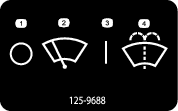
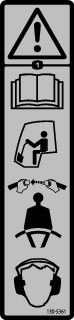
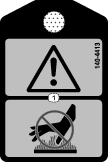
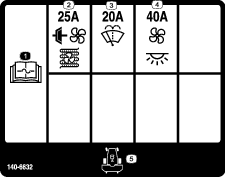
Safety decals and instructions are easily visible to the operator and are located near any area of potential danger. Replace any decal that is damaged or missing.

decal93-7272
decal125-9688
decal130-5361
decal140-4413
decal140-6632

Setup

Preparing the Machine and Cab

Parts needed for this procedure:

Bolt (3/4 x 4 inches)2
Nut (3/4 inch)2

Note: Save the shipping pallet for long term storage after the cab is removed. Save all hardware for the machine when installing or removing the cab.

  1. Park the machine on a level surface, engage the parking brake, lower the attachment, shut off the engine, and remove the key.

  2. Disconnect the negative (-) battery cable from the battery.

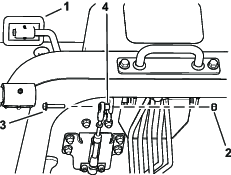
  3. Remove the nut, bolt, and spacer securing the cable to the traction pedal and rotate the pedal towards the seat (Figure 1).

    g301596
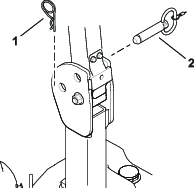
  4. Remove the ROPS pins and place them into down position hole (Figure 2).

    g302033
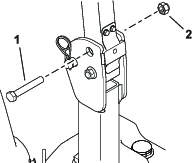
  5. Install the bolt (3/4 x 4 inches) into the top hole of the roll bar and secure it finger tight with a nut (3/4 inch). Refer to (Figure 3).

    Note: Ensure that the bolt is installed on the inside of the roll bar.

    g302032
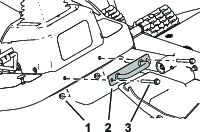
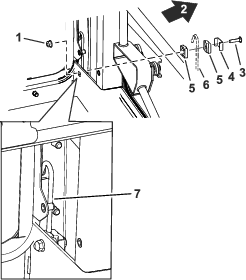
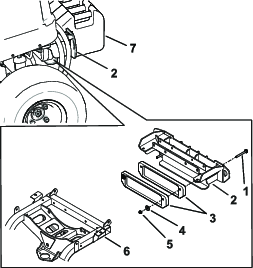
  6. Remove the front mower-deck latch from the front of the machine (Figure 4). Save the latch and hardware.

    g302034
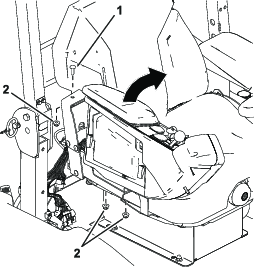
  7. Remove the nuts and bolts from the right armrest and fold it to the center (Figure 5).

    g301595
  8. Tilt the steering column to its lowest position; refer to the Operators Manual.

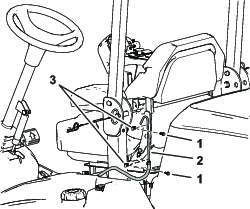
  9. Remove the R-clamps from the roll bar securing the vent tubes (Figure 6).

  10. Lay the vent tubes out of the way for mounting the cab.

  11. Install the R-clamps back into the roll bar without the vent tubes (Figure 6).

    g301597

Installing the Cab Firewall

Parts needed for this procedure:

Cab firewall1
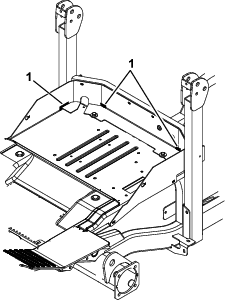
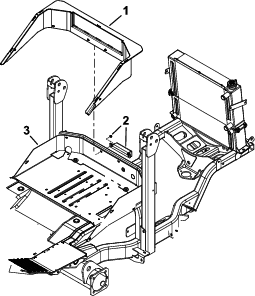
  1. Caulk the existing firewall openings on both sides at the locations shown in Figure 7 with black RTV sealant.

    g301598
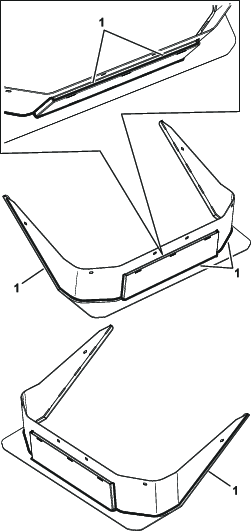
  2. Caulk the cab firewall at the locations shown in Figure 8 with black RTV sealant.

    g336508
  3. Remove the existing hardware that connects the existing firewall to the roll bar tube.

  4. Place the cab firewall around the seat and onto the existing firewall (Figure 9).

    g301513
  5. Use the existing hardware to install the cab firewall.

Installing the Cab

Parts needed for this procedure:

Cab1
Left ROPS stop1
Right ROPS stop1
ROPS mount2
ROPS brace2
Retainer cover2
Seal2
Screw (1/4 x 3/4)8
Bolt (3/8 x 1 inch)4
Locknut (3/8 inch)4
Foam seal1

Important: Loosely install the fasteners for the cab until all hardware is installed. After all the hardware is installed, tighten the fasteners.

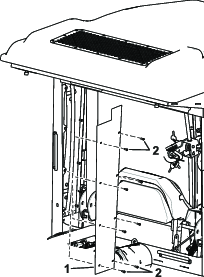
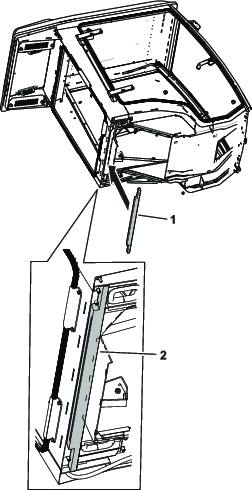
  1. Remove the left and right panels from inside the cab as shown in Figure 10.

    g301842
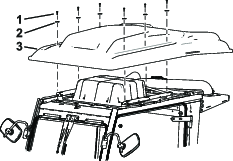
  2. Remove the cab roof as shown in Figure 11.

    g302035
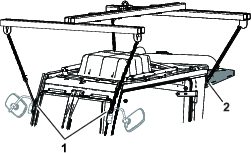
  3. Use a hoist to support the cab and connect the cab hoist to the 4 lift points on the cab (Figure 12).

    Note: A cab hoist is available through your authorized Toro distributor.

    g322358
  4. Raise the cab with a hoist (Figure 12).

  5. Install the foam seal on the bottom of the cab as shown in Figure 13.

    g301543
  6. Align the cab over the roll bar.

  7. While lowering the cab, position the vent tubes through the rear posts (Figure 16).

    Note: Ensure that the traction pedal is rotated rearward towards the seat.

  8. Lower the cab until it is approximately 51 mm (2 inches) above the firewall and machine.

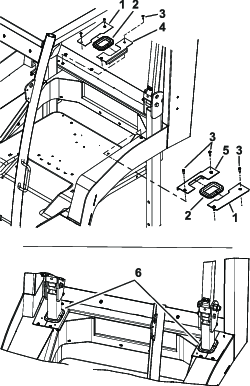
  9. Install the roll bar seals around each side of the roll bar (Figure 14).

  10. Install the left cover and 1 retainer cover into the left seal and secure the covers with 4 screws (1/4 x 3/4 inches); refer to Figure 14.

  11. Install the right cover and 1 retainer cover into the right seal and secure the covers with 4 screws (1/4 x 3/4 inches); refer to Figure 14.

    g301688
  12. Lower the cab onto the firewall and machine.

  13. Loosely install the mower deck latch to the front of the cab (Figure 4).

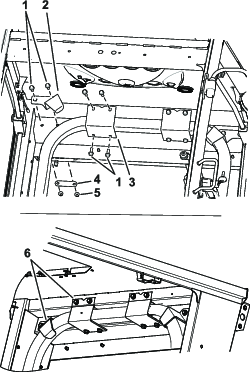
  14. Loosely install the ROPS mounts to secure the cab to the roll bar on the machine (Figure 15).

  15. Loosely install the left ROPS stop on the corner of the roll bar with 2 bolts (3/8 x 1 inch), a ROPS brace, and 2 nuts (3/8 inch).

  16. Loosely install the right ROPS stop on the corner of the roll bar with 2 bolts(3/8 x 1 inch), a ROPS brace, and 2 nuts (3/8 inch).

    g301843

    Note: Ensure that the ROPS bolts are tightened last (Figure 3).

  17. After all the parts and hardware is installed, tighten the hardware.

  18. Torque all nuts and bolts attaching the cab to the roll bar to 127 to 157 N∙m (94 to 116 ft-lb). Refer to Figure 15

  19. Torque the nuts and bolts for the mower deck latch in the front of the cab to 127 to 157 N∙m (94 to 116 ft-lb). Refer to Figure 4.

  20. Torque the roll bar bolt and nut to 329 to 403 N∙m (243 to 297 ft-lb). Refer to Figure 3.

  21. Install the cab roof (Figure 11).

  22. Install the nut, bolt, and spacer to secure the cable to the traction pedal (Figure 1).

Installing the Vent Tubes

Parts needed for this procedure:

Bolt (5/16 x 1-1/2 inch)2
Nut (5/16 inch)2
Plate clamp2
Tube clamp2
  1. Install the vent tubes to each side of the cab. Refer to Figure 16.

  2. Secure each vent tube with a bolt (5/16 x 1-1/2 inch), a plate clamp, a tube clamp, and a nut (5/16 inch) (Figure 16).

    g330010
  3. Install the side panels previously removed (Figure 11).

Installing the Step

Parts needed for this procedure:

Step mount1
Carriage bolt (3/8 x 7/8 inch)2
Nut (3/8 inch)2
Carriage bolt (5/16 x 3/4 inch)2
Carriage bolt (5/16 x 1-1/4 inch)1
Nut (5/16 inch)3
Deck step1
Floor mat1
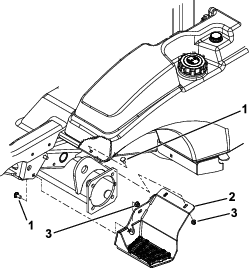
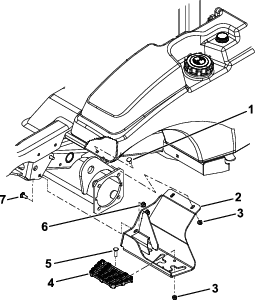
  1. Remove the existing step on the side of the machine (Figure 17).

    Note: The existing step does not need to be installed when the cab is removed. Use the step that comes with the cab.

    g302817
  2. Install the deck step to the step mount with a carriage bolt (5/16 x 1-1/4 inch) and a nut (5/16 inch). Refer to Figure 18.

  3. Install the step to the side of the machine with 2 carriage bolts (3/8 x 7/8 inches), 2 nuts (3/8 inch), a carriage bolt (3/8 x 7/8 inch),and nut (3/8 inch). Refer to Figure 18.

    g301516
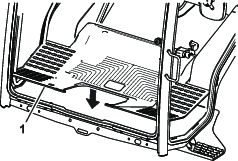
  4. Install the floor mat into the cab (Figure 19).

    g302840

Installing the Hoses for the 24 hp Engine

Parts needed for this procedure:

Hose1
Female coupler1
Female dust plug1
Straight fitting (3/8 NPT x 5/8 barb)2
Hose clamp4
Male coupler1
Male dust plug1
R-clamp2
Carriage bolt (1/4 x 3/4 inch)2
Flange nut (1/4 inch)2
Engine fitting2
Cable ties8
Straight adaptor (3/8 inch)1
Adaptor (M16)1
  1. Apply sealant to the straight fittings (3/8 NPT x 5/8 barb), skipping the first thread.

  2. Slip hose clamps over the hoses.

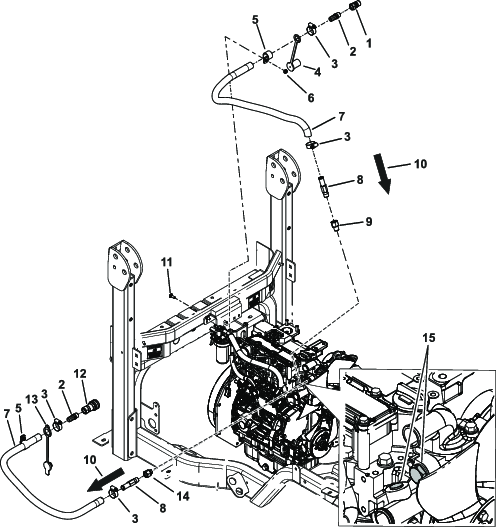
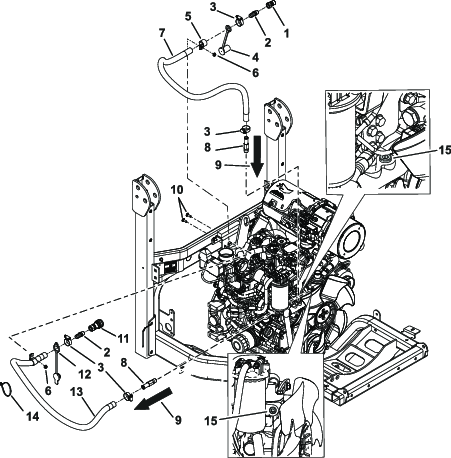
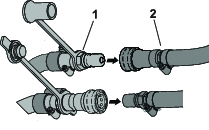
  3. Slip the dust plug and dust cap over the barbed end of the assemblies (Figure 20).

  4. Thread the straight fittings (3/8 NPT x 5/8 barb) into the male and female couplers (Figure 20).

  5. Tighten the straight fittings (3/8 NPT x 5/8 barb) in the male and female couplers 2 to 3 turns from finger-tight.

  6. Insert the barbed end of the assemblies into the hoses and secure them with the hose clamps (Figure 20).

  7. Install the straight adapter (3/8 inch) onto the engine fitting for the hose with the male coupler (Figure 20).

  8. Install the straight adapter (M16) onto the engine fitting for the hose with the female coupler (Figure 20).

    g301831
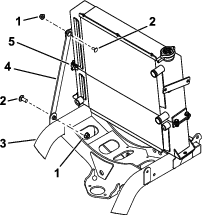
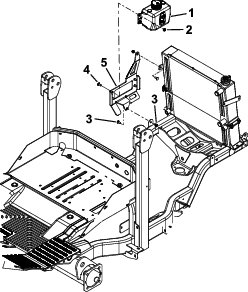
  9. Remove the existing bracket from the machine frame and radiator (Figure 21). Save the hardware.

    g315428
  10. Drain half of the engine coolant from the radiator by using the valve on the right side of the radiator as shown in Figure 21.

  11. Locate and remove the engine plugs shown in Figure 20.

  12. Apply pipe sealant to the threads on the engine fittings.

  13. Manually secure the engine fittings into the ports until they are finger-tight.

  14. Secure the engine fittings 2 to 3 additional turns from finger-tight.

  15. Slip the hose clamps over the hoses.

  16. Insert the hoses over the barb ends of the engine fittings and secure them with the hose clamps (Figure 20).

  17. Install the R-clamps around the hoses (Figure 20).

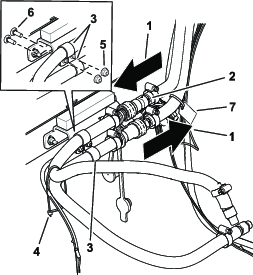
  18. Secure the hoses to the back of the cab with 2 carriage bolts and 2 nuts (Figure 20 and Figure 22).

    g301828
  19. Secure the hoses away from moving parts and hot surfaces with cable ties.

  20. Fill the radiator with engine coolant.

  21. Start the engine and purge the air out of the cooling system.

  22. Shut off the engine and check the engine-coolant level.

  23. If needed, add more engine coolant.

    Note: When the engine is cold, the coolant level should be no higher than the FULL (COLD) mark (bottom mark).

    Note: Refer the traction unit Operator’s Manual for the correct fluid.

Installing the Hoses for the 37 hp Engine

Parts needed for this procedure:

Hose1
Female coupler1
Female dust plug1
Straight fitting (3/8 NPT x 5/8 barb)2
Hose clamp4
Male coupler1
Male dust plug1
R-clamp2
Carriage bolt (1/4 x 3/4 inch)2
Flange nut (1/4 inch)2
Engine fitting2
Cable ties8
Straight adaptor (3/8 inch)1
Adaptor (M16)1
  1. Apply sealant to the straight fittings (3/8 NPT x 5/8 barb), skipping the first thread.

  2. Slip hose clamps over the hoses.

  3. Slip the dust plug and dust cap over the barbed end of the assemblies (Figure 24).

  4. Thread the straight fittings (3/8 NPT x 5/8 barb) into the male and female couplers (Figure 24).

  5. Tighten the straight fittings (3/8 NPT x 5/8 barb) in the male and female couplers 2 to 3 turns from finger-tight.

  6. Insert the barbed end of the assemblies into the hoses and secure them with the hose clamps (Figure 24).

  7. Remove the existing bracket from the machine frame and radiator (Figure 23). Save the hardware.

    g315428
  8. Drain half of the engine coolant from the radiator by using the valve on the right side of the radiator as shown in Figure 23.

  9. Locate and remove the engine plugs shown in Figure 24.

    g301830
  10. Apply pipe sealant to the threads on the engine fittings.

  11. Manually secure the engine fittings into the ports until they are finger-tight.

  12. Secure the engine fittings 2 to 3 additional turns from finger-tight.

  13. Slip the hose clamps over the hoses.

  14. Insert the hoses over the barb ends of the engine fittings and secure them with the hose clamps (Figure 24).

  15. Install the R-clamps around the hoses (Figure 24).

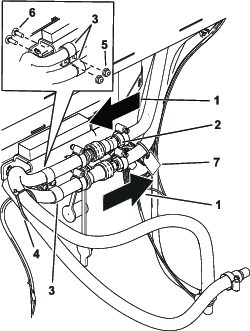
  16. Secure the hoses to the back of the cab with 2 carriage bolts and 2 nuts (Figure 24 and Figure 25).

    g301829
  17. Secure the hoses away from moving parts and hot surfaces with cable ties (Figure 25).

  18. Fill the radiator with engine coolant.

  19. Start the engine and purge the air out of the cooling system.

  20. Shut off the engine and check the engine-coolant level.

  21. If needed, add more engine coolant.

    Note: When the engine is cold, the coolant level should be no higher than the FULL (COLD) mark (bottom mark).

    Note: Refer the traction unit Operator’s Manual for the correct fluid.

Installing the Washer-Fluid Tank

Parts needed for this procedure:

Washer-fluid bracket1
Washer-fluid tank1
Carriage bolt (5/16 x 3/4 inch)4
Locknut (5/16 inch)4
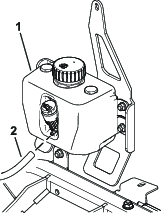
  1. Install the tank to the bracket with 4 carriage bolts (5/16 x 3/4 inch) and 4 nuts (5/16 inch); refer to Figure 26.

    g301514
  2. Install the tank and bracket to the frame and radiator with the previously removed hardware (Figure 21 or Figure 23).

Installing the Washer Fluid Hoses

Parts needed for this procedure:

Female-hose fitting1
Male-hose fitting1

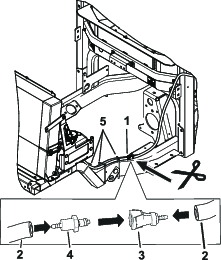
Note: The hoses are extra long and need to be cut to install the connections.

  1. Route the hoses along the frame and back to the washer-fluid tank (Figure 28).

  2. Install the hose to the washer-fluid tank as shown in Figure 27.

    g301599
  3. Install the hose to the tank.

  4. Cut the hose at the location shown in Figure 28.

  5. Install the fitings as shown in Figure 28.

    g301541
  6. Secure the hose with plastic ties (Figure 28).

Connecting the Wire Harness

Parts needed for this procedure:

Fuse (10 A)1
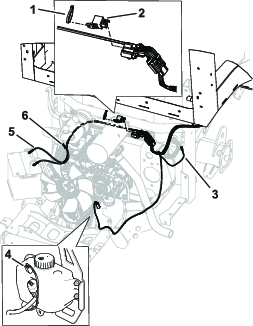
  1. Route the wire harness along the machine frame (Figure 29).

    g302187
  2. Remove the nut that secures the positive-battery clamp to the positive-battery terminal.

  3. Attach the positive-battery terminal from the wire harness to the bolt used to secure the battery clamp.

  4. Secure the clamp with the nut you removed previously.

  5. Repeat the previous steps for the negative battery terminal on the wire harness.

  6. Install the connector to the fluid tank (Figure 29).

  7. Plug the connector shown in Figure 29 to the main harness of the machine.

  8. Install a fuse (10 A) to the traction-unit fuse block; refer to the electrical-system maintenance section of your traction unit Operator’s Manual for the appropriate location.

Installing the Weights

Parts needed for this procedure:

Weight (6 kg or 15 lb)2
Bolt (3/8 x 3-1/2 inches)2
Washer (3/8 inch)2
Locknut (3/8 inch)2
  1. Install 2 weights (6 kg or 15 lb) between the frame and the rear bumper with 2 bolts (3/8 x 3-1/2 inches), 2 washers (3/8 inch), and 2 locknuts (3/8 inch). Refer to Figure 30.

  2. If you also install an attachment (e.g., a snow blade, snow broom, or cutting unit), refer to the traction unit Operator's Manual for the appropriate amount of rear weight.

g315463

Completing the Installation

  1. Check for leaks.

  2. Check for parts that interfere with moving parts and make corrections before operating the machine.

  3. Connect the negative (-) battery cable to the battery.

  4. Check the operation of all controls before operating the machine.

  5. Have an assistant help to adjust the rearview and side mirrors before operating the machine.

Product Overview

Cab Controls

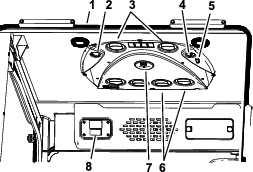
g302074

Windshield-Wiper Switch

Use this switch to turn the windshield wipers on or off (Figure 31).

Temperature Control

Rotate the temperature control knob to regulate the air temperature in the cab (Figure 31).

Fan Control

Rotate the fan control knob to regulate the speed of the fan (Figure 31).

Maintenance

Recommended Maintenance Schedule(s)

Maintenance Service IntervalMaintenance Procedure
After the first 250 hours
  • Clean the cab air filters(replace them if they are torn or excessively dirty).
  • Cleaning

    Caution

    If you leave the key in the switch, someone could accidently start the engine and seriously injure you or other bystanders.

    Remove the key from the switch before you do any maintenance.

    Cleaning the Cab

    Important: Use care around the cab seals (Figure 32). If you are using a pressure washer, keep the washer wand at least 0.6 m (2 ft) away from the machine. Do not use the pressure washer directly on the cab seals, glass seals, and under the rear overhang.
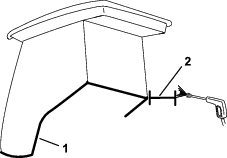
    g302075

    Cleaning the Air Filters

    Maintenance Service IntervalMaintenance Procedure
    After the first 250 hours
  • Clean the cab air filters(replace them if they are torn or excessively dirty).
    1. Remove the thumb screws and the grates from the rear cab air filters (Figure 33).
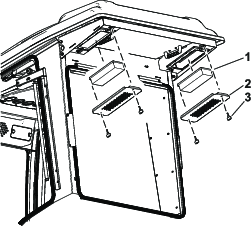
      g302176
    2. Clean the filters by blowing clean, oil free, compressed air through them.

      Important: Replace any damaged filters.

    3. Install the filters and grate, securing them with the thumb screws.
    Storage

    Remove the cab from the machine for storage.

    Preparing to Remove the Cab from the Machine

    1. Move the machine underneath the cab hoist, shut off the engine, set the parking brake, and remove the key.

    2. Allow the engine to cool.

    3. Remove the bolt and nut securing traction pedal (Figure 1).

    4. Remove the front mower-deck latch from the front of the machine (Figure 4).

    5. Remove the bolts from the right armrest and rotate it to the center (Figure 5).

    6. Remove the left and right panels inside the cab (Figure 10).

    7. Remove the vent tube from each side of the cab behind the panels (Figure 16).

    8. Tilt the steering column to its lowest position; refer to the machine Operators’ Manual.

    9. Disconnect the black (-) cable from the battery.

    Disconnecting the Wire Harness

    1. Disconnect the wire harness secured to the machine from the wire harness secured to the cab at the relay location (Figure 29).

    2. Disconnect the connect attached to the main machine harness (Figure 29).

    3. Cover the connectors for the machine and cab with tape to keep them clean.

    Disconnecting the Hoses

    1. Disconnect the washer hose (Figure 20).

    2. Disconnect the heater hoses (Figure 34).

      Note: Be prepared to collect or wipe the fluid that can drain from the hoses when you disconnect them.

      g302188
    3. Seal the heater hoses using the dust caps (Figure 34).

    Removing the Cab

    1. Remove the cab roof (Figure 11).

    2. Remove the ROPS stops and ROPS mounts (Figure 15).

      Note: Do not remove the firewall.

    3. Remove the covers and roll bar seals from the base of ROPS inside the cab (Figure 14).

      Note: Return all the hardware that you removed to the original mounting location in the order it is used to secure the cab to the machine. This can prevent losing the mounting hardware and simplify installation.

    4. Install the left and right panels inside the cab (Figure 10).

    5. Connect the cab hoist to the 4 lift points on the cab (Figure 12).

    6. Raise the cab to a height that will allow you to safely move the machine away from the cab.

    7. Move the machine away from the cab.

    8. Lower the cab onto the shipping pallet to allow you to move it to a storage location.

      Note: Secure the wire harness and hoses to prevent damaging them when you lower or store the cab. Cover the cab to prevent dust and debris from accumulating on it while it is in storage.

    9. Move the ROPS pins and bolts back to their original positions (Figure 2 and Figure 3).

    10. Torque each bolt to 91 to 113 N∙m (67 to 83 ft-lb).

    11. Install the bolt and nut securing the traction pedal (Figure 1).

    12. Install the front mower-deck latch from the front of the machine (Figure 4).

    13. Rotate the armrest into position and Install the bolts (Figure 5).

    14. Install the vent tube on each side to the roll bar (Figure 6).