Introduction

This attachment is intended to be used on a Toro compact tool carrier. It is designed primarily to prepare seed and sod beds by pulverizing rough soil, dethatching, and removing rocks and debris. Using this product for purposes other than its intended use could prove dangerous to you and bystanders.

Read this information carefully to learn how to operate and maintain your product properly and to avoid injury and product damage. You are responsible for operating the product properly and safely.

Visit www.Toro.com for product safety and operation training materials, accessory information, help finding a dealer, or to register your product

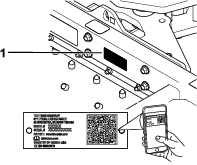
Whenever you need service, genuine Toro parts, or additional information, contact an Authorized Service Dealer or Toro Customer Service and have the model and serial numbers of your product ready. Figure 1 identifies the location of the model and serial numbers on the product. Write the numbers in the space provided.

Important: With your mobile device, you can scan the QR code on the serial number decal (if equipped) to access warranty, parts, and other product information.

g385114

This manual identifies potential hazards and has safety messages identified by the safety-alert symbol (Figure 2), which signals a hazard that may cause serious injury or death if you do not follow the recommended precautions.

g000502

This manual uses 2 words to highlight information. Important calls attention to special mechanical information and Note emphasizes general information worthy of special attention.

Warning

CALIFORNIA

Proposition 65 Warning

Use of this product may cause exposure to chemicals known to the State of California to cause cancer, birth defects, or other reproductive harm.
Safety

General Safety

Always follow all safety instructions to avoid serious injury or death.

  • Do not exceed the rated operating capacity, as the machine may become unstable, which may result in loss of control.

  • Do not transport an attachment with the arms raised or extended (if applicable). Always transport the attachment close to the ground; refer to Transport Position.

  • Have the property or work area marked for buried lines and other objects, and do not dig in marked areas.

  • Read and understand the content of this Operator’s Manual before starting the machine.

  • Use your full attention while operating the machine. Do not engage in any activity that causes distractions; otherwise, injury or property damage may occur.

  • Never allow children or untrained people to operate the machine.

  • Keep your hands and feet away from the moving components and attachments.

  • Do not operate the machine without the guards and other safety protective devices in place and working on the machine.

  • Keep bystanders and pets away from the machine.

  • Stop the machine, shut off the machine, and remove the key before servicing, fueling, or unclogging the machine.

Improperly using or maintaining this machine can result in injury. To reduce the potential for injury, comply with these safety instructions and always pay attention to the safety-alert symbol Graphic, which means Caution, Warning, or Danger—personal safety instruction. Failure to comply with these instructions may result in personal injury or death.
Slope Safety

  • Operate the machine up and down slopes with the heavy end of the machine uphill. Weight distribution changes with attachments. This attachment makes the front of machine the heavy end.

  • Raising or extending (if applicable) the loader arms on a slope affects the stability of the machine. Keep the loader arms in the lowered and retracted position when on slopes..

  • Slopes are a major factor related to loss of control and tip-over accidents, which can result in severe injury or death. Operating the machine on any slope or uneven terrain requires extra caution.

  • Establish your own procedures and rules for operating on slopes. These procedures must include surveying the site to determine which slopes are safe for machine operation. Always use common sense and good judgment when performing this survey.

  • Slow down and use extra care on hillsides. Ground conditions can affect the stability of the machine.

  • Avoid starting or stopping on a slope. If the machine loses traction, proceed slowly, straight down the slope.

  • Avoid turning on slopes. If you must turn, turn slowly and keep the heavy end of the machine uphill.

  • Keep all movements on slopes slow and gradual. Do not make sudden changes in speed or direction.

  • If you feel uneasy operating the machine on a slope, do not do it.

  • Watch for holes, ruts, or bumps, as uneven terrain could overturn the machine. Tall grass can hide obstacles.

  • Use caution when operating on wet surfaces. Reduced traction could cause sliding.

  • Evaluate the area to ensure that the ground is stable enough to support the machine.

  • Use caution when operating the machine near the following:

    • Drop-offs

    • Ditches

    • Embankments

    • Bodies of water

    The machine could suddenly roll over if a track goes over the edge or the edge caves in. Maintain a safe distance between the machine and any hazard.

  • Do not remove or add attachments on a slope.

  • Do not park the machine on a hillside or slope.

Power Rake Safety

  • Keep away from the rotating teeth while operating the power rake.

  • Never directly discharge toward people, animals, or property.

  • Never use the attachment to carry loads.

  • After striking a foreign object, shut off the engine, remove the key, thoroughly inspect the attachment for any damage, and repair the damage before starting and operating the attachment.

  • Always lower the attachment and shut off the machine each time you leave the operating position.

Maintenance and Storage Safety

  • Check fasteners at frequent intervals for proper tightness to ensure that the equipment is in safe operating condition.

  • Refer to the Operator’s Manual for important details if you store the attachment for an extended period of time

  • Maintain or replace safety and instruction labels, as necessary.

Safety and Instructional Decals

Graphic

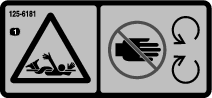
Safety decals and instructions are easily visible to the operator and are located near any area of potential danger. Replace any decal that is damaged or missing.

decal93-9084
decal125-6181
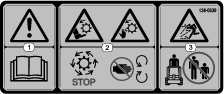
decal138-6699
decal138-0539

Product Overview

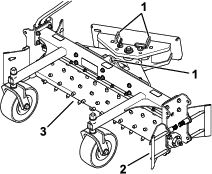
g384867
Raking width120 cm (48 inches)
Overall width148 cm (58.5 inches)
Height47 cm (18.5 inches)
Depth148 cm (58.5 inches)
Weight221 kg (487 lb)
Roller angle30°
Offset distance7.6 cm (3.0 inches)

To ensure optimum performance and continued safety certification of the machine, use only genuine Toro replacement parts and accessories. Replacement parts and accessories made by other manufacturers could be dangerous, and such use could void the product warranty.

Operation

Determine the left and right sides of the machine from the normal operating position.

Installing and Removing the Attachment

Refer to the Operator’s Manual for the traction unit for the installation and removal procedure.

Important: Before installing the attachment, position the machine on a level surface, ensure that the mount plates are free of any dirt or debris, and ensure that the pins rotate freely. If the pins do not rotate freely, grease them.

Note: Always use the traction unit to lift and move the attachment.

Warning

If you do not fully seat the quick-attach pins through the attachment mount plate, the attachment could fall off the machine, crushing you or bystanders.

Ensure that the quick-attach pins are fully seated in the attachment mount plate.

Warning

Hydraulic fluid escaping under pressure can penetrate skin and cause injury. Fluid injected into the skin must be surgically removed within a few hours by a doctor familiar with this form of injury; otherwise, gangrene may result.

  • Ensure that all hydraulic-fluid hoses and lines are in good condition and all hydraulic connections and fittings are tight before applying pressure to the hydraulic system.

  • Keep your body and hands away from pinhole leaks or nozzles that eject high-pressure hydraulic fluid.

  • Use cardboard or paper to find hydraulic leaks; never use your hands.

Caution

Hydraulic couplers, hydraulic lines/valves, and hydraulic fluid may be hot. If you contact hot components, you may be burned.

  • Wear gloves when disconnecting the hydraulic couplers.

  • Allow the machine to cool before touching hydraulic components.

  • Do not touch hydraulic fluid spills.

Starting the Power Rake

  1. Start the traction unit.

  2. Lower the power rake to the ground.

    Important: Do not lower the power rake to the ground with the roller turning; otherwise, high speed jolts can damage the motor.

  3. Engage the auxiliary hydraulics in the opposite direction of machine travel.

    Roller RotationTravel Direction
    GraphicGraphic
    GraphicGraphic
  4. Increase the engine speed to full throttle. If operating the machine in heavy rock, reduce the engine speed slightly.

  5. Operate the machine at a ground speed between 4.8 and 8.0 kph (3 and 5 mph) in normal conditions; if operating in heavy rock, reduce the ground speed to 1.6 to 4.8 kph (1 to 3 mph).

    Important: Before changing the roller direction, stop the machine, disengage the auxiliary hydraulics, and wait for the roller to stop.

  6. After raking, stop the traction unit and decrease the engine speed to half throttle.

  7. Raise the rake and disengage the auxiliary hydraulics.

  8. Lower the rake to the ground.

Using the End Plates

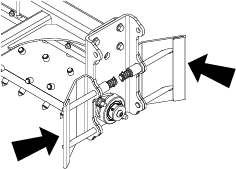
The end plates contain the material in front of the roller, while the clean material passes between the roller and the barrier. With the end plates mounted in the working (down) position and the rake straight (parallel with the traction unit track), the material can be moved, filling in low areas.

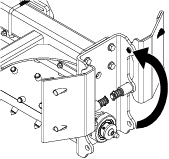
To dig deeper, rotate the endplates up.

g384698
g384697

Adjusting the Angle

  1. Park the machine on a level surface, disengage the auxiliary hydraulics, engage the parking brake, and lower the loader arms.

  2. Raise the attachment so it is just off the ground.

  3. Shut off the engine and remove the key.

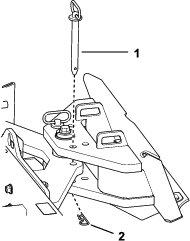
  4. Remove the angle pins and hairpin cotter.

    g384761
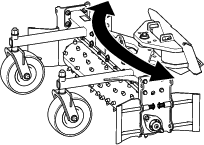
  5. Manually rotate the rake to the desired position.

    g384762
  6. Install the angle pins and hairpin cotters to secure the rake.

Transport Position

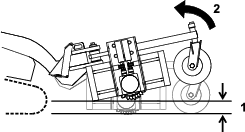
When transporting the attachment, keep it as close to the ground as possible, no more than 15 cm (6 inches) above the lowest position. Tilt it rearward.

g384763

Application Techniques

Breaking Compacted Soil

Roll back the attachment plate until the caster wheels are lifted and only the toothed roller is in contact with the ground. The rake can be straight or angled, but rotate the endplates up.

Removing Loose Debris

Tilt the attachment plate until the caster wheels control the depth of the toothed roller. You can angle the rake at this time for windrowing debris or you can set the rake straight with both end plates installed to collect debris. Increase the traction unit speed when you do this.

Finishing Grading

Tilt the rake forward until the teeth of the roller are barely touching the soil. Increase the traction unit speed to collect the material from the high spots and leave it in the lower areas.

Spreading Fill and Topsoil

Position the rake so it is tilted on the caster wheels. Install the endplates and set the windrow angle as needed to control material movement.

Changing Grade

To modify grade during finish grading, angle the rake to collect and windrow the maximum amount of material toward the targeted area.

Thatching Grassy Area

Tilt the attachment plate forward to support the rake on the caster wheels. Raise the roller so that the teeth just graze the surface. The travel speed should be slow and careful.

Operating Tips

  • Always begin power raking at the slowest ground speed possible. Increase the ground speed if conditions permit.

  • Always use the maximum engine speed.

  • If the roller stalls, slow down the travel speed or decrease the roller depth by raising the roller.

  • Do not rake under wet conditions; soil stuck to the roller and teeth decreases performance.

  • You may need to make multiple passes when working in sod or compacted soil.

  • Mow and remove tall grass and weeds before raking minimizes grass and weeds wrapping around the roller.

  • If a rock or other obstruction gets into the teeth, disengage the auxiliary hydraulics and drive the traction unit forward until the obstruction is dislodged.

  • The roller should be level with the ground. The power rake should also be level with the ground from front to back. To accomplish this, raise or lower the caster wheels and tilt the attachment plate as needed.

  • You can achieve further depth control by tilting the rake forward on its caster wheels to raise the roller, or tilt the rake back to raise the caster wheels, and allow the roller to penetrate more deeply.

Maintenance

Determine the left and right sides of the machine from the normal operating position.

Checking the Hydraulic Lines

Maintenance Service IntervalMaintenance Procedure
Before each use or daily
  • Check the hydraulic lines for leaks, loose fittings, kinked lines, loose mounting supports, wear, weather, and chemical deterioration.(Make necessary repairs before operating.)
  • Warning

    Hydraulic fluid escaping under pressure can penetrate skin and cause injury. Fluid injected into the skin must be surgically removed within a few hours by a doctor familiar with this form of injury; otherwise, gangrene may result.

    • Keep your body and hands away from pinhole leaks or nozzles that eject high-pressure hydraulic fluid.

    • Use cardboard or paper to find hydraulic leaks; never use your hands.

    Storage

    1. Before long-term storage, wash the attachment with mild detergent and water to remove dirt and grime.

    2. Paint all scratched or bare metal surfaces.

      Note: Paint is available from your Authorized Service Dealer.

    3. Store the attachment in a clean, dry garage or storage area. Cover it to protect it and keep it clean.

    Troubleshooting

    ProblemPossible CauseCorrective Action
    The roller does not turn.
    1. The hydraulic valve on the traction unit is not engaged.
    2. The relief-valve setting on the traction unit is not properly adjusted.
    3. The hydraulic motor is worn or damaged.
    4. There is not enough hydraulic fluid in the system.
    5. The hose ends are not completely engaged.
    6. There is air in the hydraulic lines.
    7. There is an obstruction in the hydraulic lines.
    8. There is an obstruction between the roller and the barrier.
    1. Refer to the traction unit Operator’s Manual.
    2. Contact your Authorized Service Dealer.
    3. Repair or replace the hydraulic motor.
    4. Service the traction unit hydraulic reservoir.
    5. Check the hose couplings and engage properly.
    6. Cycle the loader auxiliary system several time to remove air from the lines.
    7. Replace the obstructed or damaged line.
    8. Reverse the roller to clear the obstruction.
    There are oil leaks.
    1. A seal is worn or damaged.
    2. Hoses are loose or damaged.
    3. Hose connections are loose or damaged.
    1. Replace the seal.
    2. Replace the damaged hoses and secure loose hoses.
    3. Replace the damaged hose connections and tighten the loose fittings.