Introduction

This rotary-blade lawn cutting deck is mounted to a ride-on machine and is intended to be used by professional, hired operators in commercial applications. It is primarily designed for cutting grass on well-maintained lawns in parks, sports fields, and on commercial grounds. Using this product for purposes other than its intended use could prove dangerous to you and bystanders.

Read this information carefully to learn how to operate and maintain your product properly and to avoid injury and product damage. You are responsible for operating the product properly and safely.

Visit www.Toro.com for product safety and operation training materials, accessory information, help finding a dealer, or to register your product.

Whenever you need service, genuine Toro parts, or additional information, contact an Authorized Service Dealer or Toro Customer Service and have the model and serial numbers of your product ready. The model and serial numbers are stamped on a plate on the rear of the cutting unit, under the cover. Write the numbers in the space provided.

This manual identifies potential hazards and has safety messages identified by the safety-alert symbol (Figure 1), which signals a hazard that may cause serious injury or death if you do not follow the recommended precautions.

g000502

This manual uses 2 words to highlight information. Important calls attention to special mechanical information and Note emphasizes general information worthy of special attention.

This product complies with all relevant European directives. For details, please see the Declaration of Incorporation (DOI) at the back of this publication.

Warning

CALIFORNIA

Proposition 65 Warning

Use of this product may cause exposure to chemicals known to the State of California to cause cancer, birth defects, or other reproductive harm.

Safety

This cutting unit meets applicable standards when installed on the traction unit.

General Safety

This product is capable of amputating hands and feet and of throwing objects. Always follow all safety instructions to avoid serious personal injury

  • Read and understand the contents of this Operator’s Manual before starting the machine.

  • Use your full attention while operating the machine. Do not engage in any activity that causes distractions; otherwise, injury or property damage may occur.

  • Do not put your hands or feet near moving components of the machine.

  • Do not operate the machine without all guards and other safety protective devices in place and functioning properly on the machine.

  • Keep clear of any discharge opening.

  • Keep bystanders and children out of the operating area. Never allow children to operate the machine.

  • Before you leave the operator’s position, do the following:

    • Park the machine on a level surface.

    • Lower the cutting unit(s).

    • Disengage the drives.

    • Engage the parking brake (if equipped).

    • Shut off the engine and remove the key.

    • Wait for all movement to stop.

Improperly using or maintaining this machine can result in injury. To reduce the potential for injury, comply with these safety instructions and always pay attention to the safety-alert symbol Graphic, which means Caution, Warning, or Danger—personal safety instruction. Failure to comply with these instructions may result in personal injury or death.
Safety and Instructional Decals

Graphic

Safety decals and instructions are easily visible to the operator and are located near any area of potential danger. Replace any decal that is damaged or missing.

decal93-7818
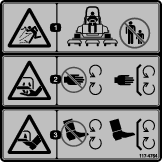
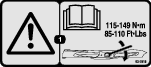
decal117-4764
decal104-1086

Setup

Warning

If you leave the key in the switch, someone could accidentally start the engine and seriously injure you or other bystanders.

Remove the key from the switch before you install the cutting unit

Note: Determine the left and right sides of the machine from the normal operating position.

Preparing the Machine

  1. Park the machine on a level surface.

  2. Engage the parking brake.

  3. Shut off the engine and remove the key.

Mounting the Cutting Unit to the Traction Unit

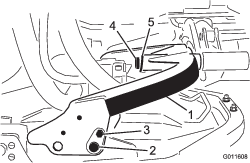
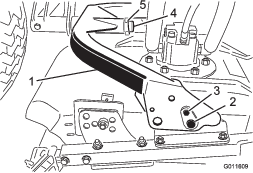
  1. Pivot the carrier frame and secure it to the deck bracket with the flag pin, bolt and nut. Position it as shown in Figure 2.

    Note: For rear cutting units, pivot the carrier frame forward (Figure 2). For front cutting units, pivot the carrier frame rearward.

    g011608
    g011609
  2. Move the cutting deck into position in front of the traction unit.

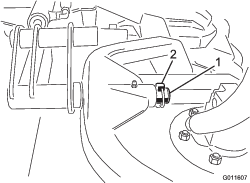
  3. Slide the deck carrier frame onto lift-arm pivot pin and secure it with the lynch pin (Figure 4).

    g011607
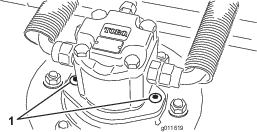
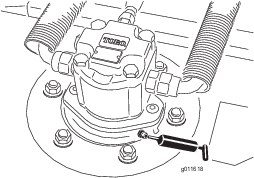
  4. Install the hydraulic motor to the deck (Figure 5). Make sure that the O-ring is in position and not damaged.

    g011619
  5. Grease the spindle.

Adjusting the Height-of-Cut

Important: The cutting units often cut approximately 6 mm (1/4 inch) lower than a reel cutting unit with the same bench setting. It may be necessary to set the cutting-unit bench measurement at 6 mm (1/4 inch) above that of reel cutting units cutting in the same area.

Important: Access to the rear cutting units is greatly improved by removing the cutting unit from the machine.

  1. Park the machine on a level surface, engage the parking brake, lower the cutting unit to the ground, shut off the engine, and remove the key.

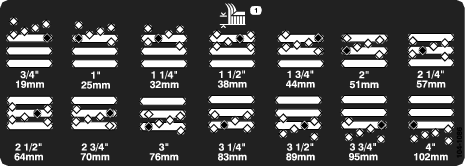
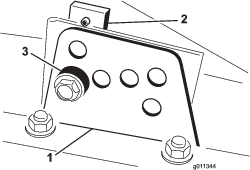
  2. Loosen the bolt securing each height-of-cut bracket to the height-of-cut plate (front and each side) as shown inFigure 6.

  3. Beginning with front adjustment, remove the bolt.

    g011344
  4. While supporting the chamber, remove the spacer (Figure 6).

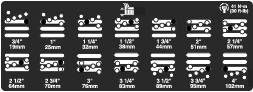
  5. Move the chamber to the desired height of cut and install a spacer into the designated height-of-cut hole and slot (Figure 7).

    g201855
  6. Position the tapped plate in-line with the spacer..

  7. Install the bolt finger tight.

  8. Repeat steps 4 through 7 for each side adjustment.

  9. Torque all 3 bolts to 41 N∙m (30 ft-lb). Always tighten the front bolt first.

    Note: Adjustments of more than 3.8 cm (1-1/2 inches) may require temporary assembly to an intermediate height to prevent binding (e.g., changing from 3.1 to 7 cm (1-1/4 to 2-3/4 inches) height of cut).

Adjusting the Roller Scraper

Optional

The optional rear roller scraper functions best when there is an even gap of 0.5 to 1 mm (0.02 to 0.04 inch) between the scraper and the roller.

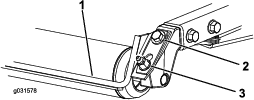
  1. Loosen the grease fitting and the mounting screw (Figure 8).

    g031578
  2. Slide the scraper up or down until you obtain a gap of 0.5 to 1 mm (0.02 to 0.04 inch) between the rod and the roller.

  3. Tighten the grease fitting and screw to 41 N∙m (30 ft-lb) in an alternating sequence.

Installing the Mulching Baffle

Optional

Contact your authorized Toro distributor for the correct mulching baffle.

  1. Thoroughly clean debris from the mounting holes on the rear wall and left wall of the chamber.

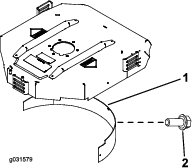
  2. Install the mulching baffle in the rear opening and secure it with 5 flange-head bolts (Figure 9).

    g031579
  3. Verify that the mulching baffle does not interfere with the tip of the blade and does not protrude inside the surface of the rear chamber wall.

    Danger

    Using the high-lift blade with the mulching baffle could cause the blade to break, resulting in personal injury or death.
    Do not use the high-lift blade with the baffle.

Product Overview

Note: Specifications and design are subject to change without notice.

Length80.8 cm (31.8 inches)
Width72.1 cm (28.4 inches)
Height21.6 cm (8.5 inches) to carrier mount 26.7 cm (10.5 inches) at 3/4 inch height of cut with drive motor 34.8 cm (13.7 inches) at 4 inch height of cut with drive motor
Net weight63.5 kg (140 lbs)

Attachments/Accessories

A selection of Toro approved attachments and accessories is available for use with the machine to enhance and expand its capabilities. Contact your Authorized Service Dealer or authorized Toro distributor or go to www.Toro.com for a list of all approved attachments and accessories.

To ensure optimum performance and continued safety certification of the machine, use only genuine Toro replacement parts and accessories. Replacement parts and accessories made by other manufacturers could be dangerous, and such use could void the product warranty.

Operation

Note: Determine the left and right sides of the machine from the normal operating position.

Caution

If you leave the key in the ignition switch, someone could accidently start the engine and seriously injure you or other bystanders.

Remove the key from the ignition before you do any maintenance.

Selecting a Blade

Standard Combination Sail

This blade was designed to provide excellent lift and dispersion in almost any condition. If more or less lift and discharge velocity is required, consider a different blade.

Attributes: Excellent lift and dispersion in most conditions

Angled Sail (Not CE Compliant)

The blade generally performs best in lower heights of cut—1.9 to 6.4 cm (3/4 to 2-1/2 inches).

Attributes:

  • Discharge remains more even at lower heights of cut.

  • Discharge has less tendency to throw left and thus a cleaner look around bunkers and fairways.

  • Lower power requirement at lower heights and dense turf.

High-Lift Parallel Sail (Not CE Compliant)

The blade generally performs better in the higher heights of cut—7 to 10 cm (2 to 4 inches).

Attributes:

  • More lift and higher discharge velocity

  • Sparse or limp turf is picked up significantly at higher heights of cut

  • Wet or sticky clippings are discharged more efficiently reducing congestion in the deck

  • Requires more horsepower to run

  • Tends to discharge further left and can tend to windrow at lower heights of cut

Warning

Using a high-lift blade with the mulching baffle could cause the blade to break, resulting in personal injury or death.

Do not use the high-lift blade with the mulching baffle.

Atomic Blade

This blade was designed to provide excellent leaf mulching.

Attribute: Excellent leaf mulching

Operating Tips

Mow when the Grass is Dry

Mow either in the late morning to avoid the dew, which causes grass clumping, or in late afternoon to avoid the damage that can be caused by direct sunlight on the sensitive, freshly mowed grass.

Selecting the Proper Height-of-Cut Setting to Suit Conditions

Remove no more than approximately 25 mm (1 inch), or 1/3 of the grass blade when cutting. In exceptionally lush and dense grass, you may need to raise your height-of-cut setting.

Mowing with Sharp Blades

A sharp blade cuts cleanly and without tearing or shredding the grass blades. A dull blade, which tears and shreds grass, causes grass to turn brown at the edges. This impairs grass growth and increases susceptibility to diseases. Ensure that the blade is in good condition and that there is a full sail.

Checking the Cutting Unit Condition

Ensure that the chambers of each cutting unit are in good condition. Straighten any chamber-component bends to ensure the correct blade tip/chamber clearance.

Checking the Mower Housing After Operating

To ensure that optimum performance is met, clean the underside of mower housing. If you allow residue to build up in mower housing, cutting performance will decrease.

Choosing Accessories

Optional Equipment Configurations

 Angle Sail BladeHigh-Lift, Parallel-Sail Blade(Do not use with the mulching baffle) (Not CE Compliant)Mulching BaffleRoller Scraper
Grass Cutting: 1.9 to 4.4 cm (3/4 to 1-3/4 inches) height of cutRecommended in most applicationsMay work well in light or sparse turfHas been shown to improve dispersion and after-cut performance on northern grasses that are cut at least 3 times per week and less than 1/3 of the grass blade is removed. Do not use with the high-lift, parallel-sail bladeUse it whenever the rollers build up with grass or large, flat grass clumps of grass are seen. The scrapers may increase clumping in certain applications.
Grass Cutting: 5 to 6.4 cm (2 to 2-1/2 inches) height of cutRecommended for thick or lush turfRecommended for light or sparse turf
Grass Cutting: 7 to 10 cm (2-3/4 to 4 inches) height of cutMay work well in lush turfRecommended in most applications
Leaf MulchingRecommended for use with the mulching baffleNot AllowedUse with combination sail or angle sail blade only
ProsEven discharge at lower height of cut; cleaner look around bunkers and fairways; lower power requirementsMore lift and higher discharge velocity; sparse or limp turf is picked up at high height of cut; wet or sticky clippings are discharged efficientlyMay improve dispersion and appearance in certain grass cutting applications; very good for leaf mulchingReduces roller buildup in certain applications
ConsDoes not lift the grass well in high height-of-cut applications; wet or sticky grass has a tendency to build up in the chamber, leading to poor quality of cut and higher power requirementsRequires more power to run in some applications; tends to windrow at lower height of cut in lush grass; do not use with the mulching baffleGrass will build up in the chamber if you attempt to remove too much grass with the baffle in place 

Maintenance

Note: Determine the left and right sides of the machine from the normal operating position.

Recommended Maintenance Schedule(s)

Maintenance Service IntervalMaintenance Procedure
Before each use or daily
  • Check the blade stopping time.
  • Every 50 hours
  • Grease the bearings
  • Caution

    If you leave the key in the ignition switch, someone could accidently start the engine and seriously injure you or other bystanders.

    Remove the key from the ignition and disconnect the wire from the spark plug before you do any maintenance. Set the wire aside so that it does not accidentally contact the spark plug.

    Greasing the Bearings

    Maintenance Service IntervalMaintenance Procedure
    Every 50 hours
  • Grease the bearings
  • If you operate the machine under normal conditions, use No. 2 lithium grease to lubricate all bearings and bushings at the specified maintenance interval. Lubricate bearings and bushings immediately after every washing, regardless of the interval listed.

    The grease fitting locations and quantities are as follows:

    • Cutting unit spindle-shaft bearings (2 per cutting unit)—Figure 10

      Note: You can use either fitting, whichever is more accessible. Pump grease into the fitting until a small amount appears at bottom of the spindle housing (under the cutting unit).
      g011618
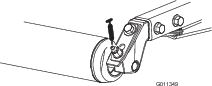
    • Rear-roller bearings (2 per cutting unit)—Figure 11
      g011349

      Note: Ensure that the grease groove in each roller mount aligns with the grease hole in each end of the roller shaft. To help align the groove and hole, there is also an alignment mark on 1 end of the roller shaft.

    Separating the Cutting Unit from the Traction Unit

    1. Position the machine on a level surface, lower the cutting units to the floor, turn the key in the switch to the OFF position, and engage the parking brake.

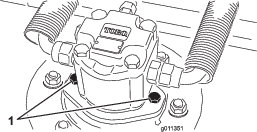
    2. Disconnect and remove the hydraulic motor from the cutting unit (Figure 12). Cover the top of the spindle to prevent contamination.
      g011351
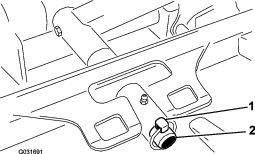
    3. Remove the lynch pin securing the deck-carrier frame to the lift-arm pivot pin (Figure 13).
      g031691
    4. Roll the cutting unit away from the traction unit.

    Mounting the Cutting Unit to the Traction Unit

    Servicing the Cutting Blades

    Blade Safety

    • Inspect the blade periodically for wear or damage.

    • Use care when checking the blades. Wrap the blades or wear gloves, and use caution when servicing the blades. Only replace or sharpen the blades; never straighten or weld them.

    • On multi-bladed machines, take care as rotating 1 blade can cause other blades to rotate.

    Servicing the Blade Plane

    The rotary deck comes from the factory preset at 5 cm (2 inches) height of cut and blade rake of 7.9 mm (0.310 inch). The left and right heights are also preset to within ± 0.7 mm (0.030 inch) of the other.

    The cutting deck is designed to withstand blade impacts without deformation of the chamber. If a solid object is struck, inspect the blade for damage and the blade plane for accuracy.

    Inspecting the Blade Plane

    1. Remove the hydraulic motor from the cutting deck and remove the cutting deck from the tractor.

    2. Use a hoist (or minimum of 2 people) and place the cutting deck on a flat table.

    3. Mark 1 end of the blade with a paint pen or marker. Use this end of the blade to check all heights.

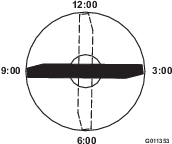
    4. Position the cutting edge of the marked end of the blade at 12 o’clock (straight ahead in the direction of mowing) (Figure 14) and measure height from table to cutting edge of blade.
      g011353
    5. Rotate the marked end of the blade to the 3 and 9 o’clock positions (Figure 14) and measure the heights.

    6. Compare the 12 o’clock measured height to the height-of-cut setting. It should be within 0.7 mm (0.030 inch). The 3 and 9 o’clock heights should be 1.6 to 6.0 mm (0.06 to 0.24 inch) higher than the 12 o’clock setting and within 1.6 to 6.0 mm (0.06 to 0.24 inch) of each other.

    Note: If any of these measurements are not within specification, proceed to Adjusting the Blade Plane.

    Adjusting the Blade Plane

    Start with the front adjustment (change 1 bracket at a time).

    1. Remove the height-of-cut bracket (front, left, or right) from the deck frame (Figure 15).

    2. Adjust 1.5 mm (0.060 inch) shims and/or 0.7 mm (0.030 inch) shim between the deck frame and bracket to achieve the desired height setting (Figure 15).
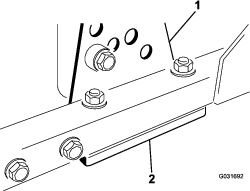
      g031692
    3. Install the height-of-cut bracket to the deck frame with the remaining shims assembled below the height-of-cut bracket.

    4. Secure the socket-head bolt/spacer and flange nut.

      Note: Socket-head bolt/spacer are held together with thread-locking adhesive to prevent the spacer from falling inside the deck frame.

    5. Verify the 12 o’clock height and adjust if needed.

    6. Determine if only 1 or both (right and left) height-of-cut brackets need to be adjusted. If the 3 or 9 o’clock side is 1.6 to 6.0 mm (0.06 to 0.24 inch) higher than the new front height then no adjustment is needed for that side. Adjust the other side to within 1.6 to 6.0 mm (0.06 to 0.24 inch) of the correct side.

    7. Adjust the right and/or left height-of-cut brackets by repeating steps 1 through 3.

    8. Secure the carriage bolts and flange nuts.

    9. Again, verify the 12, 3, and 9 o’clock heights.

    Removing and Installing the Cutting-Unit Blade(s)

    Replace the blade if it hits a solid object, is out of balance, or is bent. Always use genuine Toro replacement blades to ensure safety and optimum performance.

    1. Park the machine on a level surface, raise the cutting unit to the transport position, engage the parking brake, shut off the engine, and remove the key.

      Note: Block or lock the cutting unit to prevent it from accidentally falling.

    2. Grasp the end of the blade using a rag or thickly-padded glove.

    3. Remove the blade bolt, anti-scalp cup, and blade from the spindle shaft (Figure 16).
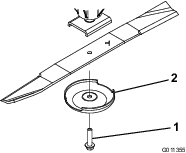
      g011355
    4. Install the blade, anti-scalp cup, and blade bolt and tighten the blade bolt to 115 to 149 N∙m (85 to 110 ft-lb).

      Important: The curved part of the blade must be pointing toward the inside of the cutting unit to ensure proper cutting.

      Note: 7After striking a foreign object, torque all spindle-pulley nuts to 115 to 149 N∙m (85 to 110 ft-lb).

    Inspecting and Sharpening the Blade

    1. Raise the cutting deck to the transport position, turn the key in the ignition switch to the OFF position, and engage the parking brake.

    2. Block the cutting deck to prevent it from falling accidentally.

    3. Examine the cutting ends of the blade carefully, especially where the flat and curved parts of the blade meet (Figure 17).

      Note: Since sand and abrasive material can wear away the metal that connects the flat and curved parts of the blade, check the blade before using the machine.

    4. If wear is noticed (Figure 17), replace the blade; refer to Servicing the Blade Plane.

      Danger

      If the blade is allowed to wear, a slot will form between the sail and flat part of the blade (Figure 17). Eventually a piece of the blade may break off and be thrown from under the housing, possibly resulting in serious injury to yourself or bystanders.

      • Inspect the blade periodically for wear or damage.

      • Always replace a worn or damaged blade.
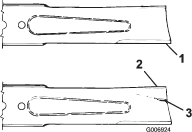
      g006924
    5. Inspect the cutting edges of all blades. Sharpen the cutting edges if they are dull or nicked. Sharpen only the top of the cutting edge and maintain the original cutting angle to make sure that it is sharp (Figure 18).

    6. If dull or nicked, sharpen only the top cutting edge while maintaining the original cutting angle (Figure 18).

      Note: The blade will remain balanced if the same amount of metal is removed from both cutting edges.
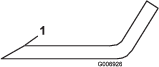
      g006926
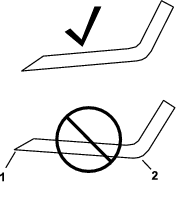
    7. To check the blade for being straight and parallel, lay the blade on a level surface and check its ends.

      Note: Position the ends of the blade slightly lower than the center, and the cutting edge lower than the heel of the blade. This blade produces a good quality of cut and requires minimal power from the engine. By contrast a blade that is higher at the ends than the center, or if cutting edge is higher than the heel, the blade is bent or warped and must be replaced.
      g276373
    8. Install the blade, sail facing toward cutting deck, with the anti-scalp cup and blade bolt. Torque the blade bolt to 115 to 149 N∙m (85 to 110 ft-lb).

    Checking the Blade Stopping Time

    Maintenance Service IntervalMaintenance Procedure
    Before each use or daily
  • Check the blade stopping time.
  • The blades of the cutting deck should come to a complete stop in approximately 5 seconds after you shut down the cutting-deck-engagement switch.

    Note: Make sure that the decks are lowered onto a clean section of turf or hard surface to avoid thrown dust and debris.

    1. Have a second person stand back from the deck at least 6 m (20 feet) and watch the blades on 1 of the cutting decks.

    2. Shut the cutting decks down and record the time it takes for the blades to come to a complete stop.

      Note: If this time is greater than 7 seconds, the braking valve needs adjustment. Call your authorized Toro distributor for assistance in making this adjustment.

    Servicing the Front Roller

    Inspect the front roller for wear, excess wobble, or binding. Service or replace the roller or components if any of these conditions exist.

    Disassembling the Front Roller

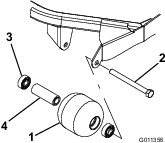
    1. Remove the roller-mounting bolt (Figure 20).

    2. Insert a punch through the end of the roller housing and drive the opposite bearing out by alternating taps to the opposite side of inner bearing race. There should be a 1.5 mm (0.060 inch) lip of inner race exposed.
      g011356
    3. Push the second bearing out in press.

    4. Inspect the roller housing, bearings, and bearing spacer for damage (Figure 20). Replace any damaged components and assemble them.

    Assembling the Front Roller

    1. Press the first bearing into the roller housing (Figure 20). Press on the outer race only or equally on the inner and outer race.

    2. Insert the spacer (Figure 20).

    3. Press the second bearing into the roller housing (Figure 20). Pressing equally on the inner and outer race until the inner race contacts the spacer.

    4. Install the roller assembly into the cutting-unit frame.

    5. Verify that there is no more than a 1.5 mm (0.060 inch) gap between roller assembly and the roller mount brackets of the cutting-unit frame. If there is a gap over 1.5 mm (0.060 inch), install enough 5/8-inch diameter washers to take up the slop.

      Important: Securing the roller assembly with a gap larger than 1.5 mm (0.060 inch) creates a side load on the bearing and can lead to premature bearing failure

    6. Torque the mounting bolt to 108 N∙m (80 ft-lb).

    Storage

    If the cutting deck is separated from the traction unit for any length of time, install a spindle plug in the top of the spindle to protect the spindle from dust and water.