


Introduction

Read this information carefully to learn how to operate and maintain your product properly and to avoid injury and product damage. You are responsible for operating the product properly and safely.

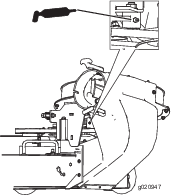
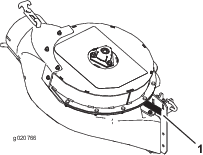
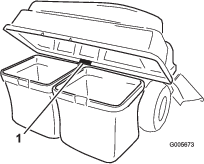
Whenever you need service, genuine parts, or additional information, contact an Authorized Service Dealer or Customer Service and have the model and serial numbers of your product ready. Figure 1 and Figure 2 identifies the location of the model and serial numbers on the product. Write the numbers in the space provided.

g020766
g005673

This manual uses 2 words to highlight information. Important calls attention to special mechanical information and Note emphasizes general information worthy of special attention.

The safety-alert symbol(Figure 3) appears both in this manual and on the machine to identify important safety messages that you must follow to avoid accidents. This symbol will appear with the word Danger, Warning, or Caution.

  • Danger indicates an imminently hazardous situation which, if not avoided, will result in death or serious injury.

  • Warning indicates a potentially hazardous situation which, if not avoided, could result in death or serious injury.

  • Caution indicates a potentially hazardous situation which, if not avoided, may result in minor or moderate injury.

g000502

Warning

CALIFORNIA

Proposition 65 Warning

The engine exhaust from this product contains chemicals known to the State of California to cause cancer, birth defects, or other reproductive harm.

Safety

  • Become familiar with the safe operation of the equipment, with the operator controls, and safety signs.

  • Use extra care with grass catchers or other attachments. These can change the operating characteristics and the stability of the machine.

  • Follow the manufacturer's recommendations for adding or removing wheel weights or counterweights to improve stability.

  • Do not use a grass catcher on steep slopes. A heavy grass catcher could cause loss of control or overturn the machine.

  • Slow down and use extra care on hillsides. Be sure to travel in the recommended direction on hillsides. Turf conditions can affect the stability of the machine. Use extreme caution while operating near drop-offs.

  • Keep all movement on slopes slow and gradual. Do not make sudden changes in speed, direction, or turning.

  • The grass catcher can obstruct the view to the rear. Use extra care when operating in reverse.

  • Use care when loading or unloading the machine into a trailer or truck.

  • Never operate with the discharge deflector raised, removed or altered, unless using a grass catcher.

  • Keep hands and feet away from moving parts. Do not make adjustments with the engine running.

  • Park the machine on level ground, disengage the drives, and shut off the engine before leaving the operator's position for any reason including emptying the grass catcher or unclogging the chute.

  • If you remove the grass catcher, be sure to install any discharge deflector or guard that might have been removed to install the grass catcher. Do not operate the mower without either the entire grass catcher or the grass deflector in place.

  • Do not leave grass in the grass catcher for extended periods of time.

  • Grass catcher components are subject to wear, damage and deterioration, which could expose you to moving parts or allow objects to be thrown. Frequently check components and replace with the manufacturer's recommended parts, when necessary.

Safety and Instructional Decals

Graphic

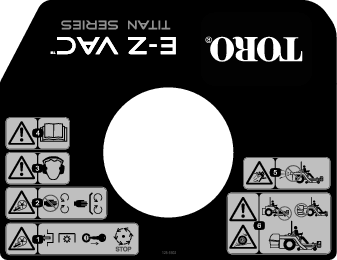
Safety decals and instructions are easily visible to the operator and are located near any area of potential danger. Replace any decal that is damaged or missing.

decal126-4659
decal109-6809
decal114-1606
decal125-5502

Setup

Preparing the Mower

Perform the following procedure to prepare the mower for attaching the blower and bagger kit.

  1. Park the machine on a level surface.

  2. Disengage the blade-control switch.

  3. Move the motion-control levers outward to the NEUTRAL-LOCK position to engage the parking brake.

  4. Shut off the engine and remove the key.

Installing the Bagger Frame

Parts needed for this procedure:

Bagger frame support bracket1
Plate1
Self tapping bolts (5/16 x 3/4 inch)2
Bolt (5/16 x 2-1/2 inch)2
Locknut (5/16 inch)2
Bagger frame1
Clevis pin (1/2 x 2-1/4 inch)1
Hair pin cotter pin5
Rod2
Washer4
Clevis pin (1/2 x 1-1/2 inch)2
Spacer plate1
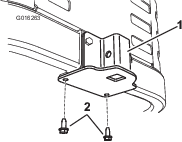
  1. Remove the existing self tapping bolts in the bottom of the machine frame (Figure 5). Discard the bolts.

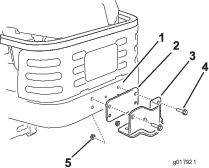
  2. Install the support spacer plate and the support bracket to the machine frame as shown in Figure 4. Secure the plate and bracket to the frame using two bolts (5/16 x 2-1/2 inch) and two locknuts (5/16 inch).

    g017921
  3. Secure the support bracket to the bottom of the machine frame from below using 2 new self-tapping screws (5/16 x 3/4 inch) as shown in Figure 5.

    g016263
  4. Remove the fasteners securing the existing rectangular spacer plate from the top of the engine frame and remove the plate, if so equipped.

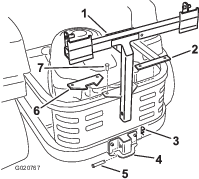
  5. Install the new spacer plate as shown in Figure 6 using the fasteners removed previously.

  6. Install the bagger frame to the support bracket. Secure the bagger frame with a clevis pin (1/2 x 2-1/4 inch) and hairpin cotter pin (Figure 6).

    g020767
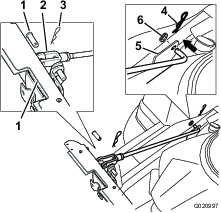
  7. Install two support rods, one to each side of the bagger frame. Locate the existing bracket between the rear drive wheel and frame (Figure 7).

    g020997
  8. Insert the bent ends of the rod into the bagger frame as shown in Figure 7. Secure the end of the rod with a washer and hairpin cotter pin.

  9. Adjust the support rods so that bagger frame is held secure to the machine frame and sits in the notch of the angle spacer plate installed previously. Repeat these steps for each support rod:

    1. Loosen the jam nut at the base of the clevis end of the rod.

    2. Rotate the clevis end of the rod to adjust the rod to the desired length.

    3. Align the holes in the clevis end with the hole in the bagger frame at the attachment point.

    4. Secure the clevis end of the rods to the bagger frame using a clevis pin and hairpin cotter pin (Figure 7).

    5. Tighten the jam nut.

  10. With both rods installed and attached, check the bagger frame for play. The bagger frame should be held tight to the machine frame. If necessary, repeat the previous step to secure the bagger frame.

Installing the Hood Baffle

Parts needed for this procedure:

Bagger hood 1
Baffle 1
Hairpin cotter pin (small) 2
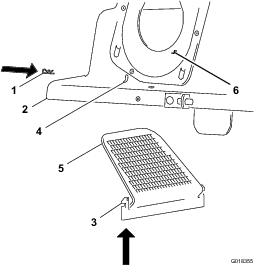
  1. Locate the baffle slots in the front and back side walls of the bagger hood, and the mounting tabs on the hood baffle (Figure 8).

    g018355
  2. Position the hood so that the duct seal is on your left, as illustrated in Figure 8.

  3. Align the baffle so that the screened area is up and angled left (Figure 8).

  4. Insert the baffle up into the hood from the bottom (Figure 8).

  5. Align the baffle-mounting tabs with the baffle slots in the hood, and push the mounting tabs up and through the slots (Figure 8).

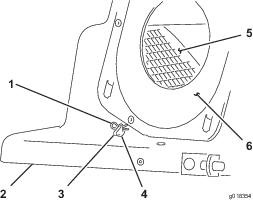
  6. Secure the baffle to the hood by inserting the hairpins into the holes in the baffle-mounting tabs as shown in Figure 9.

    g018354

Installing the Hood and the Hood Rod

Parts needed for this procedure:

Circular cotter pin1
Hood rod1
Hairpin cotter pin1

Note: The bagger hood is easier to install when two people work together.

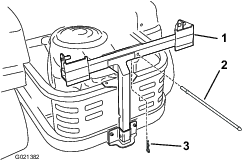
  1. Install the hood rod to the bagger frame with a hairpin cotter pin. Install the hairpin cotter pin from the bottom (Figure 10).

    g021382
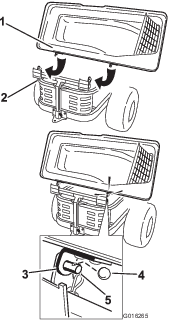
  2. Install the bagger hood to the bagger frame.

  3. Slide the brackets over the posts in the bagger frame and install the circular cotter pin into the hole in the right hand post (Figure 11).

  4. Rotate the bagger hood down to the operating position.

    Note: To remove the circular cotter pin, continue to rotate it in the same direction as installed.

    g016265
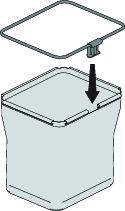
  5. Install the 2 bag frames to the 2 bag assemblies.

    g453040
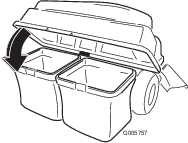
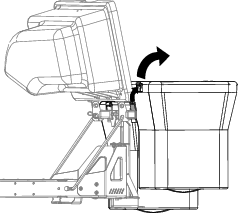
  6. Lower the bagger top onto the bags. (Figure 13).

    g005757
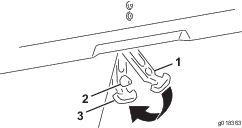
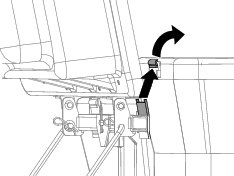
  7. Align the hole in the rubber hood latch with the hood rod (Figure 14).

  8. Attach the rubber hood latch to the hood rod end as shown in Figure 14.

    g018363

Installing the Blower Assembly

Parts needed for this procedure:

Blower assembly (from the Blower and Drive Kit) 1
Spring (from the Blower and Drive Kit) 1
Metal belt cover (from the Blower and Drive Kit) 1

Warning

An uncovered discharge opening could allow the lawn mower to throw objects in the operator's or bystander's direction and result in serious injury. Also, contact with the blade could occur.

  • Never operate the lawn mower unless you install a cover plate, a mulch plate, or a grass chute and catcher.

  • Make sure that the grass deflector is installed when you remove the grass chute and catcher.

Important: Install the side-discharge chute when you remove the bagger and blower.

Important: Save all the hardware and the side-discharge chute.

  1. If necessary, install the belt onto the blower pulley (Figure 18).

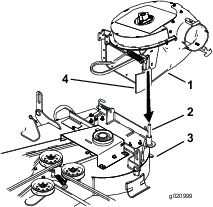
  2. Lower the blower and slide the pivot hole onto the pivot pin (Figure 15).

    Note: Ensure that the belt remains positioned in the blower pulley and the rubber flap on the blower remains on the outside of the mower deck (Figure 15).

    g020999
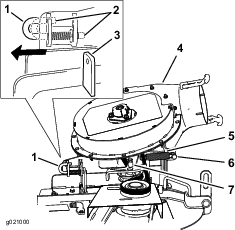
  3. Move the latch pin from the locking position to the open position (Figure 16).

  4. Close the blower assembly and align the latch pin with the hole in the blower support.

  5. Move the latch pin to the locking position (Figure 16).

    Note: Ensure that the latch pin extends through the hole in blower support (Figure 16).

    Note: Ensure that the latch firmly holds the blower assembly against the mower deck, but can be released by hand.

    g021000

Installing the Blower Belt and Plastic Belt Cover

Parts needed for this procedure:

Plastic belt cover (from the Blower and Drive Kit) 1
Knobs (from the Blower and Drive Kit) 2
Blower belt (from the Blower and Drive Kit) 1
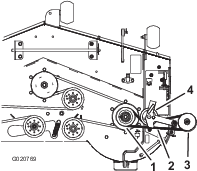
  1. If needed, install the belt around the blower pulley (Figure 17 and Figure 18). Refer to Installing the Blower Assembly.

    g020769
    g020950
  2. Ensure that the belt remains aligned to the blower pulley while you are installing the blower assembly.

  3. Route the belt around the drive pulley as illustrated in Figure 17 and Figure 18.

  4. Temporarily route the belt beneath the idler pulley (Figure 18).

  5. Install the spring on to the idler pulley post (Figure 16).

  6. Install the spring on to the shoulder bolt (Figure 16).

  7. Pull the spring loaded idler pulley away from the fixed spring post, and route the belt around the mower deck pulley (Figure 18).

    Note: Ensure the belt is routed around the blower pulley correctly.

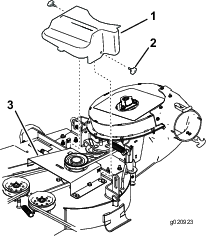
  8. Align the plastic belt cover over the drive pulley and belt.

  9. Secure the plastic belt cover to the blower support and the metal belt cover with 2 knobs (Figure 19).

    g020923

Installing the Discharge Tubes

Parts needed for this procedure:

Upper tube 1
Screw (1/4 x 3/4 inches) 2
Washer (1/4 inch)2
Locknut (1/4 inch) 2
Lower tube 1

Important: Make sure that the mower deck is in the lowest height-of-cut position before installing the discharge tubes.

Note: Remember to install the grass deflector when you remove the bagger from the mower.

  1. Disengage the PTO and set the parking brake.

  2. Stop the engine, remove the key, and wait for all moving parts to stop before leaving the operating position.

  3. Lower the mower deck to the lowest height-of-cut position.

  4. Remove the bags for viewing the tube under the hood.

  5. Lower and latch the hood.

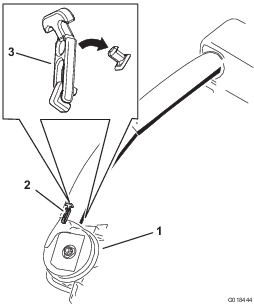
  6. Use both latches to attach the lower tube to the blower assembly (Figure 20).

    Note: Ensure the notch in the lower tube is at the bottom when installed (Figure 22).

    g018444
  7. Make note of where the two bolts in the upper tube are installed.

    Note: The hole near the molded arrowheads will not be used.

  8. Remove the two bolts in the lower end of the upper tube. Use the 2 holes as a template for the lower tube. Retain the hardware.

  9. Insert the upper end (no holes) of the upper tube through the tube seal in the hood by pushing the tube in until the tube contacts the inside of the hood,

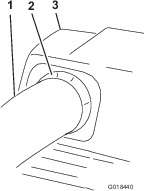
  10. Pull the upper tube out slightly so that the seal extends outward and over the lower tube (Figure 21).

    g018440
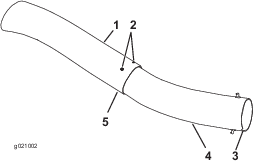
  11. Align the upper tube holes to match the dimples on the surface of the lower tube.

    Note: Ensure the side profile looks similar to what is shown in Figure 22.

    g021002
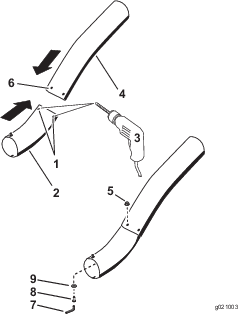
  12. Using the existing holes in the upper tube as a template, drill 2 holes, a 1/4 inch (6.5 mm) diameter, through the dimples on the lower tube (Figure 23).

    g021003
  13. Remove the upper and lower tubes from the machine.

  14. Slide the tubes together and align the holes.

  15. Install the washers (1/4 inch) onto the bolts (Figure 23).

  16. Using a hex key tool, install the screws (1/4 x 3/4 inch) and washers (1/4 inch) from the inside of the lower tube and through the existing holes in the upper tube (Figure 23).

  17. Secure the tubes together with the nuts (1/4 inch) (Figure 23).

  18. Insert the upper discharge tube through the tube seal in the hood.

  19. Pull the upper tube out slightly so that the seal extends outward and over the blower assembly (Figure 21).

  20. Use both latches to attach the lower tube to the blower assembly (Figure 20).

Installing the Weight

Parts needed for this procedure:

Weight2
Adhesive bumper2
Rod1
Washer (5/16 inch)4
Hairpin cotter pin2
  1. Install an adhesive bumper to the weight (Figure 1).

    g016271

    Note: On Titan MX machines and the 60 inch ZX machine, disconnect the front deck pan from the frame to allow installation of the weights. Ensure the pan is installed once the weights are secured.

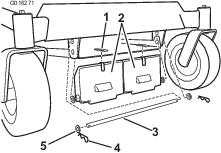
  2. Install the weight to the front of the machine frame. Secure the weight with a rod, four washers, and two hairpins as shown in Figure 24.

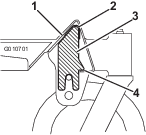
    Note: When installing the front weight allow it to rest on the front lip of the underside of the machine frame as shown Figure 25. This will suspend the weight while you secure it to the machine. Use care not to dislodge the weight when installing the supporting rod.

    g010701

    Important: Whenever you remove the bagger attachment, remember to remove the front weight to return the proper stability to the machine.

Operation

Note: Determine the left and right sides of the machine from the normal operating position.

Warning

To avoid personal injury, follow these procedures:

  • Become familiar with all operating and safety instructions in the Operator's Manual for the mower before using this attachment.

  • Never remove the discharge tube, bags, bagger hood, or the chute while the engine is running.

  • Always shut the engine off and wait for all moving parts to stop before clearing an obstruction from the bagging system.

  • Never do maintenance or repairs while the engine is running.

Warning

Without the grass deflector, bagger tubes or complete bagger assembly mounted in place, you and others are exposed to blade contact and thrown debris. Contact with the rotating mower blade(s) and thrown debris will cause injury or death.

  • Always install the grass deflector when removing the bagger and changing to side discharge mode.

  • If the grass deflector is ever damaged, replace it immediately. The grass deflector routes material down toward the turf.

  • Never put your hands or feet under the mower.

  • Never try to clear the discharge area or mower blades unless you move the power take off (PTO) to off and rotate the ignition key to off. Also remove the key and pull the wire off of the spark plug(s).

  • Turn off the engine before unclogging the discharge chute.

Emptying the Grass Bags

Danger

Debris, such as leaves, grass, or brush can catch fire. A fire in the engine area can cause personal injury and property damage.

  • Keep the engine and muffler area free of debris accumulation.

  • Take care when opening the bagger cover to keep debris from falling onto the engine and muffler area.

  • Allow the machine to cool before storing it.

Be careful when lifting or handling a grass bag that is full. To empty the grass bags:

  1. Park the machine on a level surface and disengage the blade control switch.

  2. Move the motion control levers outward to the NEUTRAL LOCK position, shut off the engine, remove the key, set the parking brake and wait for all moving parts to stop before leaving the operating position.

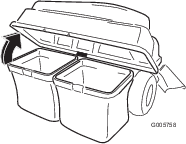
  3. Open (raise) the bagger top (Figure 26).

    g005758
  4. Compress debris into the bags. With both hands, lift up on the bag and unhook it from the retaining bracket. Empty the bag. Repeat the procedure for the other bag.

    g300218
    g300217
  5. Install the bags by sliding the bag frame hooks onto the retaining brackets.

  6. Lower the bagger top onto the bags.

Clearing Obstructions from the Bagger

Warning

When the bagger is in operation, the blower is rotating and can cut off or injure hands and fingers.

  • Before adjusting, cleaning, repairing and inspecting the blower, and before unclogging the chute, shut off the engine and wait for all moving parts to stop. Remove the key.

  • Use a stick or similar object, not your hands, to remove an obstruction from the blower and tube.

  • Keep your face, hands, feet, and any other part of your body or clothing away from concealed, moving, or rotating parts.

  1. Park the machine on a level surface and disengage the blade control switch.

  2. Move the motion control levers outward to the NEUTRAL LOCK position, stop the engine, remove the key, set the parking brake and wait for all moving parts to stop before leaving the operating position.

  3. Check the grass bags and empty them if they are full.

  4. Remove and separate the discharge tube and chute from the bagger top and mower. Using a stick or similar object, carefully remove and clear the obstruction from the mower, discharge tube, chute, and the bagger top.

  5. After you remove the obstruction, install the complete bagger system and resume operation.

Removing the Bagger

Caution

Failing to remove the front bagger weights and operating the machine without the bagger attachment may cause an unstable condition which could result in a loss of control.

  • Always remove the front weights when removing the bagger attachment.

  • Never operate the machine without the bagger attachment and the front weights still installed.

The bagger can be removed by repeating the Setup sections from all installed bagger related kits in reverse order. If weights are installed, always remove the front bagger weights when removing the bagger attachments.

Note: When switching back to side discharge mode, remove the bagging baffle and install the original cutoff baffle and side-discharge chute that came with the machine.

Operating Tips

Tips for Bagging

Remembering the Size

Remember that the machine is longer and wider with this attachment installed. By turning too sharply in confined places you may damage the attachment.

Trimming

Always trim with the left side of the mower. Do not trim with the right side of the mower because you could damage the bagger's chute and discharge tube.

Cutting Height

Do not set the mower cutting height too low because long grass surrounding the mower can prevent air from getting under the mower and entering the bagging system. If enough air doesn't get under the mower, the bagging system will plug.

Cutting Frequency

Cut the grass often, especially when it grows rapidly. You will have to cut your grass twice if it gets excessively long.

Cutting Technique

For best lawn appearance, be sure to slightly overlap the mower into the previously cut area. This helps reduce the load on the engine and reduces the chance of plugging the chute and discharge tube.

Bagging Speed

Most often you will bag with the mower throttle in the Fast position and drive at a normal ground speed. However, in extremely dry and dusty grass, you may want to slightly reduce the throttle speed and increase the ground speed of the mower. The bagging system may plug if you drive too fast and the engine speed gets too slow. On hills it may be necessary to slow the mower ground speed. This helps maintain the engine speed and bagging efficiency. Mow downhill whenever possible.

Caution

As the bagger fills, extra weight is added to the back of the machine. If you stop and start suddenly on hills, you may lose steering control or the machine may tip.

  • Do not start or stop suddenly when going uphill or downhill. Avoid uphill starts.

  • If you do stop the machine when going uphill, disengage the blade control. Then back down the hill using a slow speed.

  • Avoid sudden turns or rapid speed changes on slopes.

  • Never operate the machine without the bagger attachment and the front weights still installed.

Bagging Long Grass

Bagging Long Grass Excessively long grass is heavy and may not be propelled completely into the grass bags. If this happens, the discharge tube and chute may plug. To avoid plugging the bagging system, mow the grass at a high height of cut, then lower the mower to your normal cutting height and repeat the bagging process.

Bagging Wet Grass

Always try to cut grass when it is dry because your lawn will have a neat appearance. If you must cut wet grass, use the conventional side discharge feature of the mower. Several hours later, when the clippings are dry, install the complete bagger attachment and vacuum up the grass clippings.

Signs of Plugging

As you are bagging, a small amount of grass clippings normally blow out the front of the mower. An excessive amount of clippings blowing out indicates that the bags are full or the system is plugged.

Maintenance

Note: Determine the left and right sides of the machine from the normal operating position.

Recommended Maintenance Schedule(s)

Maintenance Service IntervalMaintenance Procedure
After the first 8 hours
  • Inspect the blower belt.
  • Inspect the bagger.
  • After each use
  • Clean the hood screen.
  • Clean the bagger.
  • Every 25 hours
  • Inspect the blower belt.
  • Every 50 hours
  • Grease the idler arm.
  • Every 100 hours
  • Inspect the bagger.
  • Warning

    If you leave the key in the ignition switch, someone could accidently start the engine and seriously injure you or other bystanders.

    Remove the key from the ignition and disconnect the wire from the spark plug before you do any maintenance. Set the wire aside so that it does not accidentally contact the spark plug.

    Warning

    An engine can become hot while it operates. Severe burns can occur from contacting hot surfaces.

    Allow the engine, especially the muffler, to cool before touching it.

    Warning

    Debris, such as leaves, grass, or brush can catch fire. A fire in the engine area can cause personal injury and property damage.

    • Keep the engine and muffler area free of debris accumulation.

    • Take care when opening the bagger cover to keep debris from falling onto the engine and muffler area.

    • Allow the machine to cool before storing it.

    Preparing for Maintenance

    Do the following steps before preforming maintenance on the machine:

    1. Park the machine on a level surface.

    2. Disengage the PTO, move the motion control levers to the neutral locked position, and set the parking brake.

    3. Stop the engine, remove the key, and wait for all moving parts to stop before leaving the operating position.

    4. Clean the mower of any debris on the deck or rear part of the mower to ease maintenance.

    Cleaning the Hood Screen

    Maintenance Service IntervalMaintenance Procedure
    After each use
  • Clean the hood screen.
    1. Disengage the power take off (PTO) and set the parking brake.

    2. Turn off the engine, remove the key, and wait for all moving parts to stop before leaving the operating position.

    3. Open the bagger hood.

    4. Clean the debris from the screen.

    5. Close the bagger hood.

    Cleaning the Bagger and Bags

    Maintenance Service IntervalMaintenance Procedure
    After each use
  • Clean the bagger.
    1. Wash the inside and outside of the bagger hood, bags, tube, and the underside of the mower.

      Note: Use a mild automotive detergent to remove dirt.

    2. Make sure that you remove matted grass from all parts.

    3. After washing all parts, let them dry thoroughly.

    Note: With all parts installed, start and run the machine for a minute to assist in drying.

    Inspecting the Blower Belt

    Maintenance Service IntervalMaintenance Procedure
    After the first 8 hours
  • Inspect the blower belt.
  • Every 25 hours
  • Inspect the blower belt.
  • Check belts for cracks, frayed edges, burn marks or any other damage. Replace damaged belts.

    Replacing the Blower Belt

    1. Disengage the PTO, move the motion control levers to the neutral locked position, and set the parking brake.

    2. Stop the engine, remove the key, and wait for all moving parts to stop before leaving the operating position.

    3. Remove the plastic belt cover.

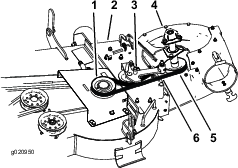
    4. Pull back on the spring-loaded idler pulley to relieve the belt tension (Figure 29).
      g020950
    5. Remove the existing bagger belt from the mower-deck pulley.

    6. Remove the blower from the mower deck.

    7. Remove the existing bagger belt from the blower pulleys.

    8. Install the new belt around the blower pulleys (Figure 29).

    9. Install the blower onto the blower support.

    10. Install the new belt around the mower-deck pulley (Figure 29).

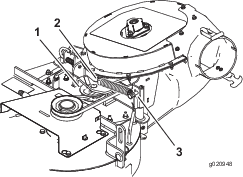
    11. Install the spring onto the idler pulley post (Figure 30).

    12. Stretch and install the spring onto the shoulder bolt (Figure 30).
      g020948
    13. Pull back on the spring loaded idler pulley and install the belt onto the spring loaded idler pulley (Figure 29).

    Greasing the Idler Arm

    Maintenance Service IntervalMaintenance Procedure
    Every 50 hours
  • Grease the idler arm.
  • g020947

    Inspecting the Bagger

    Maintenance Service IntervalMaintenance Procedure
    After the first 8 hours
  • Inspect the bagger.
  • Every 100 hours
  • Inspect the bagger.
    1. Disengage the PTO, move the motion control levers to the neutral locked position, and set the parking brake.

    2. Stop the engine, remove the key, and wait for all moving parts to stop before leaving the operating position.

    3. Check the upper tube, lower tube, bagger hood, and the blower assembly.

      Note: Replace these parts if they are cracked or broken.

    4. Check the bags, bagger frame, and screen.

      Note: Replace any parts that are cracked or broken.

    5. Tighten all nuts bolts and screws.

    Inspecting the Mower Blades

    1. Inspect the mower blades regularly and whenever a blade strikes a foreign object.

    2. If blades are badly worn or damaged, install new blades. Refer to your machine Operator's Manual for complete blade maintenance.

    Storage

    Storing the Bagger Attachment

    1. Clean the bagger attachment; refer to Cleaning the Bagger Attachment.

    2. Inspect the bagger attachment for damage; refer to Inspecting the Bagger Attachment.

    3. Make sure the grass bags are empty and thoroughly dry.

    4. Store the bagger in a clean, dry place, out of direct sunlight. This protects the plastic parts and extends the life of the bagger. If you must store the bagger outside, cover it with a weatherproof cover.

    Troubleshooting

    ProblemPossible CauseCorrective Action
    Abnormal vibration.
    1. Cutting blade(s) is/are bent or unbalanced.
    2. Blade-mounting bolt is loose.
    3. Loose blower pulley or pulley assembly.
    4. Worn bagger belt.
    5. Blower fan blade(s) is/are bent or unbalanced.
    1. Install new cutting blade(s).
    2. Tighten the blade-mounting bolt.
    3. Tighten the appropriate pulley.
    4. Replace the belt.
    5. Contact an Authorized Service Dealer.
    Reduced bagging performance.
    1. Low engine speed.
    2. Plugged screen in bagger hood.
    3. Loose bagger belt.
    4. A plugged tube or blower.
    5. Full bags.
    1. Always operate the engine at full throttle.
    2. Remove debris, leaves or grass clippings from the screen.
    3. Replace the bagger belt.
    4. Locate and remove plugged debris.
    5. Empty the hopper.
    Blower and tubes plug too frequently.
    1. Bags are too full.
    2. Low engine speed.
    3. Grass is too wet.
    4. Grass is too long.
    5. Plugged screen in hood.
    6. Ground speed is too fast.
    7. Worn bagger belt.
    1. Dump more frequently.
    2. Always operate the engine at full throttle.
    3. Cut grass when it is dry.
    4. Cut no more than 51-76 mm (2-3 inches) or 1/3 of the grass height, which ever is less.
    5. Remove debris, leaves or grass clippings from the screen.
    6. Drive slower at full throttle.
    7. Replace belt.
    Debris blowout.
    1. Bags are too full.
    2. Ground speed is too fast.
    3. Mower deck is not leveled.
    1. Dump more frequently.
    2. Drive the machine at slow ground speed while operating the engine at full throttle.
    3. See the machine Operator's Manual for leveling the mower deck.
    Blower impeller does not spin freely.
    1. Plugged blower.
    2. Impeller not aligned.
    1. Remove debris, leaves or grass clippings from the blower impeller.
    2. Contact an Authorized Service Dealer.