


This product complies with all relevant European directives. For details, please see the Declaration of Incorporation (DOI) at the back of this publication.

Note: Determine the left and right sides of the machine from the normal operating position.

Setup

Preparing the Machine

  1. Park the machine on a level surface.

  2. Lower the attachments.

  3. Engage the parking brake.

  4. Shut off the engine and remove the key.

Removing the Shrouds

  1. Raise the rear of the machine and position jacks under the rear wheel motor mounts.

  2. Remove the right rear tire.

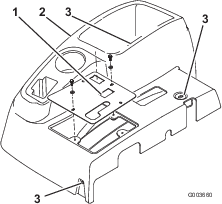
  3. Remove the 4 washers and bolts mounting the control panel to the console (Figure 1).

  4. Unplug the wire from the hour meter.

  5. Remove the control panel (Figure 1).

  6. Remove the 3 bolts securing the console to the frame (Figure 1). Remove the console by gently lifting the bottom edge of the console around the support bracket and sliding it up beyond the brake handle.

    g003660
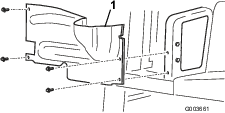
  7. Remove the 4 bolts securing the right hand wheel shroud to the frame and remove the shroud (Figure 2).

    g003661
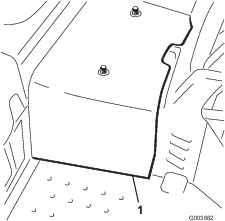
  8. Disconnect and remove the center shroud from the frame (Figure 3).

    g003662

Preparing to Install the Hydraulic Components

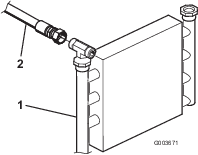
  1. Locate the hydraulic tube that goes from the oil cooler to the existing lift valve (Figure 4).

  2. Remove the fasteners and tube clamp securing the hydraulic tubes to the frame.

  3. Disconnect and remove the hydraulic tube from the oil cooler and the lift valve (Figure 4 and Figure 6).

    Note: You may discard this hydraulic tube.

    Note: To minimize oil loss when removing the hydraulic tube, have the replacement hose ready or cap the fitting on the cooler using one of the protective shipping caps removed from the tube assembly, Part No. 108-8447 (Figure 19).

    g003671
  4. Secure the remaining hydraulic tube to the frame with the clamp and fasteners previously removed.

  5. If you are installing this kit to a Model 08745 machine, do the following:

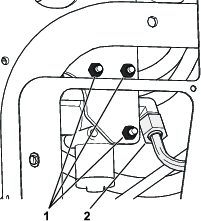
    1. Remove the 3 bolts and nuts securing the existing lift valve to the frame, and separate it from the frame to allow for removal of the T-fitting (340-94) as shown in Figure 5.

    2. Disconnect the hydraulic tube (108-8415) from the 90° fitting (340-77) on left side of existing lift valve.

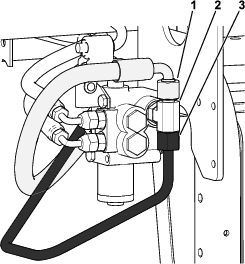
    3. Disconnect the hydraulic hose (144-1367) from the T-fitting (340-94) as shown in Figure 6.

    4. Loosen the T-fitting (340-94) on the right side of the existing lift valve.

    5. Remove the T-fitting (340-94) from existing valve and retain for later installation.

      g362552
      g362543

Installing the Lift Valve

Model 08705 Only

Parts needed for this procedure:

Straight hydraulic fitting with O-ring2
90° hydraulic fitting with O-ring2
Lift valve1
Valve plate1
Bolt (1/4 x 3 inches)3
Locknut (1/4 inch)3
Bolt (#10 x 1-1/4 inches)2
Locknut (#10)2
Lift lever1
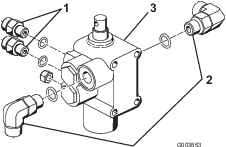
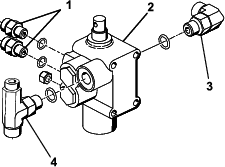
  1. Thread both 90° fittings and the 2 straight hydraulic fittings into the new lift valve as shown in Figure 7.

    Important: Do not tighten the 90° fittings at this time. Ensure that all O-rings are lubricated and properly positioned on the fittings before installation.

    g003663
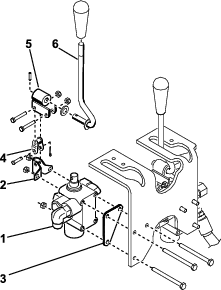
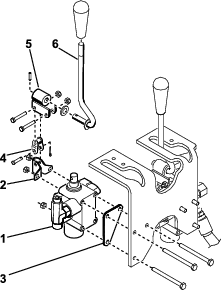
  2. Mount the valve assembly, pivot bracket, and valve plate to the frame with 3 bolts (1/4 x 3 inches) and 3 locknuts (Figure 8). Position the valve plate against the front of the frame member when mounting, and torque the fasteners to 10 to 12 N∙m (90 to 110 in-lb).

    Note: The valve installation is very similar to the existing valve that is already installed.

  3. Loosely mount the pivot lever assembly to the valve spool and to the offset link with 2 bolts (#10 x 1-1/4 inch) and 2 locknuts (Figure 8).

    Note: Do not tighten the fasteners at this time.

    Note: Mount the offset link to the rear hole of the pivot.

    g516725

Installing the Lift Valve

Model 08745 Only

Parts needed for this procedure:

Straight hydraulic fitting with O-ring2
90° hydraulic fitting with O-ring2
Lift valve1
Valve plate1
Bolt (1/4 x 3 inches)3
Locknut (1/4 inch)3
Bolt (#10 x 1-1/4 inches)2
Locknut (#10)2
Lift lever1
  1. Thread a 90° fitting into the existing lift valve where the T-fitting was removed.

    Important: Tighten only the straight fittings at this time. Ensure that all O-rings are lubricated and properly positioned on the fittings before installation.

    g362424
  2. Install the existing lift valve with the previously removed hardware and torque the fasteners to 10 to 12 N∙m (90 to 110 in-lb).

  3. Thread a 90° fitting, the 2 straight hydraulic fittings, and the T-fitting removed from the existing valve in Preparing to Install the Hydraulic Components into the new lift valve as shown in Figure 9.

  4. Mount the valve assembly, pivot bracket, and valve plate to the frame with 3 bolts (1/4 x 3 inches) and 3 locknuts (Figure 10). Position the valve plate against the front of the frame member when mounting, and torque the fasteners to 10 to 12 N∙m (90 to 110 in-lb).

    Note: The valve installation is very similar to the valve currently installed.

  5. Loosely mount the pivot lever assembly to the valve spool and to the offset link with 2 bolts (#10 x 1-1/4 inch) and 2 locknuts (Figure 10).

    Note: Do not tighten the fasteners at this time.

    Note: Mount the offset link to the rear hole of the pivot.

    g516724

Installing the Plow Plates

Parts needed for this procedure:

Right plow plate1
Left plow plate1
Bolt (1/2 x 2 inches)4
Locknut (1/2 inch)4
Hitch frame bracket1
Bolt (1/2 x 1-3/4 inches)2
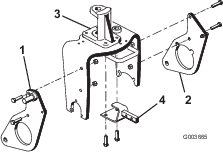
  1. Loosely mount the right hand plow plate to the right side of the caster fork with 2 bolts (1/2 x 2 inches) and locknuts as shown in Figure 11.

    Note: Do not tighten the fasteners yet.

  2. Repeat the procedure with the left hand plow plate (Figure 11).

  3. Jack up the front of the machine until the front wheel is off the floor.

  4. Remove and discard the 2 bolts securing the front of the steering pivot to the top of the caster fork (Figure 11).

  5. Using the caster fork and steering pivot mounting holes, mount the hitch frame bracket to the underside of the caster fork with 2 bolts (1/2 x 1-3/4 inches); refer to Figure 11.

    Note: It may be required to partially deflate the tire to gain clearance. The wheel motor hydraulic hose should not rest on top of the hitch frame bracket.

    g003665

Installing the Push Arms and Hitch Frame

Parts needed for this procedure:

Hitch frame 1
Bolt (3/8 x 2 inches)2
Nut (3/8 inch)2
Capscrew (3/8 x 1-1/2 inches)2
Locknut (3/8 inch)2
Cylinder pin2
Adapter plate1
Push arm tube1
Pin assembly2
Thread-forming screw2
Bolt (5/8 x 1-1/2 inches)2
Washer (1.68-inch outside diameter x 0.65-inch inside diameter)2
Tube1
Clevis pin1
Cotter pin1
  1. Lower the machine so that the front wheel is on the floor.

  2. Secure the push arm tube to the adapter plate with 2 pin assemblies and secure the pin assemblies to the adapter plates with 2 thread-forming screws.

    Note: Position the components as shown in Figure 12.

    g003787
  3. Insert a cylinder pin into each push arm tube as shown in Figure 13.

  4. Insert the push arm tubes onto the right and left plow plates aligning the cylinder pin guides with the holes in the plow plates (Figure 13).

    Note: If unable to get the push arm tubes around the plow plates, loosen the nuts securing the plow plates to the caster fork.

  5. Mount each cylinder pin to each plow plate with a bolt (5/8 x 1-1/2 inches) and a washer (1.68-inch outside diameter x 0.65-inch inside diameter) as shown in Figure 13.

    Note: Torque the bolts to 203 N-m (150 ft-lb).

    g003666
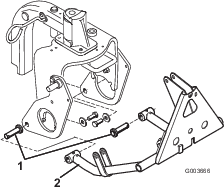
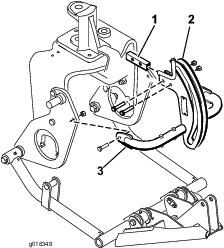
  6. Mount the top of the hitch frame to the hitch frame bracket with 2 bolts (3/8 x 2 inches) and nuts (Figure 14).

  7. Mount the hitch frame tubes to the plow plates with bolts (3/8 x 1-1/2 inches) and nuts (Figure 14), and tighten the fasteners.

    g018349
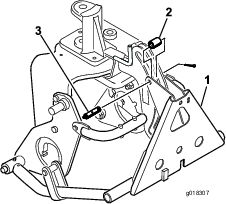
  8. Secure the frame adapter to the hitch frame with a tube, a clevis pin, and a cotter pin (Figure 15).

    g018307
    g028340

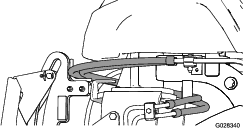
    Important: Ensure that the existing hoses are routed above the guide, as shown in Figure 16.

Installing the Hydraulic Cylinder

Parts needed for this procedure:

45° hydraulic fitting with O-ring1
Hydraulic cylinder1
90° hydraulic fitting with O-ring1
Small retaining ring1
Pin1
Large retaining ring2
  1. Thread a 90° fitting into the upper port in the hydraulic cylinder. Position the fitting as shown in Figure 17.

    Note: Make sure that all O-rings are lubricated and properly positioned on fittings before installation.

    Note: To prevent contamination to the hydraulic fittings or hoses, do not remove the caps from the fittings or hoses until they are installed.

  2. Thread a 45° fitting into the lower port in the hydraulic cylinder. Position the fitting as shown in Figure 17.

    g003669
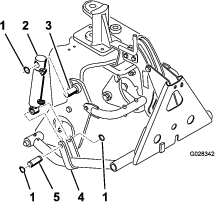
  3. Mount the top of the hydraulic cylinder barrel to the pin on the right-hand plow plate with a retaining ring (Figure 18).

    Note: Position the cylinder hydraulic ports forward.

    g028342
  4. Mount the cylinder rod to the push arm straps with a pin and 2 retaining rings (Figure 18).

Installing the Hydraulic Hoses

Model 08705 Only

Parts needed for this procedure:

Tube assembly1
Hydraulic hose (Part No. 108-8449)1
Hydraulic hose (Part No. 108-8453)1
Hydraulic hose (Part No. 108-8454)1
Wire hose holder1
Thread forming screw (5/16 x 3/4 inch)2
Plastic cable tie3
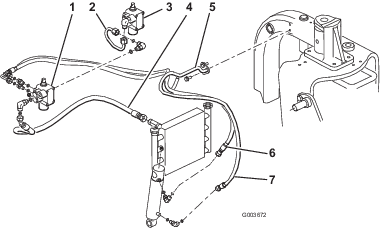
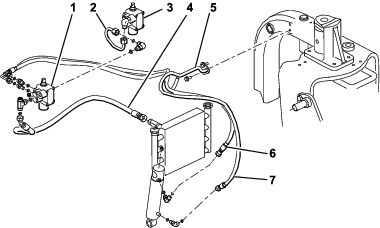
  1. Connect the tube assembly (Part No. 108-8447) to the 90° fitting on the left side of the new valve and the vacated fitting on the existing lift valve (Figure 19).

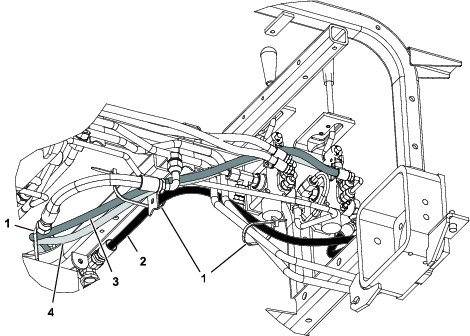
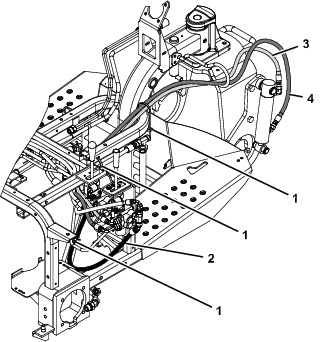
  2. Connect the 45° fitting end of hydraulic hose (Part No. 108-8449) to the 90° fitting on the right side of the valve and the straight end of the hose to the vacant oil cooler fitting (Figure 19). Refer to Figure 20 and Figure 21 for hose routing.

  3. Mount the wire hose holder to the left frame tube with 2 thread-forming screws (5/16 x 3/4 inch); refer to Figure 19.

  4. Connect the short 90° fitting end of hydraulic hose (Part No. 108-8453) to the top straight fitting on the rear of the valve. Route the hose through the wire hose holder and connect the straight end of the hose to the top hydraulic cylinder fitting (Figure 19). Refer to Figure 20 and Figure 21 for hose routing.

  5. Connect the long 90° fitting end of the hydraulic hose (Part No. 108-8454) to the bottom straight fitting on the rear of the valve. Route the hose through the wire hose holder and connect the straight end of the hose to the bottom hydraulic cylinder fitting (Figure 19). Refer to Figure 20 and Figure 21 for hose routing.

    Important: Ensure that the hoses are routed away from any sharp, hot, or moving components.

  6. Tighten all fasteners and fittings.

  7. Using cable ties, secure the hoses to the machine at the locations shown in Figure 20 and Figure 21.

    g003672
    g218466
    g218467

Installing the Hydraulic Hoses

Model 08745 Only

Parts needed for this procedure:

Tube assembly1
Hydraulic hose (Part No. 108-8449)1
Hydraulic hose (Part No. 108-8453)1
Hydraulic hose (Part No. 108-8454)1
Wire hose holder1
Thread forming screw (5/16 x 3/4 inch)2
Plastic cable tie3
  1. Connect the tube assembly (Part No. 108-8447) to the 90° fitting on the left side of the new valve and the newly installed 90° fitting on the existing lift valve (Figure 22).

  2. Connect the T-fitting with the 45° end of hydraulic hose (Part No. 108-8449) to the open side of the T-fitting on the right side of the valve and the straight end of the hose to the vacant oil cooler fitting (Figure 22). Refer toFigure 23 and Figure 24 for hose routing.

  3. Mount the wire hose holder to the left frame tube with 2 thread-forming screws (5/16 x 3/4 inch); refer to Figure 22.

  4. Connect the short 90° fitting end of hydraulic hose (Part No. 108-8453) to the top straight fitting on the rear of the valve. Route the hose through the wire hose holder and connect the straight end of the hose to the top hydraulic cylinder fitting (Figure 22). Refer to Figure 23 and Figure 24 for hose routing.

  5. Connect the long 90° fitting end of the hydraulic hose (Part No. 108-8454) to the bottom straight fitting on the rear of the valve. Route the hose through the wire hose holder and connect the straight end of the hose to the bottom hydraulic cylinder fitting (Figure 22). Refer to Figure 23 and Figure 24 for hose routing.

  6. Connect hydraulic hose (Part No. 144-1367) onto the top of the newly installed T-fitting (Part No. 340-94) on the right side of the new lift valve.

    Important: Ensure that the hoses are routed away from any sharp, hot, or moving components.

  7. Tighten all fasteners and fittings.

  8. Using cable ties, secure the hoses to the machine at the locations shown in Figure 23 and Figure 24.

    g362578
    g218466
    g362591

Installing the Control Panel and Lever Guide Plate

Parts needed for this procedure:

Lever guide plate1
Flange-head screw2
Washer2
Control panel decal1
Control panel1
Knob1
Plastic cable tie3
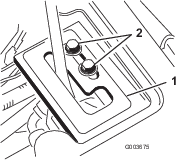
  1. Insert the lever guide plate over the lift lever and loosely secure it to the frame with 2 flange-head screws and washers (Figure 25).

    g003675
  2. Check the hydraulic-fluid level and replenish the fluid as required.

    Warning

    Hydraulic fluid escaping under pressure can penetrate skin and cause injury.

    • If hydraulic fluid is injected into the skin it must be surgically removed within a few hours by a doctor familiar with this type of injury. Gangrene may result if this is not done.

    • Keep body and hands away from pin hole leaks or nozzles that eject high-pressure hydraulic fluid.

    • Use cardboard or paper to find hydraulic leaks.

    • Safely relieve all pressure in the hydraulic system before performing any work on the hydraulic system.

    • Ensure that all hydraulic-fluid hoses and lines are in good condition and all hydraulic connections and fittings are tight before applying pressure to the hydraulic system.

  3. Start the traction unit engine and check the fitting connections.

  4. Install the wheel shroud, the center shroud, and the console.

    Note: Do not install the control panel at this time. Ensure that the shrouds do not interfere with the hoses. Route the hoses as required. Reverse the shroud installation procedure used in step 1.

  5. Install the rear tire and remove the blocks from under the rear of the machine.

  6. Torque the lugs nuts to 61 to 75 N∙m (45 to 55 ft-lb).

  7. With the engine running and lift lever in the Float position, slide the lever guide plate until the lift cylinder can be extended and retracted by hand (Figure 25).

    Warning

    The engine must be running so that the final adjustment of the lift lever detent plate can be performed. Contact with moving parts or hot surfaces may cause personal injury.

    Keep hands, feet, face, and other body parts away from rotating parts, the muffler, and other hot surfaces.

  8. Tighten both lift lever guide plate mounting screws to secure the adjustment (Figure 25).

  9. Remove the hour meter from the old control panel and install it in the new control panel.

  10. Install the new control panel and plug the wire into the hour meter.

  11. Secure the control panel in place with the fasteners previously removed (Figure 26).

    g003676
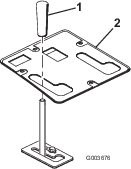
  12. Install the knob onto the lift lever (Figure 26).

  13. Grease the front lift frame; refer to Greasing the Lift Frame.

  14. Check the hydraulic-fluid level and replenish the fluid as required.

Reading/Storing the Documentation

Parts needed for this procedure:

Operator’s Manual1
  1. Read the documentation.

  2. Store the documentation in a safe place.

Operation

Specifications

Net weight38.5 kg (85 lb)

Attachments/Accessories

A selection of Toro approved attachments and accessories is available for use with the machine to enhance and expand its capabilities. Contact your Authorized Service Dealer or Distributor or go to www.Toro.com for a list of all approved attachments and accessories.

Operating Tips

  • The front lift frame is designed to accept only certain attachments. Do not try to install a rear mount attachment to the front lift frame, as damage to the machine may occur.

  • To lower the front lift frame, push the lift lever forward.

  • To allow the front lift frame to float, push the lift lever forward and to the side into the detent.

  • To raise the front lift frame, pull the lift lever rearward.

  • Become familiar with the safe operation of the equipment, with the operator controls, and safety signs.

  • Keep hands and feet away from moving parts and hot surfaces.

Maintenance

Note: To obtain an electrical schematic or a hydraulic schematic for your machine, visit www.Toro.com.

Greasing the Lift Frame

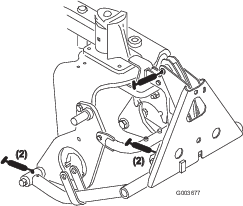
The front lift frame has 5 grease fittings (Figure 27) that must be lubricated regularly with No. 2 lithium grease. If the machine is operated under normal conditions, lubricate all bearings and bushings after every 100 hours of operation. Lubricate the bearings and bushings immediately after every washing, regardless of the interval listed.
g003677