Safety
Safety-Alert Symbol
The safety-alert symbol (Figure 1) shown in this manual and on the machine identifies important safety messages that you must follow to prevent accidents.

The safety-alert symbol appears above information that alerts you to unsafe actions or situations and is followed by the word DANGER, WARNING, or CAUTION.
DANGER indicates an imminently hazardous situation which, if not avoided, will result in death or serious injury.
WARNING indicates a potentially hazardous situation which, if not avoided, could result in death or serious injury.
CAUTION indicates a potentially hazardous situation which, if not avoided, may result in minor or moderate injury.
This manual uses two other words to highlight information. Important calls attention to special mechanical information and Note emphasizes general information worthy of special attention.
Installation
Preparing the Machine
-
Park the machine on a level surface.
-
Disengage the PTO, engage the parking brake, and move the motion-control levers outward to the NEUTRAL-LOCK position.
-
Shut off the engine and remove the key.
Warning
Mechanical or hydraulic jacks may fail to support the machine and cause serious injury.
Use jack stands when supporting the machine.
-
Raise the front of the machine so that the casters are off the ground. Support the machine using jack stands.
Note: Use jack stands rated for your machine. Refer to the Operator’s Manual for your machine to determine the weight.
Installing the Kit
Parts needed for this procedure:
| Wheel and bearing assembly | 2 |
-
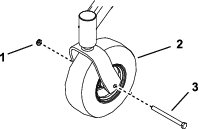
Remove the locknut and bolt holding the caster wheel to the caster fork. Remove the wheel.
-
Use the locknut and bolt to install the pneumatic caster wheel. Ensure that the valve stem faces outward from the machine. Torque the bolt to 91 to 113 N∙m (67 to 83 ft-lb).
-
Repeat the procedure for the other caster wheel.
-
Inflate the caster wheels to 483 to 552 kPa (70 to 80 psi).