Tank Rinse Kit

Multi Pro® 5800 Turf Sprayer


Introduction
 

Intended Use

This kit is designed to remove residual chemicals from a sprayer tank and affected hoses. It is a dedicated attachment for a turf spray application vehicle and is intended to be used by professional, hired operators in commercial applications.
The information in this manual can help you and others avoid injury and product damage.

Getting Help
Graphic
g014295s
Visit www.Toro.com for product safety and operation training materials, accessory information, help finding a dealer, or to register your product.
Whenever you need service, genuine Toro parts, or additional information, contact an Authorized Service Dealer or Toro Customer Service and have the model and serial numbers of your product ready. These numbers are located on the serial plate on your product . Write the numbers in the space provided.
Important  
With your mobile device, you can scan the QR code on the serial number decal (if equipped) to access warranty, parts, and other product information.
 
Model Number:
Serial Number:

Manual Conventions

This manual identifies potential hazards and has safety messages identified by the safety-alert symbol, which signals a hazard that may cause serious injury or death if you do not follow the recommended precautions.
Graphic
G405934
This manual uses 2 words to highlight information. Important calls attention to special mechanical information and Note emphasizes general information worthy of special attention.
Safety Alert Classifications
The safety-alert symbol shown in this manual and on the machine identifies important safety messages that you must follow to prevent accidents.
Safety-alert symbol appears above information that alerts you to unsafe actions or situations and is followed by the word DANGER, WARNING, or CAUTION.
Danger
Danger indicates an imminently hazardous situation which, if not avoided, will result in death or serious injury.
 
Warning
Warning indicates a potentially hazardous situation which, if not avoided, could result in death or serious injury.
 
Caution
Caution indicates a potentially hazardous situation which, if not avoided, may result in minor or moderate injury.



Safety
 

Safety and Instructional Decals

Image
Safety decals and instructions are easily visible to the operator and are located near any area of potential danger. Replace any decal that is damaged or missing.

Chemical Safety

Warning
Chemical substances used in the spray system may be hazardous and toxic to you, bystanders, animals, plants, soils, or other property.
  • Carefully read and follow the chemical warning labels and material safety data sheets (MSDS) for all chemicals used and protect yourself according to the chemical manufacturer's recommendations. For example, use appropriate personal protective equipment (PPE) including face and eye protection, gloves, or other equipment to guard against personal contact with the chemical.
  • Keep in mind that there may be more than 1 chemical used and information on each should be assessed.
  • Refuse to operate or work on the sprayer if this information is not available!
  • Before working on a spray system make sure the system has been triple rinsed and neutralized according to the recommendations of the chemical manufacturer(s).
  • Verify there is an adequate supply of clean water and soap nearby, and immediately wash off any chemicals that contact you.
 
  • Obtain proper training before using or handling chemicals.
  • Use the correct chemical for the job.
  • Follow the chemical manufacturer's instructions for the safe application of the chemical.
  • Handle chemicals in a well-ventilated area.
  • Wear goggles and other protective equipment as instructed by the chemical manufacturer. Ensure that as little skin as possible is exposed while using chemicals.
  • Have clean water available especially when filling the spray tank.
  • Do not eat, drink, or smoke while working with chemicals.
  • Always wash your hands and other exposed areas as soon as possible after finishing the work.
  • Properly dispose of unused chemicals and chemical containers as instructed by the chemical manufacturer and your local codes.
  • Chemicals and fumes in the tanks are dangerous; never enter the tank or place your head over or in the opening.
  • Follow all local, state, and federal requirements for the spraying of chemicals.


Setup
 

Loose Parts
Use the chart below to verify that all parts have been shipped.
Procedure
Description
Qty.
Use
1
No parts required
Prepare the machine.
2
Hose73.7 cm (29 inches)
1
Prepare the rinse tank.
Rinse tank
1
90° fitting
1
Hose clamp
1
Retaining fork
1
3
Hold down (rinse tank)
2
Install the rinse tank.
Bolt (3/8 x 1-1/2 inches)
2
Large washer
4
Flange locknut (3/8 inch)
2
4
No parts required
Drill the spray tank.
5
Rinse nozzle assembly
2
Install the rinse nozzles.
Bulkhead fitting assembly
2
90° fitting
2
6
Rinse tank pump
1
Install the pump and filter.
Bolt (1/4 x 1-3/4 inches)
4
Small washer
4
Serrated flange nut
4
Straight-barb fitting
2
Hose clamp
3
Filter assembly
1
Hose protector
1
Cable ties
2
Pump cover
1
7
Hose61 cm (24 inches)
2
Install the rinse tank hoses.
Hose clamp
6
T-fitting
1
Hose180 cm (71 inches)
1
8
Fuse (40 A)
2
Install the relay, fuse, and dash switch.
Power relay
6
Self-tapping bolt (#10) (S/N 420000000 and Up)
1
Bolt (#10) (419999999 and Before)
2
Locknut (#10) (S/N 315000000 through 419999999)
2
R-Clamp (S/N 315000000 through 315999999)
1
Relay (5-pin) (S/N 315000000 through 315999999)
1
3-position switch with light (315000000 and before)
1
3-position switch
1
Owner provided material:
  • PTFE sealant
  • Non-petroleum based lubricant such as vegetable oil
Note: Determine the left and right sides of the machine from the normal operating position.
Caution
Chemicals are hazardous and can cause personal injury.
  • Read the directions on the chemical labels before handling the chemicals and follow all manufacturer recommendations and precautions.
  • Keep chemicals away from your skin. Should contact occur, wash the affected area thoroughly with soap and clean water.
  • Wear goggles and any other protective equipment recommended by the chemical manufacturer.
 
  1. Park the machine on a level surface.
  2. Engage the parking brake.
  3. Shut off the engine and remove the key.
    Graphic
    G036361s
  4. Disconnect the battery.
  5. Clean the sprayer; refer to Cleaning the Sprayer in the Operators Manual for the machine.
    Note: Use caution while disconnecting any hoses during the installation of this kit and have a catch bucket ready for any solutions remaining in the hose.
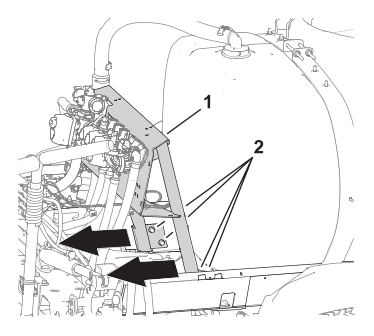
  6. Loosen the 4 flange-head bolts (3/8 x 1 inch) and 4 flange locknuts (3/8 inch) securing the valve mount to the tank frame.
    Graphic
    G206427s
    1.  Valve mount
    2.  Flange-head bolt (3/8 x 1 inch) and flange locknut (3/8 inch)
  7. Move the valve mount rearward to allow space to install the rinse tank.
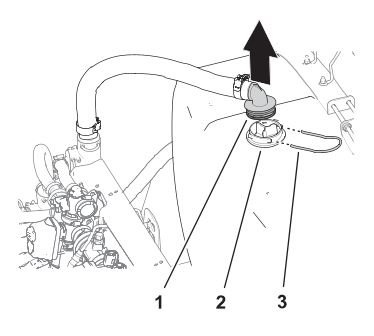
  8. Remove the retainer fork that secures the 90° barbed fitting of the supply hose to the housing of the suction screen.
    Graphic
    G206426s
    1.  90° barbed fitting (supply hose)
    2.  Housing (suction screen)
    3.  Retaining fork
  9. Separate the 90° barbed fitting from the housing and move the supply hose aside.
Parts Required
1
Hose73.7 cm (29 inches)
1
Rinse tank
1
90° fitting
1
Hose clamp
1
Retaining fork
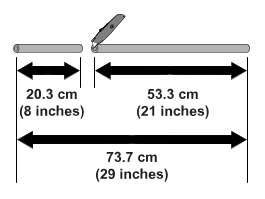
  1. Measure 20.3 cm (8 inches) from the end of the hose73.7 cm (29 inches) and mark that location.
    Graphic
    G219388s
  2. Cut the hose at the mark with a utility knife so that you have the following lengths of hose section:
    • 20.3 cm (8 inches)
    • 53.3 cm (21 inches)
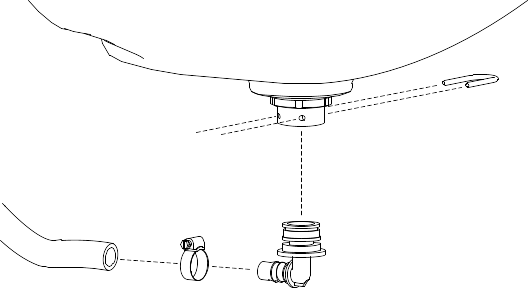
  3. Install the new 53.3 cm (21 inches) hose segment onto the 90° fitting with a hose clamp. Tighten the clamp by hand.
    Graphic
    G580150
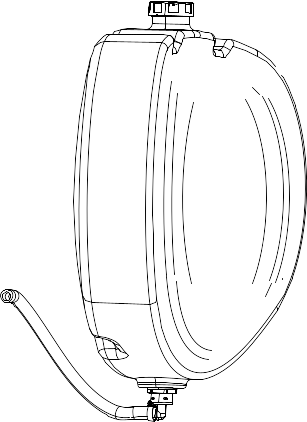
  4. Install the 90° fitting to the bulkhead fitting at the bottom of the rinse tank and secure it with a retaining fork.
  5. Rotate the fitting so that it faces rearward (towards the convex side of the rinse tank).
    Graphic
    G578920.svg
Parts Required
2
Hold down (rinse tank)
2
Bolt (3/8 x 1-1/2 inches)
4
Large washer
2
Flange locknut (3/8 inch)
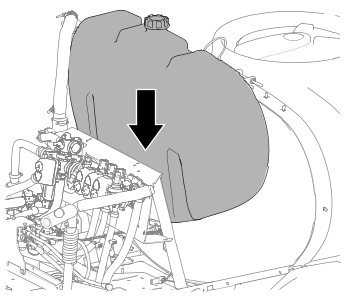
  1. Install the rinse tank onto the machine.
    Graphic
    G578573
  2. Adjust the valve mount so it is snug against the rinse tank and torque the 4 flange-head bolts (3/8 x 1 inch) and 4 flange locknuts (3/8 inch) to 37 to 45 Nm (27 to 33 ft-lb).
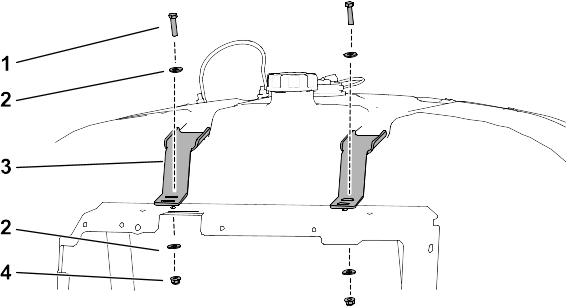
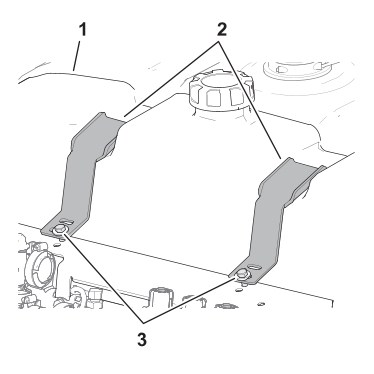
  3. Align the 2 hold downs with the recesses in the top of the rinse tank and the holes in the valve mount.
    Graphic
    G579064
    1. Bolt (3/8 x 1-1/2 inches)
    2. Large washer
    3. Hold down (rinse tank)
    4. Flange locknut (3/8 inch)
  4. Loosely install the 2 hold downs to the valve mount with 2 bolts (3/8 x 1-1/2 inches), 4 large washers, and 2 flange locknuts (3/8 inch).
  5. Carefully tighten the bolts and flange nuts by hand.
    Important  
    The rinse tank must be seated and secure, but the hold down should not deform or warp the tank.
     
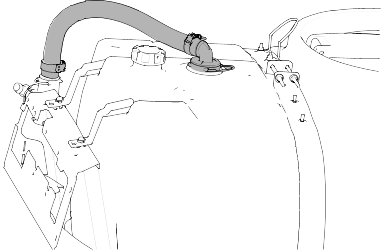
  6. Install the supply hose at the rear of the spray tank and secure it with the previously removed retaining fork.
    Graphic
    G578919
    1.  90° barbed fitting (supply hose)
    2.  Housing (suction screen)
    3.  Retaining fork
Note: Once the rinse tank has been initially filled, check the hold downs and the rinse tank for play (the weight of the water in the tank can further seat the tank against the frame). If needed, tighten the bolt(s) and flange locknut(s) until the hold downs are snug against the rinse tankdo not deform the tank.
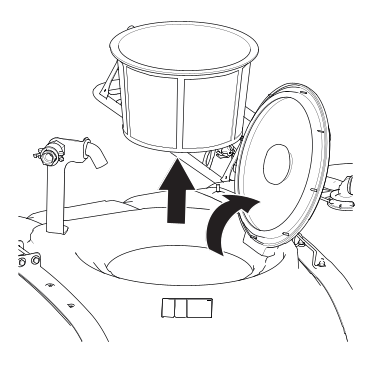
  1. Open the tank lid and remove the strainer basket.
    Graphic
    G206491s
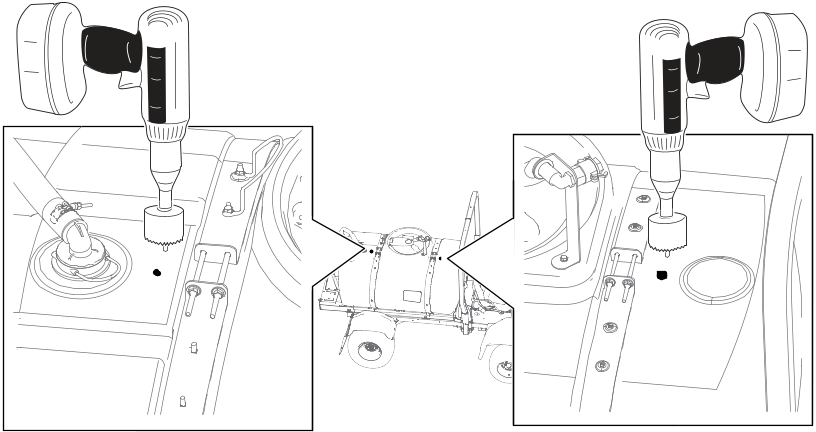
  2. Locate the 2 drill marks in the main tank.
    Note: The drill marks are dimples molded into the tank.
    Graphic
    G578923
  3. Using a hole saw, drill a 4.5 cm (1-3/4 inches) hole at both drill marks.
    Note: Place a container inside the tank below the areas where you are drilling to catch falling debris.
    Important
    Debris left inside a tank could clog and damage the spray system during operation.
     
  4. Remove any rough edges cut in the tank.
  5. Clean any debris that entered the main tank.
Parts Required
2
Rinse nozzle assembly
2
Bulkhead fitting assembly
2
90° fitting
  1. Apply PTFE thread sealant to the threads of the 2 rinse nozzle assemblies and the threads of the 90° fittings.
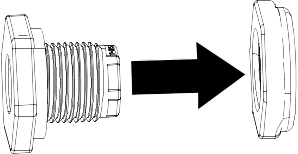
  2. Remove the plastic nut from the bulkhead fitting assembly.
    Note: Ensure that the gasket remains on the bulkhead fitting.
    Graphic
    G578921
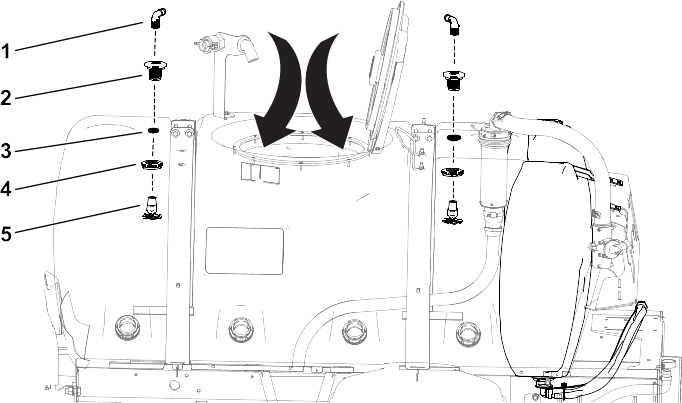
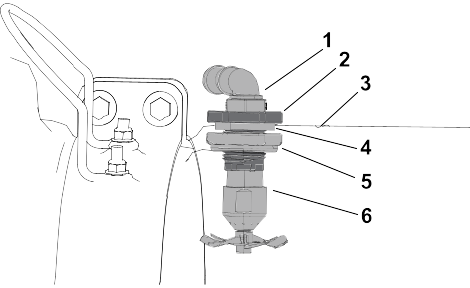
  3. Working inside the spray tank through the main opening, install the spray nozzle assembly, bulkhead assembly, and 90-degree fitting in each hole.
    Graphic
    G578922
    1. 90-degree fitting
    2. Bulkhead
    3. Hole4.5 cm (1-3/4 inch)
    4. Plastic nut
    5. Rinse nozzle assembly
    Assembled View
    Graphic
    G579063
    1. 90-degree fitting
    2. Bulkhead fitting
    3. Edge of spray tank
    4. Gasket
    5. Plastic nut
    6. Rinse nozzle assembly
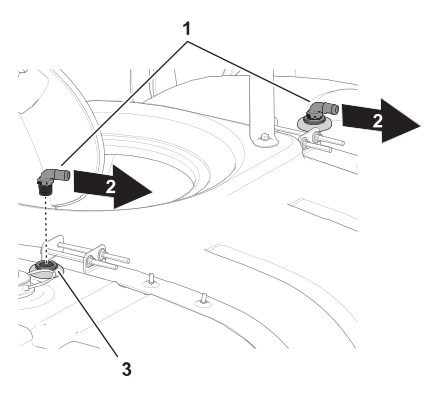
  4. Align the hose barbs of the 90° fittings to the right side of the machine.
    Graphic
    G206567s
    1. 90° fitting
    2. Right side of the machine
    3. Bulkhead fitting (rinse nozzle assembly)
  5. Install the filter basket and close the lid of the spray tank.
Installing the Pump
Parts Required
1
Rinse tank pump
4
Bolt (1/4 x 1-3/4 inches)
4
Small washer
4
Serrated flange nut
2
Straight-barb fitting
Owner provided material: PTFE sealant
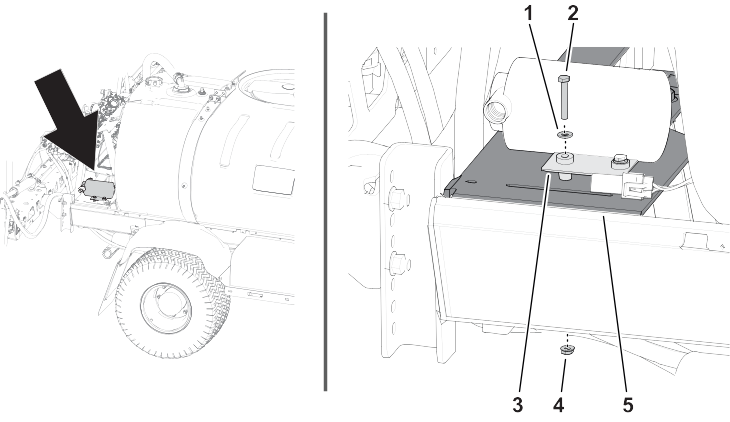
  1. Align the holes in the mounting flange spacers of the rinse tank pump with the holes in the saddle plate of the tank frame.
    Graphic
    G579062
  2. Install the pump onto the saddle plate with 4 bolts (1/4 x 1-3/4 inches) , 4 small washers , and 4 serrated flange nuts (1/4 inch) .
  3. Torque the bolts and flange nuts to 1017 to 1234 Ncm (90 to 101 in-lb).
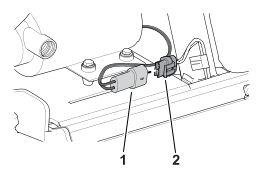
  4. Remove the dust plug from the 2-socket electrical connector of the machine harness labeled Rinse Pump.
    Graphic
    G219471s
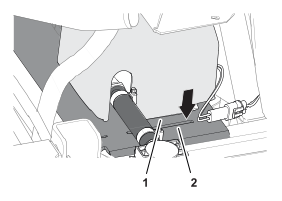
    1. 2-socket electrical connectormachine harness (Rinse Pump)
    2. 2-pin connector (pump harness)
  5. Plug the 2-pin connector of the pump harness into the 2-socket electrical connector of the machine harness labeled Rinse Pump.
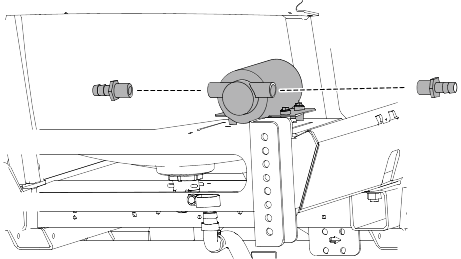
  6. Apply PTFE sealant to the threads of the 2 straight-barb fittings.
  7. Install the 2 straight-barb fittings into the 2 ports of the pump.
    Graphic
    G578918
Installing the Pump Hoses and Filter
Parts Required
3
Hose clamp
1
Hose20.3 cm (8 inches)previously cut
1
Filter assembly
1
Hose protector
2
Cable ties
Owner provided material: Non-petroleum based lubricant such as vegetable oil or silicone grease.
Note: Lightly lubricate the barbed ends of the hose fittings to ease the process of installation.
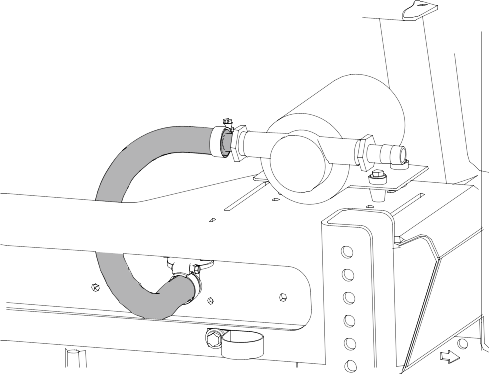
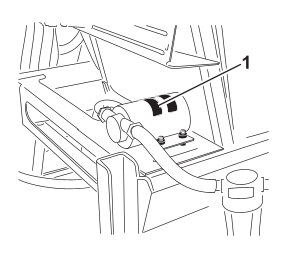
  1. Route the 21-inch hose from the bottom of the rinse tank to the pump and secure with 1 clamp. Tighten the clamp by hand.
    Graphic
    G578917
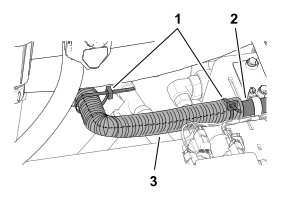
  2. Install the split hose protector over the hose connecting the rinse tank and the pump. Secure the tubing with 2 cable ties.
    Graphic
    G206821s
    1. Cable ties
    2. Hose53.3 cm (21 inches)
    3. Hose protector
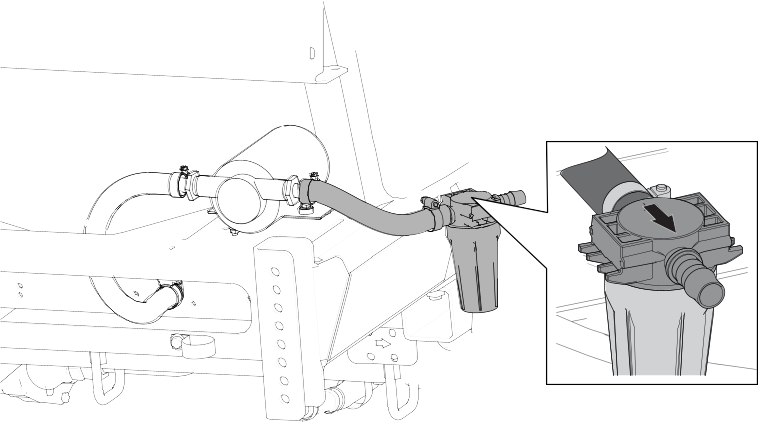
  3. Route the 8-inch hose (previously cut) from the pump to the filter and secure with 2 hose clamps
    Note: Ensure that the arrow is pointing away from the pump.
    Note: Ensure that the filter is installed outside of the hose loop.
    Graphic
    G578916
Installing the Pump Cover
Parts Required
1
Pump cover
  1. Insert the 2 tabs of the pump cover into the 2 slots in the saddle plate of the tank frame.
    Graphic
    G219998s
    1. Tab (rinse pump cover)
    2. Slot (saddle plate)
Parts Required
2
Hose61 cm (24 inches)
6
Hose clamp
1
T-fitting
1
Hose180 cm (71 inches)
Owner provided material: Non-petroleum based lubricant such as vegetable oil
Note: Lightly lubricate the barbed ends of the hose fittings with a non-petroleum based lubricant such as vegetable oil to ease the process of installation.
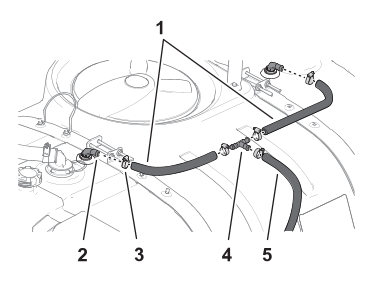
  1. Install 2 hoses61 cm (24 inches) and 2 hose clamps onto each 90° fitting at the rinse nozzle assemblies. Tighten the clamps by hand.
    Graphic
    G206607s
    1. Hose61 cm (24 inches)
    2. 90° fitting
    3. Hose clamp
    4. T-fitting
    5. Hose180 cm (71 inches)
  2. Install the other ends of the hoses onto opposite ends of the T-fitting with 2 hose clamps. Tighten the clamps by hand.
  3. Install the hose180 cm (71 inches) onto the T-fitting with a hose clamp. Tighten the clamp by hand.
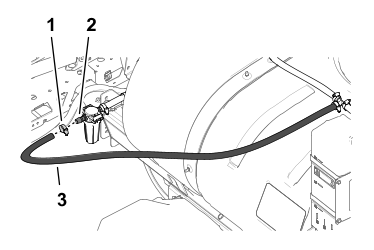
  4. Loosely install the free end of the long hose onto the straight-barb fitting at the outlet of the filter head with a hose clamp.
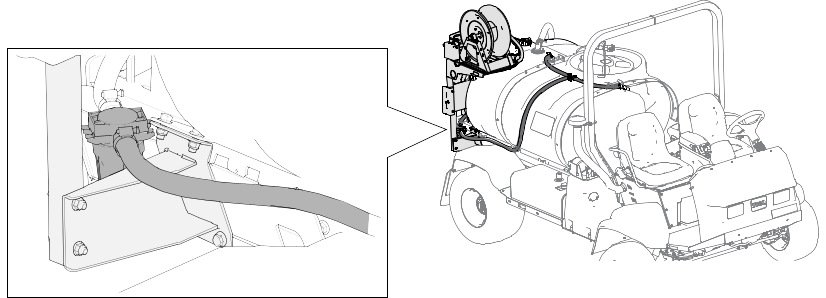
    Note: If the Pivoting Hose Reel Kit is installed, route the rinse tank hose inside the hose reel lower brackets.
    Graphic
    G206824s
    1. Hose clamp
    2. Straight-barb fitting (outletfilter)
    3. Hose180 cm (71 inches)
    Graphic
    G579541
  5. Adjust the position of the filter head so that the bowl of the filter assembly is vertical. Tighten the 2 hose clamps at the filter assembly by hand.
Installing the Relay and Fuse
Multi-Pro machines with Serial Number 420000000 and after.
Parts Required
1
Fuse (40 A)
1
Power relay
1
Self-tapping bolt (#10)
  1. Raise the operator seat to access the electronic components under the seat.
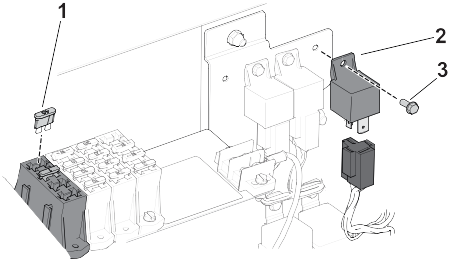
  2. Install a fuse (40 A) to the open slot in the fuse block (if needed).
    Graphic
    G579061
  3. Install the power relay (4-pin) next to the other relays of the same style on the electrical panel using a bolt (#10) .
  4. Locate the 4-socket connector on the machine wire harness and connect it to power relay (4-pin).
Installing the Delay Timer, Relays, and Fuse
Multi-Pro machines with Serial Numbers 315000000 through 419999999
Parts Required
Machines with Serial Number 315000000 through 419999999
1
Power relay (4-pin)
2
Flange-head bolt (#10-24 x 1/2 inch)
2
Locknut (#10)
   
Machines with Serial Number 315000000 through 315999999 only
1
Delay timer
1
R-Clamp
1
Relay (5-pin)
  1. Raise the operator seat to access the electronic components under the seat.
  2. For serial number 315000000 through 315999999:
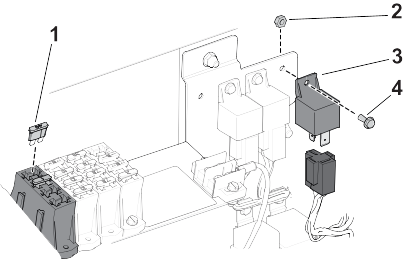
    1. Install the delay timer with the R-Clamp and hardware from the electrical panel.
    2. Connect the timer to the 2-socket connector labeled delay timer of the machine wire harness.
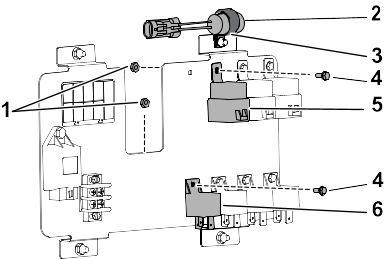
      Serial Numbers 315000000 through 315999999
      Graphic
      G579537
      1. Locknut (#10)
      2. Delay timer
      3. R-clamp
      4. Bolt (#10)
      5. Relay
      6. Power relay
  3. Install a fuse (40 A) to the open slot in the fuse block.
    Note: If a lower amperage fuse already exists in the slot, replace it with the fuse (40 A).
    Serial Numbers 316000000 through 419999999
    Graphic
    G579538
    1. Fuse (40 A)
    2. Locknut (#10-24)
    3. Power relay (4-pin)
    4. Flange-head bolt (#10-24 x 1/2 inch)
  4. Locate relay and power relay in line with the other relays of the same style, and mount them to the panel with the 2 flange-head bolts (#10-24 x 1/2 inch) and 2 locknut (#10-24).
  5. Locate the 4-socket connector and the 5-socket connector on the main harness and connect them to the relay (5-pin) and power relay (4-pin).
Installing the Switch
Parts Required
1
3-position switch (with indicator lightMulti Pro machines with Serial Number 315000000 and before)
1
3-position switch (without indicator lightMulti Pro machines with Serial Number 316000000 and after)
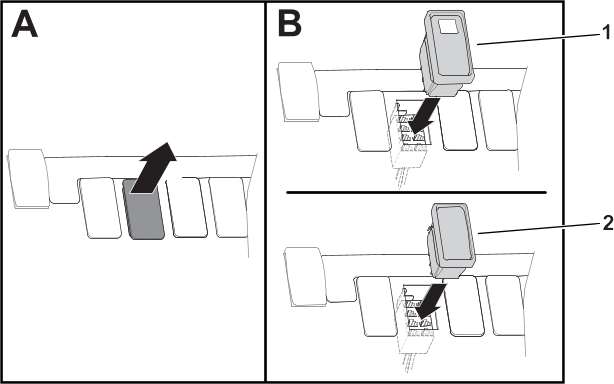
  1. Remove the plug for the rinse tank switch from the dash panel.
    Note: It is the second plug to the right of the ignition key.
    Graphic
    G579540
    1. Multi Pro machines with Serial Number 315000000 and before
    2. Multi Pro machines with Serial Number 316000000 and after
  2. Working from underneath the dash panel, remove the cable tie that secures the 8-socket connector labeled Rinse Tank from the machine wire harness.
  3. Route the 8-socket connector toward the open hole in the dash.
  4. Connect the 3-position switch into the 8-socket connector through the dash panel.
  5. Insert the 3-position switch into the opening in the dash panel until the latch of the switch snaps securely into the dash.
  6. Connect the battery and replace the battery cover on the machine.


Operation
 

Rinse Tank Kit Operation

Using the Rinse Tank Kit will result in a rinsate (a diluted solution of residual chemicals). In many cases, it is appropriate to apply the rinsate onto a treated area(s). However, before doing so, check with the chemical manufacturer to ensure that the application of a diluted solution to the treated area(s) does not adversely affect the performance of the product.
Important  
The Rinse Tank Kit is not intended to dislodge clumped masses of wetable powder or water-soluble chemicals that occur when chemicals are not properly introduced into the main tank.
 
Controls
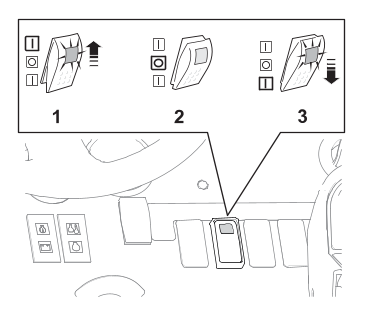
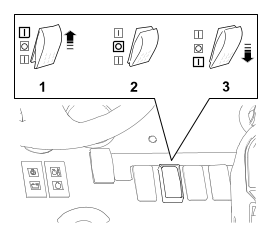
The Rinse Tank Kit is controlled by a 3-position switch.
  • The rinse tank pump is on with timed rinse when you press the 3-position switch to the On (up) position and it locksthe delay timer runs the pump.
    Note: For 2015 and before machines, the switch illuminates.
  • The rinse tank pump is off when you press the 3-position switch to the Neutral (middle) position.
  • The rinse tank pump is on momentarily when you press and hold the 3-position switch to the On (down) position to run the pump.
    Note: For 2015 and before machines, the switch illuminates.
2015 Models and Before
Graphic
g034586s
  1.  on (up) positiontimed rinse (the switch illuminates)
  2.  off (middle) position
  3.  on (down) positionmomentary rinse (the switch illuminates)
2016 Models and After
Graphic
g034587s
  1.  on (up) positiontimed rinse
  2.  off (middle) position
  3.  on (down) positionmomentary rinse

Switch Positions

Timed Rinse
  1. Press the 3-position switch to the On (up) position to start a timed rinse.
    Note: The pump runs for 110 seconds and it pumps approximately 1/3 of the rinse tank contents into the main tank. During this time the switch stays in the up position.
  2. After 110 seconds, the pump stops running.
  3. Press the 3-position switch to the Neutral (center) position to turn the rinse tank kit off.
    Note: The 3-position switch remains in the up position until you move it to the Neutral (center) position. When the switch is in the Neutral position, power is not supplied to the pump and the rinse tank kit is Off.
Manually Controlled Rinse
  1. Press and hold the 3-position switch to the On (down) position to energize a momentary switch. Power is supplied to the pump only while the switch is held down.
  2. Release the 3-position switch, and the switch moves to the Neutral (middle) position. Power to the pump is shut off.

Filling the Tank

  1. Park the machine on a level surface, engage the parking brake, shut off the sprayer pump, shut off the engine, and remove the key.
  2. Remove the rinse tank cap, fill the tank with approximately 113 L (30 gallons) with clean water, and install the cap.
    Important  
    The 113 L (30 gallon) rinse tank is only intended to be filled with clean water. The introduction of any other substance to the rinse tank can cause a safety hazard and/or damage the machine.
     

Using the Rinse Cycle

Once the rinse tank pump has moved 38 L (10 US gallons) of water into the sprayer tank, the user can use the agitation switch at their disposal to put the clean water into the agitation loop. Once finished, the rinsate can be sprayed out of the boom nozzles or manually drained from tank. This allows the machine to move during the rinse process.
  1. Turn on the rinse tank pump by performing 1 of the following:
    • Press up the 3-position switch for a timed rinse.
    • Press and hold down the 3-position switch for a desired duration.
  2. Once the rinse tank pump has moved 38 L (10 US gallons) of water into the sprayer tank, use the agitation switch to circulate the clean water through the agitation loop.
  3. Pump the rinsate out of the sprayer tank as required by federal, state, and local regulations by performing 1 of the following:
    • Spray the rinsate through the booms until the sprayer tank is empty.
    • Drain the sprayer tank contents into a suitable container and dispose of the diluted solution as required by federal, state, or local regulations.
    Note: The rinse cycle can be repeated again as necessary for 2 more timed rinse cycles.


Maintenance
 

Inspecting the Filter

Service Interval: After the first 5 hours
Every 50 hours
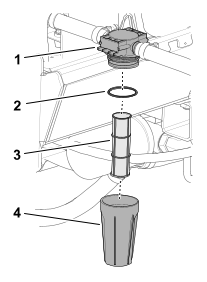
  1. Rotate the filter counterclockwise to remove the bowl from the filter head.
    Graphic
    G207171s
    1. Filter head
    2. O-ring
    3. Filter element
    4. Bowl (filter)
  2. Inspect the filter element for damage or an accumulation sediment or debris.
    Replace a damaged filter element. If there is an accumulation sediment or debris, clean the element as follows:
    1. Remove the filter element from the filter head.
    2. Rinse clean the element in fresh water.
    3. Insert the filter element into the filter head.
  3. Inspect the O-ring for damage.
    Replace the O-ring if it is damaged.
  4. Thread the bowl clockwise into the filter head, and tighten it by hand.

Inspecting the Rinse System for Leaks and Damage

Service Interval: Before each use or dailyInspect the hoses for leaks.
After the first 5 hoursInspect the hoses for damage.
Every 100 hoursInspect hoses and O-rings for damage.
  1. Contact your Authorized Toro Dealer to obtain replacement parts.

Inspecting the Rinse Tank Hold Downs

After the first hourCheck the rinse tank hold downs.
YearlyCheck the rinse tank hold downs.
  1. Fill the rinse tank with clean water.
    Graphic
    G207207s
    1.  Rinse tank
    2.  Hold downs
    3.  Bolt (3/8 x 1-1/2 inches)
  2. Check for play between the hold downs and the rinse tank.
  3. If you find play between the hold downs and the rinse tank, tighten bolt(s) and flange locknut(s) until the hold downs are snug against the rinse tank.
    Note: Do not overtighten the bolt(s) and locknut(s) of the hold down(s), or deform the tank.
    Important
    Overtightening the tank strap fasteners can deform and damage the hold downs.


Storage
 

Storing the Machine for Less than 30 Days in Above-Freezing Temperatures

  1. Drain the following components:
    • Pump-inlet line
    • Pump-outlet line
    • Filter line

Storing the Machine for More than 30 Days or in Freezing Temperatures

  1. Before storing the machine, perform the following:
    1. Add RV anti-freeze solution into the rinse tank.
    2. Circulate the anti-freeze through rinse pump.
  2. When retuning the machine to service, drain the following components:
    • Pump-inlet line
    • Pump-outlet line
    • Filter line