
 , which means
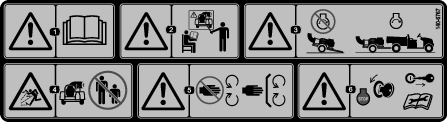
Caution, Warning, or Danger—personal safety instruction. Failure
to comply with these instructions may result in personal injury or
death.
, which means
Caution, Warning, or Danger—personal safety instruction. Failure
to comply with these instructions may result in personal injury or
death.

Maintenance
Note: Determine the left and right sides of the machine from the normal operating position.
Note: Download a free copy of the electrical or hydraulic schematic by visiting www.Toro.com and searching for your machine from the Manuals link on the home page.
Maintenance Safety
-
Before cleaning, servicing, or adjusting the machine, do the following:
-
Park the machine on a level surface.
-
Shut off the engine, remove the key, disconnect the spark-plug wire, and wait for all moving parts to stop.
-
Chock the wheels.
-
Remove the machine from the traction unit.
-
Allow machine components to cool before performing maintenance.
-
-
Perform only those maintenance instructions described in this manual. If major repairs are ever needed or you need assistance, contact an authorized Toro distributor.
-
Support the machine with blocks or jack stands when working beneath it.
-
Ensure that all guards are installed securely after maintaining or adjusting the machine.
-
Do not allow untrained personnel to service the machine.
-
Use jack stands to support the machine or components when required.
-
Carefully release pressure from components with stored energy.
-
Do not charge the batteries while servicing the machine.
-
To reduce the potential fire hazard, keep the engine area free of excessive grease, grass, leaves, and accumulation of dirt.
-
If possible, do not perform maintenance while the engine is running. Keep away from moving parts.
-
If you must run the engine to perform a maintenance adjustment, keep your hands, feet, clothing, and all other parts of your body away from the engine and any moving parts. Keep bystanders away from the machine.
-
Clean up oil and fuel spills.
-
Keep all parts in good working condition and all fasteners tightened. Replace all damaged or missing decals.
-
Do not interfere with the intended function of a safety device or reduce the protection provided by a safety device. Check their proper operation regularly.
-
Do not overspeed the engine by changing the governor settings. To ensure safety and accuracy, have an authorized Toro distributor to check the maximum engine speed with a tachometer.
-
If major repairs are ever necessary or assistance is required, contact an authorized Toro distributor.
-
Altering this machine in any manner may affect the operation of the machine, performance, durability, or its use may result in injury or death. Such use could void the product warranty of The Toro Company.
Recommended Maintenance Schedule(s)
| Maintenance Service Interval | Maintenance Procedure |
|---|---|
| After the first 8 hours |
|
| After the first 10 hours |
|
| Before each use or daily |
|
| Every 50 hours |
|
| Every 100 hours |
|
| Every 150 hours |
|
| Every 200 hours |
|
| Every 300 hours |
|
| Every 500 hours |
|
| Every 600 hours |
|
Important: Refer to your engine owner's manual for additional maintenance procedures.
Pre-Maintenance Procedures
Preparing for Maintenance
-
Park the machine on a level surface.
-
Shut off the engine, remove the key, and wait for all moving parts to stop.
-
Chock the wheels.
-
Remove the machine from the traction unit.
-
Allow machine components to cool before performing maintenance.
-
Disconnect the spark-plug wire.
Engine Maintenance
Engine Safety
-
Shut off the engine before checking the oil or adding oil to the crankcase.
-
Do not change the governor speed or overspeed the engine.
Servicing the Air Cleaner
| Maintenance Service Interval | Maintenance Procedure |
|---|---|
| Every 100 hours |
|
| Every 150 hours |
|
| Every 300 hours |
|
| Every 600 hours |
|
Removing the Filters
-
Shut off the engine, remove the key, and wait for all moving parts to stop.
-
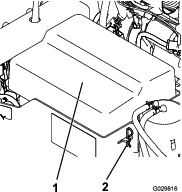
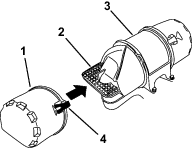
Release the latches on the air cleaner and pull the air-inlet cover off the air-cleaner body.
-
Clean the air-inlet screen and cover.
-
Install the air-inlet cover and secure it with the latches.
-
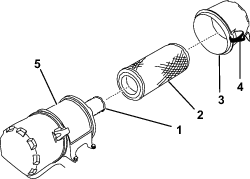
Release the latches on the air cleaner and pull the air-cleaner cover off the air-cleaner body.
-
Clean the inside of the air-cleaner cover with compressed air.
-
Gently slide the primary filter out of the air-cleaner body.
Note: Avoid knocking the filter into the side of the body.
-
Remove the inner filter only if you intend to replace it.
Inspecting the Filters
-
Inspect the safety filter. If it is dirty, replace both the safety and primary filters.
Important: Do not attempt to clean the safety filter. If the safety filter is dirty, then the primary filter is damaged.
-
Inspect the primary filter for damage by looking into the filter while shining a bright light on the outside of the filter. If the primary filter is dirty, bent, or damaged, replace it.
Note: Holes in the filter appear as bright spots. Do not clean the primary filter.
Installing the Filters
Important: To prevent engine damage, always operate the engine with both air filters and the cover installed.
-
If you are installing new filters, check each filter for shipping damage.
Note: Do not use a damaged filter.
-
If you are replacing the inner filter, carefully slide it into the filter body.
-
Carefully slide the primary filter over the safety filter.
Note: Ensure that the primary filter is fully seated by pushing on the outer rim while installing it.
Important: Do not press on the soft, inside area of the filter.
-
Install the air-cleaner cover and secure the latches.
Servicing the Engine Oil
Note: Change the oil more frequently when the operating conditions are extremely dusty or sandy.
Oil Type: Detergent oil (API service SJ or higher)
Crankcase Capacity: with filter, 2 L (67 fl oz)
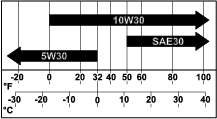
Viscosity: See the table below.
Checking the Engine-Oil Level
| Maintenance Service Interval | Maintenance Procedure |
|---|---|
| Before each use or daily |
|
Note: Check the engine oil before the engine has been started for the day. If you have run the engine, allow the oil to drain back down to the sump for at least 10 minutes before checking. If the oil level is at or below the ADD mark on the dipstick, add oil to bring the oil level to the FULL mark. Do not overfill. If the oil level is between the FULL and ADD marks, no oil addition is required.
-
Park the machine on a level surface.
-
Shut off the engine, remove the key, and wait for all moving parts to stop before leaving the operating position.
-
Clean around the oil dipstick so that dirt cannot fall into the hole and damage the engine.
-
Remove the oil dipstick and wipe the end clean.
-
Slide the oil dipstick fully into the filler tube.
-
Pull the dipstick out and look at the metal end. If the oil level is low, slowly pour only enough oil into the filler tube to raise the level to the FULL mark.
Important: Do not overfill the crankcase with oil and run the engine. Engine damage can result.
Changing the Oil
| Maintenance Service Interval | Maintenance Procedure |
|---|---|
| Every 100 hours |
|
-
Start the engine and let it run for 5 minutes.
Note: A running engine will warm the oil, allowing it to easily drain from the engine.
-
Park the machine so that the drain side is slightly lower than the opposite side to ensure the oil drains completely.
-
Shut off the engine, remove the key, and wait for all moving parts to stop before leaving the operating position.
-
Place a pan below the drain. Rotate the oil drain valve to allow the oil to drain.
Note: A hose may be inserted onto the drain valve to direct the oil flow. The hose is not included with the machine.
-
When the oil has drained completely, close the drain valve.
Note: Dispose of the used oil at a recycling center.
-
Slowly pour approximately 80% of the specified oil into the filler hole.
-
Check the oil level.
Changing the Oil Filter
| Maintenance Service Interval | Maintenance Procedure |
|---|---|
| Every 200 hours |
|
Note: Change the oil filter more frequently when the operating conditions are extremely dusty or sandy.
-
Drain the oil from the engine.
-
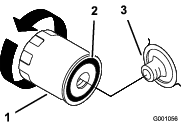
Remove the old filter and wipe the filter-gasket surface.
-
Apply a thin coat of new oil to the rubber gasket on the replacement filter.
-
Install the replacement oil filter to the filter adapter, turn the oil filter clockwise until the rubber gasket contacts the filter adapter, then tighten the filter an additional 2/3 to 1 turn.
-
Fill the crankcase with the proper type of new oil.
-
Run the engine for about 3 minutes, shut off the engine, and check for oil leaks around the oil filter.
-
Check the engine oil level and add oil if needed.
Servicing the Spark Plugs
Ensure that the air gap between the center and side electrodes is correct before installing the spark plugs. Use a spark plug wrench for removing and installing the spark plugs and a gapping tool/feeler gauge to check and adjust the air gap. Install new sparks plugs if necessary.
Type: Champion® RC12YC, Champion® Platinum 3071 or equivalent
Air Gap: 0.76 mm (0.030 inch)
Checking the Spark Plugs
| Maintenance Service Interval | Maintenance Procedure |
|---|---|
| Every 200 hours |
|
-
Look at the center of the spark plugs. If you see light brown or gray on the insulator, the engine is operating properly. A black coating on the insulator usually means that the air cleaner is dirty.
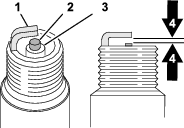
Important: Always replace a spark plug when it has a black coating, worn electrodes, an oily film, or cracks.
-
Check the gap between the center and side electrodes. Bend the side electrode if the gap is not correct.
Removing the Spark Plugs
| Maintenance Service Interval | Maintenance Procedure |
|---|---|
| Every 500 hours |
|
-
Shut off the engine, remove the key, and wait for all moving parts to stop before leaving the operating position.
-
Disconnect the spark-plug wires from the spark plugs.
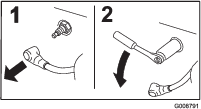
-
Clean around the spark plugs to prevent dirt from falling into the engine and potentially causing damage.
-
Remove the spark plugs and the metal washers.
Installing the Spark Plugs
-
Install the spark plugs and the metal washer. Ensure that the air gap is set correctly.
-
Tighten the spark plugs to 24 to 30 N∙m (18 to 22 ft-lb).
-
Connect the spark-plug wires to the spark plugs.
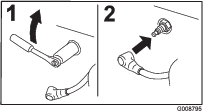
Fuel System Maintenance
Replacing the Fuel Filter
| Maintenance Service Interval | Maintenance Procedure |
|---|---|
| Every 200 hours |
|
Never install a dirty filter if it is removed from the fuel line.
-
Shut off the engine, remove the key, and wait for all moving parts to stop before leaving the operating position.
-
Allow the machine to cool down.
-
Squeeze the ends of the hose clamps together and slide them away from the filter.
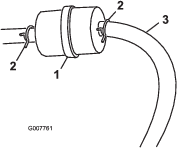
-
Remove the filter from the fuel lines.
-
Install a new filter and move the hose clamps close to the filter.
Servicing the Fuel Tank
Danger
In certain conditions, fuel is extremely flammable and highly explosive. A fire or explosion from fuel can burn you and others and can damage property.
-
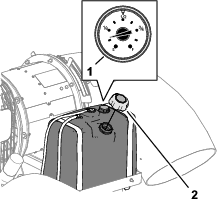
Drain fuel from the fuel tank when the engine is cold. Do this outdoors in an open area. Wipe up any spilled fuel.
-
Never smoke when handling fuel, and stay away from an open flame or a spark that could ignite fuel fumes.
-
Park the machine on a level surface to ensure that the fuel tanks drain completely.
-
Shut off the engine, remove the key, and wait for all moving parts to stop before leaving the operating position.
-
Loosen the hose clamp at the fuel filter and slide it up the fuel line away from the fuel filter.
-
Disconnect the fuel line from the fuel filter.
Note: Allow the fuel to drain into a fuel container or drain pan.
Note: This is the best time to install a new fuel filter, as the fuel tank is empty.
-
Install the fuel line onto the fuel filter. Slide the hose clamp close to the fuel filter to secure the fuel line.
Servicing the Carbon Canister
Replacing the Carbon Canister Air Filter
| Maintenance Service Interval | Maintenance Procedure |
|---|---|
| Every 200 hours |
|
-
Shut off the engine, remove the key, and wait for all moving parts to stop before leaving the operating position.
-
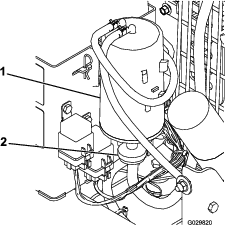
Remove and discard the carbon canister air filter, but retain the hoses (Figure 23).
-
Install the new air filter and the previously removed hoses.
Replacing the Carbon Canister Purge-line Filter
| Maintenance Service Interval | Maintenance Procedure |
|---|---|
| Every 200 hours |
|
Note: Check the purge-line filter occasionally for dirt. If the filter appears to be dirty, replace it.
-
Shut off the engine, remove the key, and wait for all moving parts to stop before leaving the operating position.
-
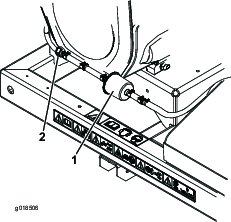
Move the spring-type hose clamps on both sides of the carbon canister purge-line filter away from the filter (Figure 24).
-
Remove and discard the carbon filter (Figure 24).
-
Install a new filter into the hose with the arrow on the filter pointing toward the check valve and secure it with the hose clamps (Figure 24).
Electrical System Maintenance
Important: Before welding on the machine, disconnect the controller and the negative cable from the battery to prevent damage to the electrical system.
Electrical System Safety
-
Disconnect the battery before repairing the machine. Disconnect the negative terminal first and the positive last. Connect the positive terminal first and the negative last.
-
Charge the battery in an open, well-ventilated area, away from sparks and flames. Unplug the charger before connecting or disconnecting the battery. Wear protective clothing and use insulated tools.
Replacing the Fuses
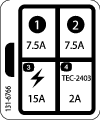
Engine
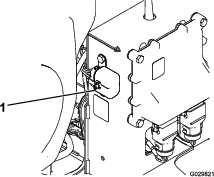
An in-line fuse (10A) is incorporated into the engine wiring harness.
Receiver
A fuse block is incorporated into the receiver wire harness. It is located behind the receiver on the right side of the control tower.
Drive System Maintenance
Checking Tire Air Pressure
| Maintenance Service Interval | Maintenance Procedure |
|---|---|
| Before each use or daily |
|
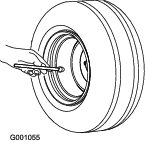
Check the tire pressure.
-
Model 44557—241 kPa (35 psi)
-
Models 44556 and 44558—96.5 kPa (14 psi)
Torquing the Wheel Lug Nuts
| Maintenance Service Interval | Maintenance Procedure |
|---|---|
| After the first 10 hours |
|
Warning
Failure to maintain proper torque could result in failure or loss of wheel and could result in personal injury.
Torque wheel lug nuts to 95 to 122 N⋅m (70 to 90 ft-lb).
-
Prepare the machine for maintenance; refer to .
-
Torque the wheel lug nuts to 95 to 122 N⋅m (70 to 90 ft-lb).
Inspecting the Tires
| Maintenance Service Interval | Maintenance Procedure |
|---|---|
| Every 100 hours |
|
Operating accidents can damage a tire or rim, so inspect the tire condition after an accident.
The DOT tire information is located on the side of each tire. This information gives load and speed ratings. Replacement tires should have the same or better ratings.
is an example of tire wear caused by under inflation.

is an example of tire wear caused by over inflation.

Belt Maintenance
Adjusting the Nozzle-Control Belt Tension
| Maintenance Service Interval | Maintenance Procedure |
|---|---|
| After the first 8 hours |
|
| Every 50 hours |
|
If the nozzle-control belt slips while changing blower-nozzle direction, adjust the belt tension.
-
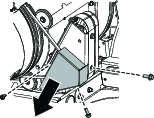
Remove the belt guard.
-
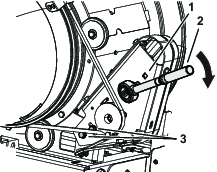
Loosen the bolts securing the pulley mounting bracket to the blower frame.
-
Insert the drive of a torque wrench into the pulley mounting bracket as shown in Figure 30.
-
With the handle of the wrench, pivot the pulley mounting bracket away from the nozzle so the belt is tensioned and the torque wrench reads 22.6 to 26.0 N⋅m (200 to 230 in-lb).
-
While maintaining the correct belt tension, tighten the mounting bolts.
Blower Maintenance
Checking the Blower-Nozzle Clamp
| Maintenance Service Interval | Maintenance Procedure |
|---|---|
| Before each use or daily |
|
-
Prepare the machine for maintenance.
-
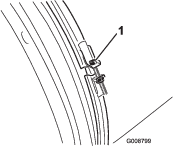
Check the blower-nozzle clamp for signs of wear or damage.
-
Check the blower-nozzle clamp daily to ensure that it is tight.
Important: If the blower nozzle contacts an obstacle or through a low area in the terrain, the blower-nozzle clamp could become loose.
-
If the clamp is loose, torque the nut of the clamp to 5.1 to 5.7 N∙m (45 to 50 in-lb).
Cleaning the Nozzle Guides
| Maintenance Service Interval | Maintenance Procedure |
|---|---|
| Before each use or daily |
|
-
Prepare the machine for maintenance.
-
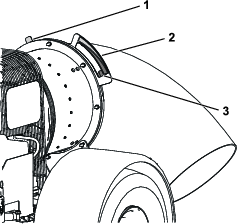
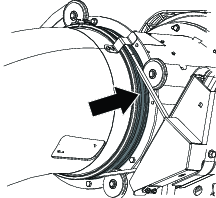
Remove any grass, dirt or debris buildup around and in between the nozzle guides.
Note: If the nozzle guides are not free of debris, the nozzle may not rotate freely, which may damage the motor.
Handheld Remote Maintenance
Handheld Remote and the Wireless-Control Module
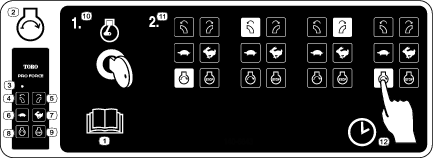
The handheld remote must link with the wireless-control module before you can use the remote control system. The handheld remote is associated to the wireless-control module at the factory. When you need to re-establish handheld remote and wireless-control module communication (e.g., introducing a new or spare remote control to an existing base unit or changing the signal frequency due to local interference issues), refer to Associating the Remote and the Control Module.
You can associate only Pro Force handheld remote to the Pro Force wireless-control module. Associating a Pro Force remote control to a different Pro Force wireless-control module disassociates that remote control from the original Pro Force machine.
Note: Local interference during operation may disassociate the handheld remote from the wireless-control module. Since the wireless-control module selects the best of numerous signal frequencies during the association process, move the machine to the area of signal disruption or disassociation, and perform the association procedure for best results.
Associating the Remote and the Control Module
Important: Read the entire procedure before starting it.
-
Rotate the ignition key to the STOP position.
-
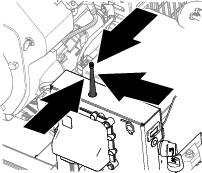
Ensure that you have a clear line of sight to the antenna.
-
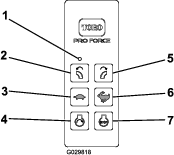
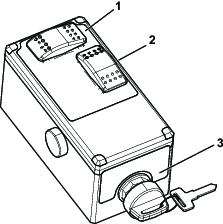
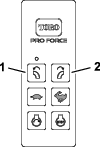
Simultaneously press and hold the ROTATE NOZZLE LEFT and ROTATE NOZZLE RIGHT buttons.
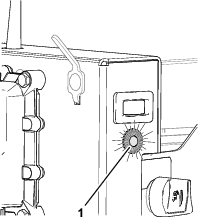
Note: The LED will blink about once per second.
-
Release both buttons when the LED blinks about twice per second
-
Press and hold the ROTATE NOZZLE LEFT button and turn the ignition key start to the RUN position.
Note: The LED turns solid if the procedure is successful. It may take up to 20 seconds for the LED turns solid.
-
Release the ROTATE NOZZLE LEFT button and rotate the ignition key to the STOP position.
Note: The remote-control system is ready for use with the associated handheld remote.
Cleaning
Washing the Machine
Important: Do not use brackish or reclaimed water to clean the machine.
Important: Do not pressure wash the machine.
-
Wash the machine with mild detergent and water.
-
Avoid excessive use of water, especially near the control console.
Disposing of Waste
Engine oil, engine and remote control batteries are pollutants to the environment. Dispose of these according to your state and local regulations.